Normal Equation in Linear Regression: Formula, Intuition, and Comparison with Gradient Descent
Understand the Normal Equation in linear regression, its closed-form solution, mathematical formula, advantages, limitations, and how it compares to gradient descent for model optimization.

Normal Equation (Closed-Form Solution)
Instead of solving multiple iteration of gradient descent, Normal equation can get theta in one step
- Θ can be directly calculated where cost function is minimal using calculus in one step instead of iterating iterative optimization:
Advantages
- No learning rate required
- Direct computation
Limitations
- Computationally expensive for very large datasets
- Matrix inversion can be costly
Steps:
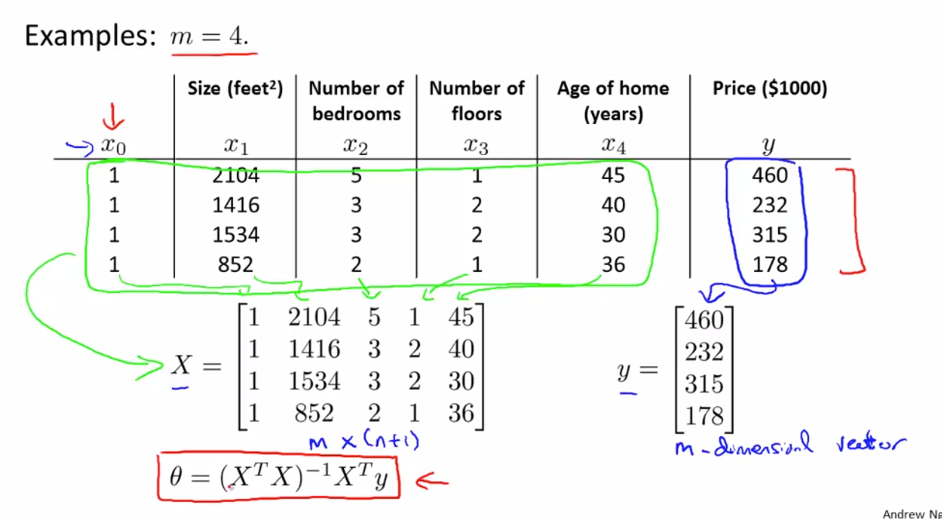
- Construct design matrix X using feature columns and add 1 in first column
- Construct y vector using result values Y
- calculate:
Θ = (XTX)-1 XTy
Feature scaling is not required for Normal Equation method
Normal Equation vs Gradient Descent:
| Feature | Gradient Descent | Normal Equation |
|---|---|---|
| Complexity | Complex need to debug alpha | Convenient & Simple to implement |
| Choose Learning Rate(α) | Required | No need |
| Feature Scaling | Required | No need |
| Iteration | Many Iteration Required | Not required |
| Feature Set>=million | Efficient if n is huge O(kn2) | Slow if n is huge, cost of inverse matrix is O(n3) |
| Complex Learning Algo | Can used for Complex learning algo | Not supported |
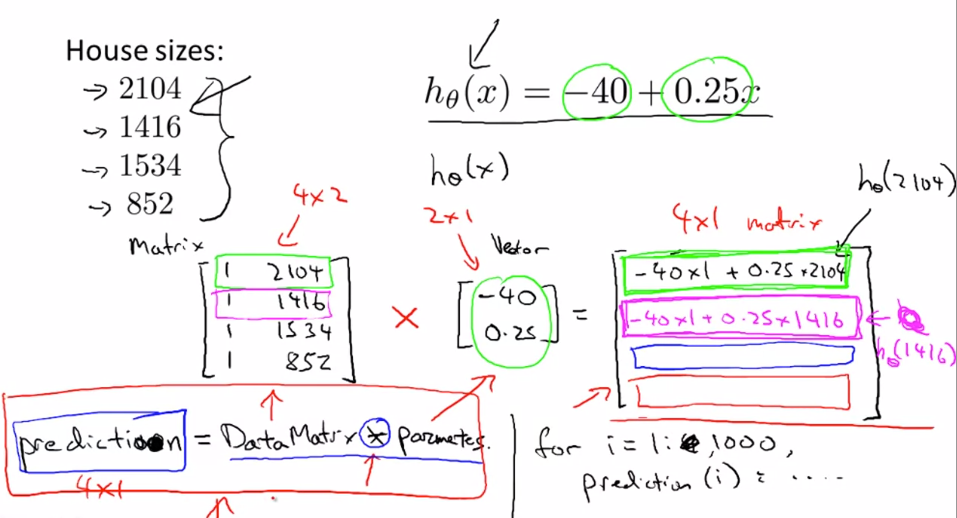
Faster single Hypothesis Prediction calculation given data set and Thetas **Much faster than nested for loops
Data Matrix * Parameter Vector = Prediction Vector
h(x) = Theta0 + Theta1x
[1 , x]*[Theta Vector] = [h(x)]
Usage:
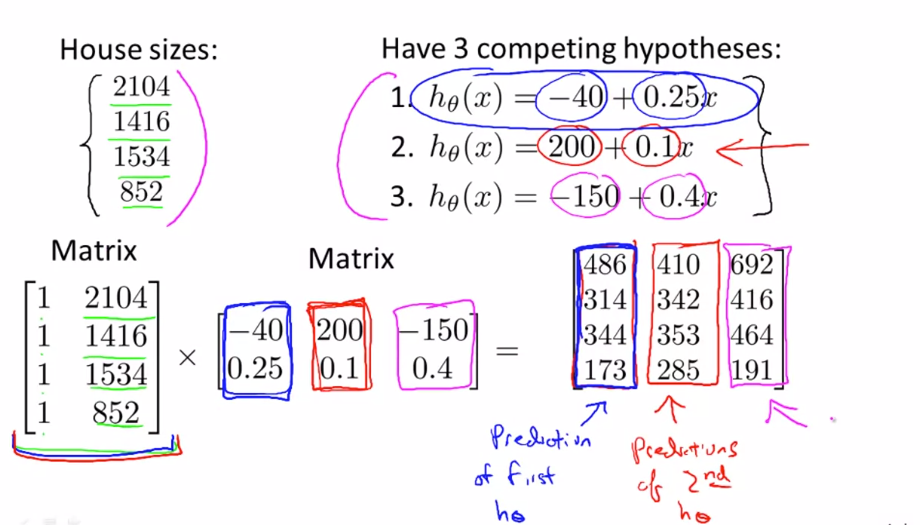
- Faster multiple Hypothesis Prediction calculation given data set and Thetas
- Much-much faster than nested for loops
Data Matrix * Parameter Matrix = Prediction Matrix
given h(x) = Theta0 + Theta1x
[1 , x]*[Theta Matrix] = [h(x)]