
Normal Equation in Linear Regression
Detailed explanation of the Normal Equation for linear regression, including matrix formulation, closed-form solution, comparison with gradient descent, and practical considerations for implementation.

Normal Equation (Closed-Form Solution)
Instead of solving multiple iteration of gradient descent, Normal equation can get theta in one step
- Θ can be directly calculated where cost function is minimal using calculus in one step instead of iterating iterative optimization:
Advantages
- No learning rate required
- Direct computation
Limitations
- Computationally expensive for very large datasets
- Matrix inversion can be costly
Steps:
- Construct design matrix X using feature columns and add 1 in first column
- Construct y vector using result values Y
- calculate:
Θ = (XTX)-1 XTy
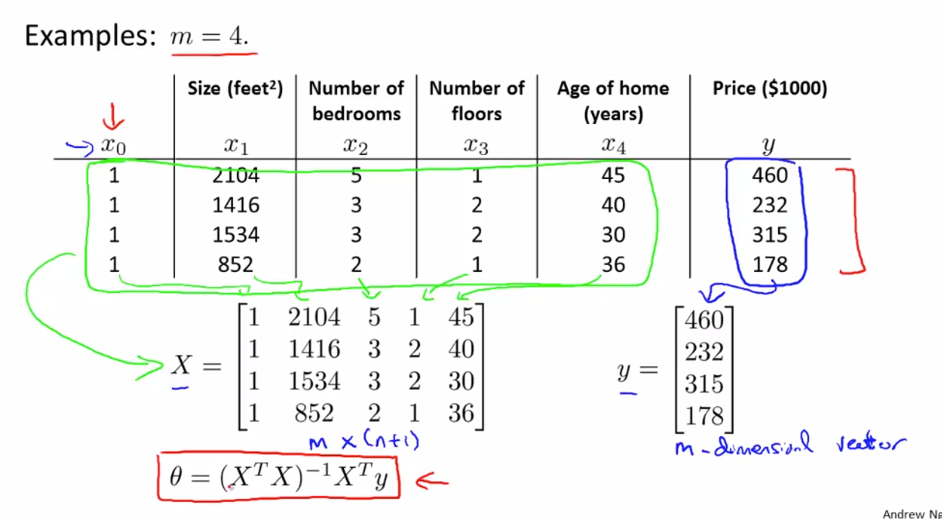
Feature scaling is not required for Normal Equation method
Normal Equation vs Gradient Descent:
| Feature | Gradient Descent | Normal Equation |
|---|---|---|
| Complexity | Complex need to debug alpha | Convenient & Simple to implement |
| Choose Learning Rate(α) | Required | No need |
| Feature Scaling | Required | No need |
| Iteration | Many Iteration Required | Not required |
| Feature Set>=million | Efficient if n is huge O(kn2) | Slow if n is huge, cost of inverse matrix is O(n3) |
| Complex Learning Algo | Can used for Complex learning algo | Not supported |
Inverse Matrix(A-1)
A' called inverse if
A'.A = A'.A = I
Matrix without Inverse called Degenerate Matrix/ Singular/ Non Invertible
Cause for non invertible Matrix:
- Redundant feature: two feature related by a linear equation x2 = kx1 eg: size in feet and meter
- More feature than training set(m<=n)): delete some feature or use regularization
Octave method for inverting matrix:
- pinv(A) : Pseudo Inverse, calculates inverse even if matrix is non invertible
- inv(A) : Inverse