Passiv (Passive Voice) 🔄
Learn the German Passive Voice (Passiv): formation with werden + Partizip II, all tenses, passive with modal verbs, agent phrases (von/durch), and Zustandspassiv. Core B1 grammar for telc.
Voices :: Genus Verbi
Voice (Genus Verbi) describes whether the subject performs an action or receives an action.
1. Active Voice :: Aktiv
The subject performs the action.
Structure
Most common structures
2. Passive Voice :: Passiv
Passive shifts focus from who does the action to the action / the affected thing itself.
    Voices
    │
    ├── 1. Active Voice :: Aktiv
    │   └── Subject performs the action
    │
    └── 2. Passive Voice :: Passiv
            ├── Vorgangspassiv
            └── Zustandspassiv
Subject & Object Interchange
Akkusativ object (active) → Subject (passive, Nominativ)
The agent (who did it) becomes unimportant or unknown.
Example:
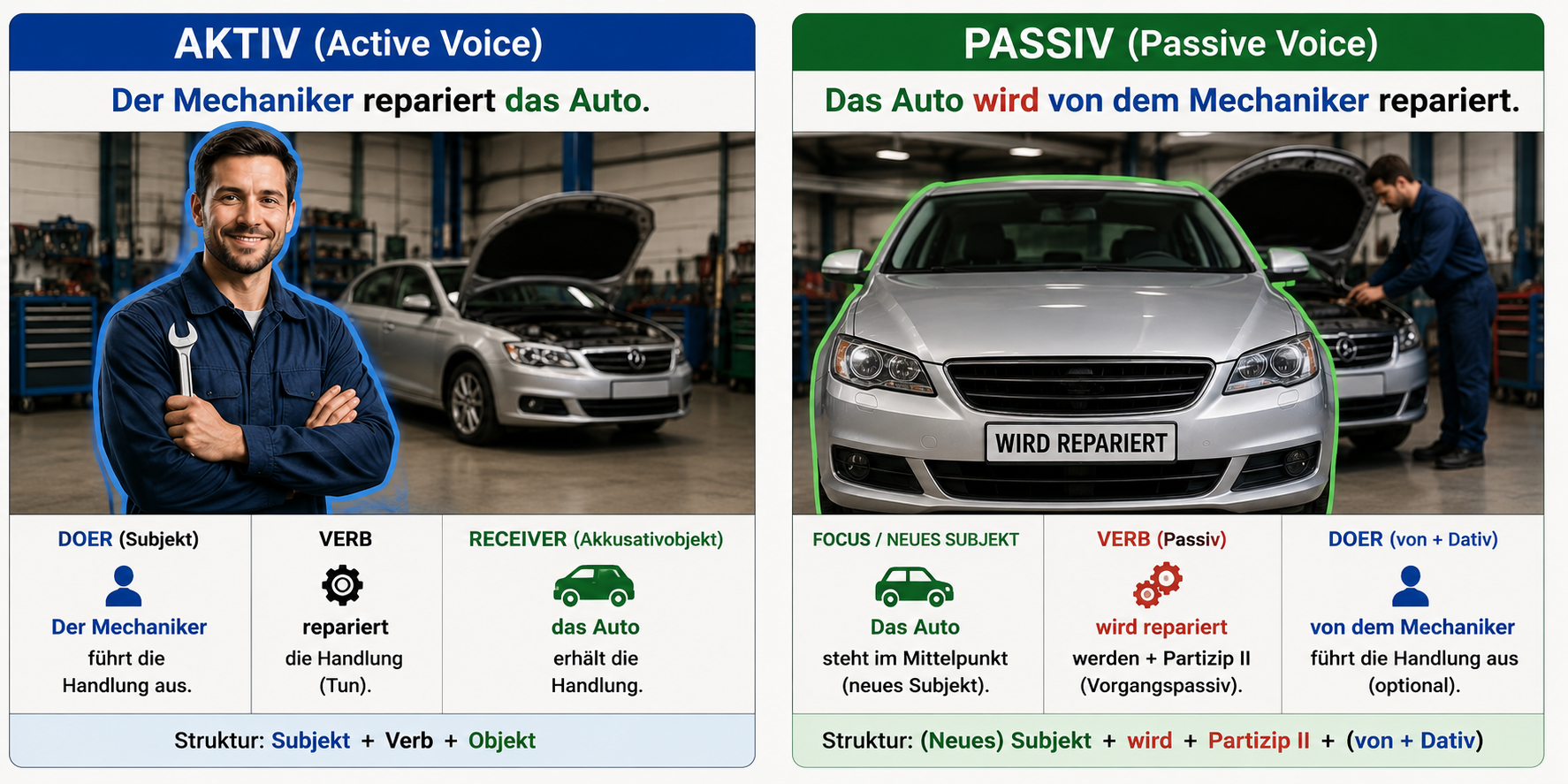
| Aktiv | Passiv | |
|---|---|---|
| Sentence | Der Mechaniker repariert das Auto. | Das Auto wird von dem Mechaniker repariert. |
| Subject | Der Mechaniker = Subjekt | Das Auto = neues Subjekt |
| Object | das Auto = Akkusativobjekt | — |
| Verb | repariert | wird repariert |
| Doer | Der Mechaniker | von dem Mechaniker |
More Example:
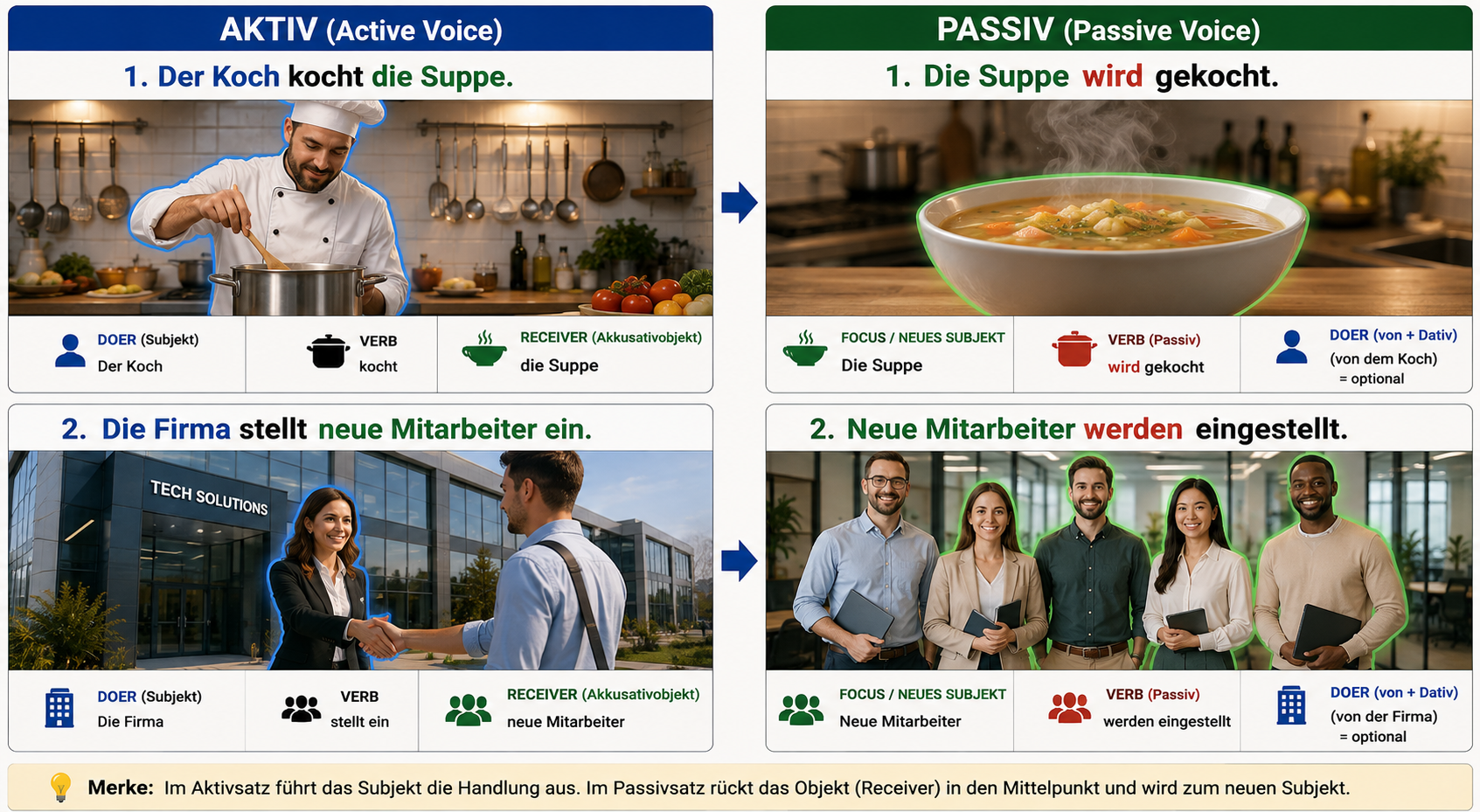
- Der Koch kocht die Suppe. --> Die Suppe wird gekocht.
- Die Firma stellt neue Mitarbeiter ein. --> Neue Mitarbeiter werden eingestellt
The Verb changes
Based on Verb changes we can classify Passive in 2 forms
1. Subjektloses Passiv :: Impersonal Passive
Subjektloses Passiv is used with verbs that do not have an Akkusativ object, especially intransitive verbs.
- Passive Without Object
Used with verbs that have no Akkusativ object (intransitive verbs)
There is no real subject, so es fills the front position or it's dropped if another element starts the sentence.
flowchart TD
    subgraph Passive["🟩 Passiv"]
        direction LR
        D["<b>es</b>"] --> E["Verb<br/><b>wird</b>"] --> F["Partizip II<br/><b>getanzt</b>"]
    end

    subgraph Active["🟦 Aktiv"]
        direction LR
        A["Subject<br/><b>Man</b>"] --> B["Verb<br/><b>tanzt</b>"] --> C["Object<br/><b>❌ kein Objekt</b>"]
    end

    style Active fill: #e5f0ff, stroke: #1677ff, color: #000
    style Passive fill: #e8f8e8, stroke: #27ae60, color: #000
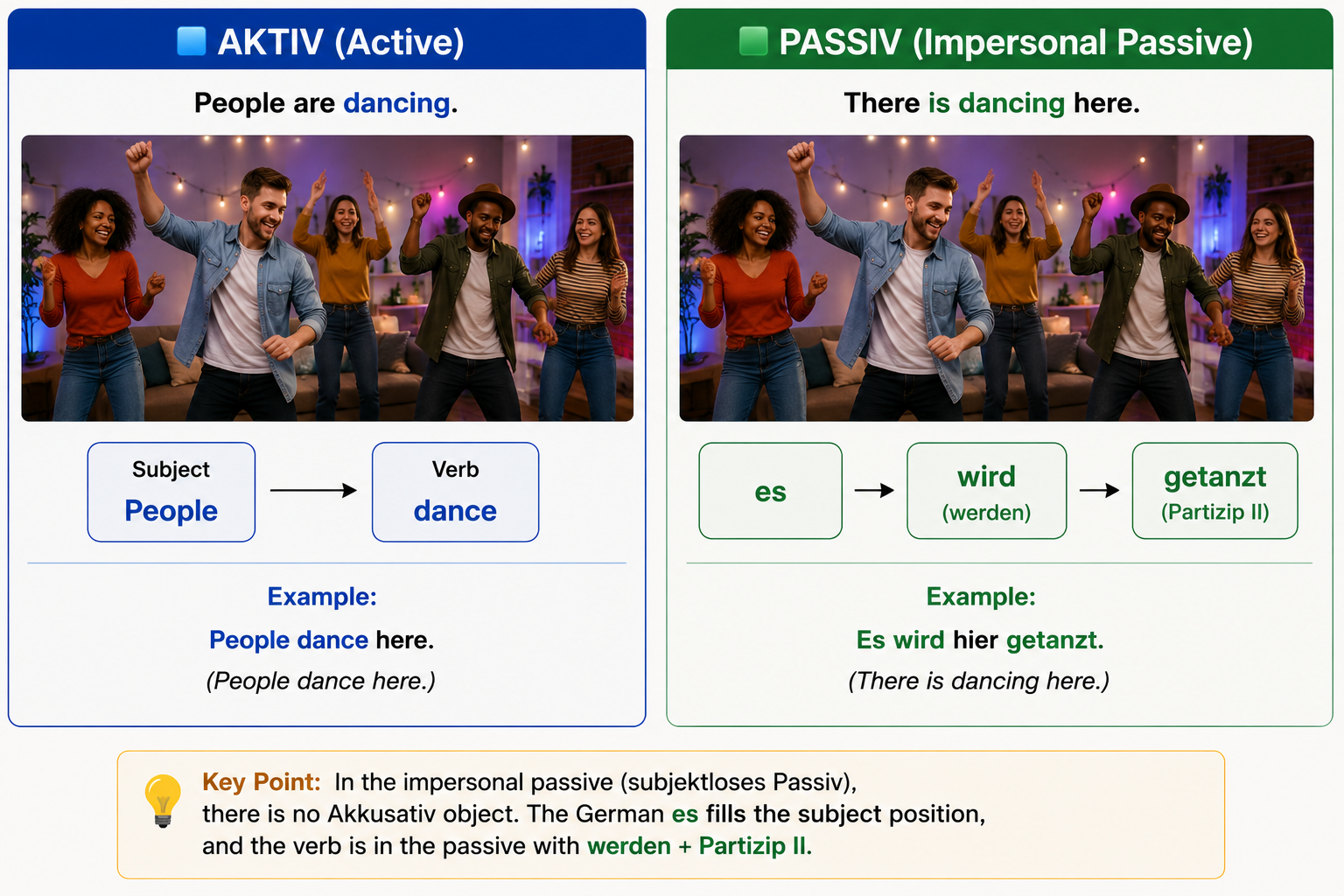
Example Subjektloses Passive
| Aktiv | Passiv | English |
|---|---|---|
| Man tanzt hier. | Es wird hier getanzt. | People dance here. / There is dancing here. |
| Man lacht viel. | Es wird viel gelacht. | People laugh a lot. |
| Man arbeitet heute. | Es wird heute gearbeitet. | People are working today. |
| Man arbeitet sonntags nicht. | Sonntags wird nicht gearbeitet. | People don't work on Sundays. |
| Man raucht hier. | Hier wird geraucht. | People smoke here. |
Only a verb with an Akkusativ object can form a passive in which that object becomes the new subject.
2 Vorgangspassiv :: Process Passive 👩🏻🍳
The everyday passive — describes an action happening, not a finished state.
The conjugated verb converted into werden:
Based on Tense werden also changes form
| Tense | Formula | Example | Translation |
|---|---|---|---|
| Präsens | werden (conjugated) + Partizip II | Das Auto wird repariert. | The car is being repaired. |
| Präteritum | wurde (conjugated) + Partizip II | Das Auto wurde repariert. | The car was repaired. |
| Perfekt | sein (conjugated) + Partizip II + worden | Das Auto ist repariert worden. | The car has been repaired. |
| Plusquamperfekt | war (conjugated) + Partizip II + worden | Das Auto war repariert worden. | The car had been repaired. |
| Futur I | werden (conjugated) + Partizip II + werden | Das Auto wird repariert werden. | The car will be repaired. |
werden Conjugation — quick reference
| Präsens | Präteritum | |
|---|---|---|
| ich | werde | wurde |
| du | wirst | wurdest |
| er/sie/es | wird | wurde |
| wir | werden | wurden |
| ihr | werdet | wurdet |
| sie/Sie | werden | wurden |
⚠️ Key trap: In Perfekt/Plusquamperfekt Passiv, the Partizip II of werden is worden — not geworden. (
geworden is only used when werden means "to become".)
Subject is Optional
In German passive, the doer is often omitted when it is:
- unknown
- unimportant
- obvious from context
Active
Der Mechaniker repariert das Auto.
Passive
You have two correct versions:
Das Auto wird von dem Mechaniker repariert.
- The car is being repaired by the mechanic.
Das Auto wird repariert.
- The car is being repaired.
Examples: Vorgangspassiv
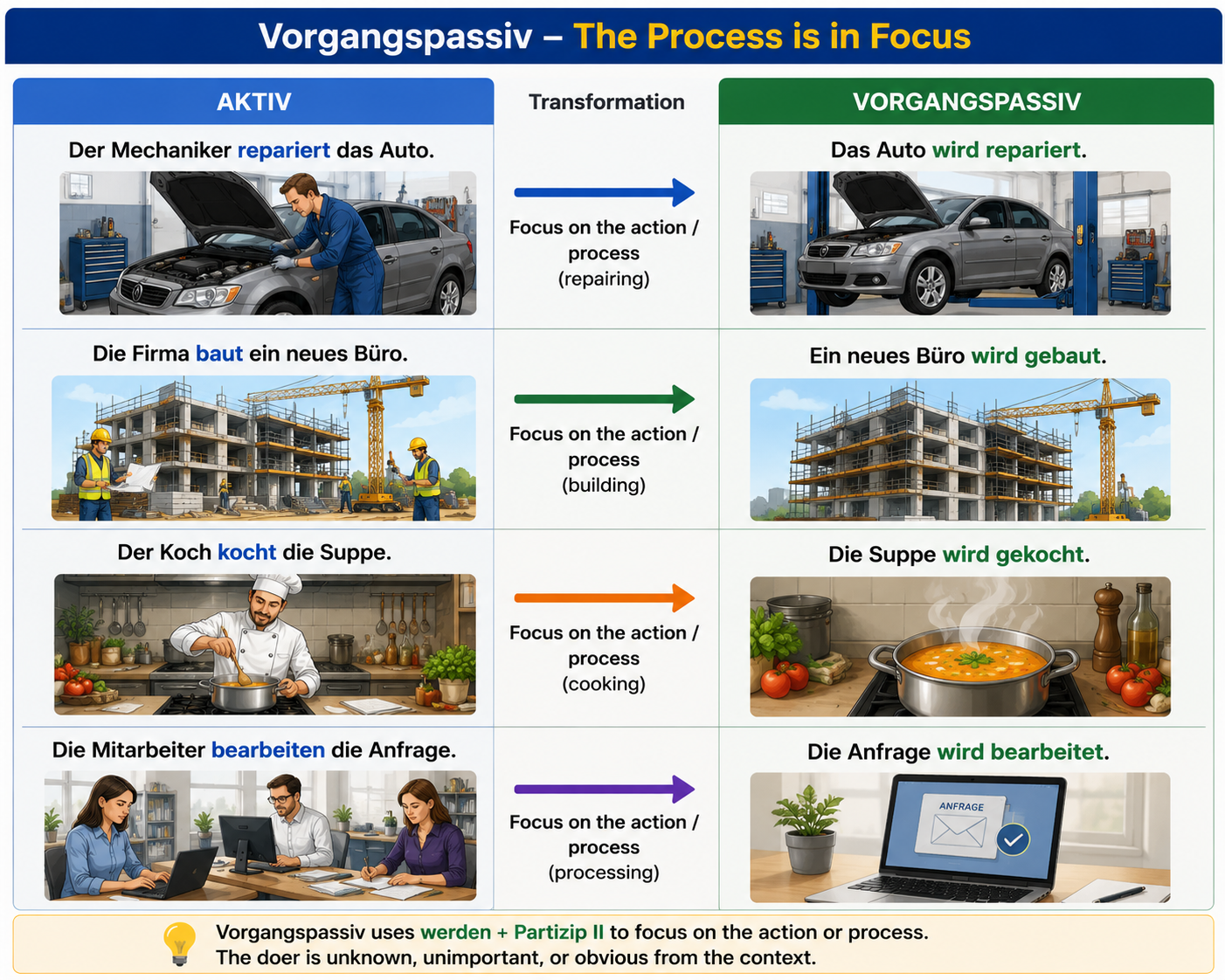
| Aktiv | Vorgangspassiv |
|---|---|
| Der Mechaniker repariert das Auto. | Das Auto wird repariert. |
| Die Firma baut ein neues Büro. | Ein neues Büro wird gebaut. |
| Der Koch kocht die Suppe. | Die Suppe wird gekocht. |
| Die Mitarbeiter bearbeiten die Anfrage. | Die Anfrage wird bearbeitet. |
3 Zustandspassiv :: State Passive 🥘
Describes the resulting state, not the action happening.
🧠 Rule of thumb:
werden= process in progresssein= finished result/state.
Zustandspassiv looks like Perfekt but describes a current condition, not a completed past event.
Vorgangspassiv vs Zustandspassiv
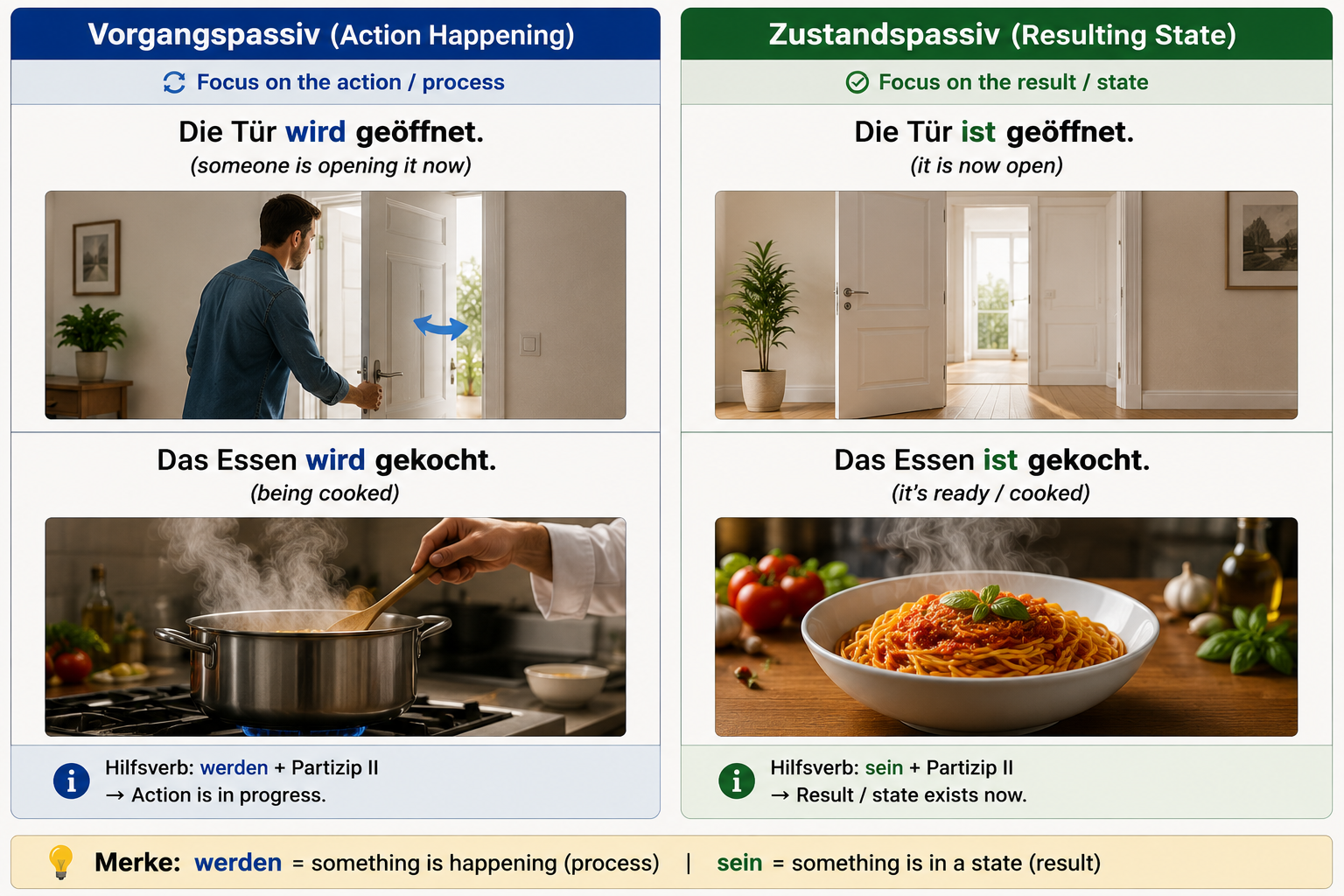
| Vorgangspassiv | Zustandspassiv | |
|---|---|---|
| Focus | Action / process | Result / state |
| Auxiliary | werden | sein |
| Example | Die Tür wird geöffnet. | Die Tür ist geöffnet. |
| English | The door is being opened. | The door is open. |
Example: Zustandspassiv
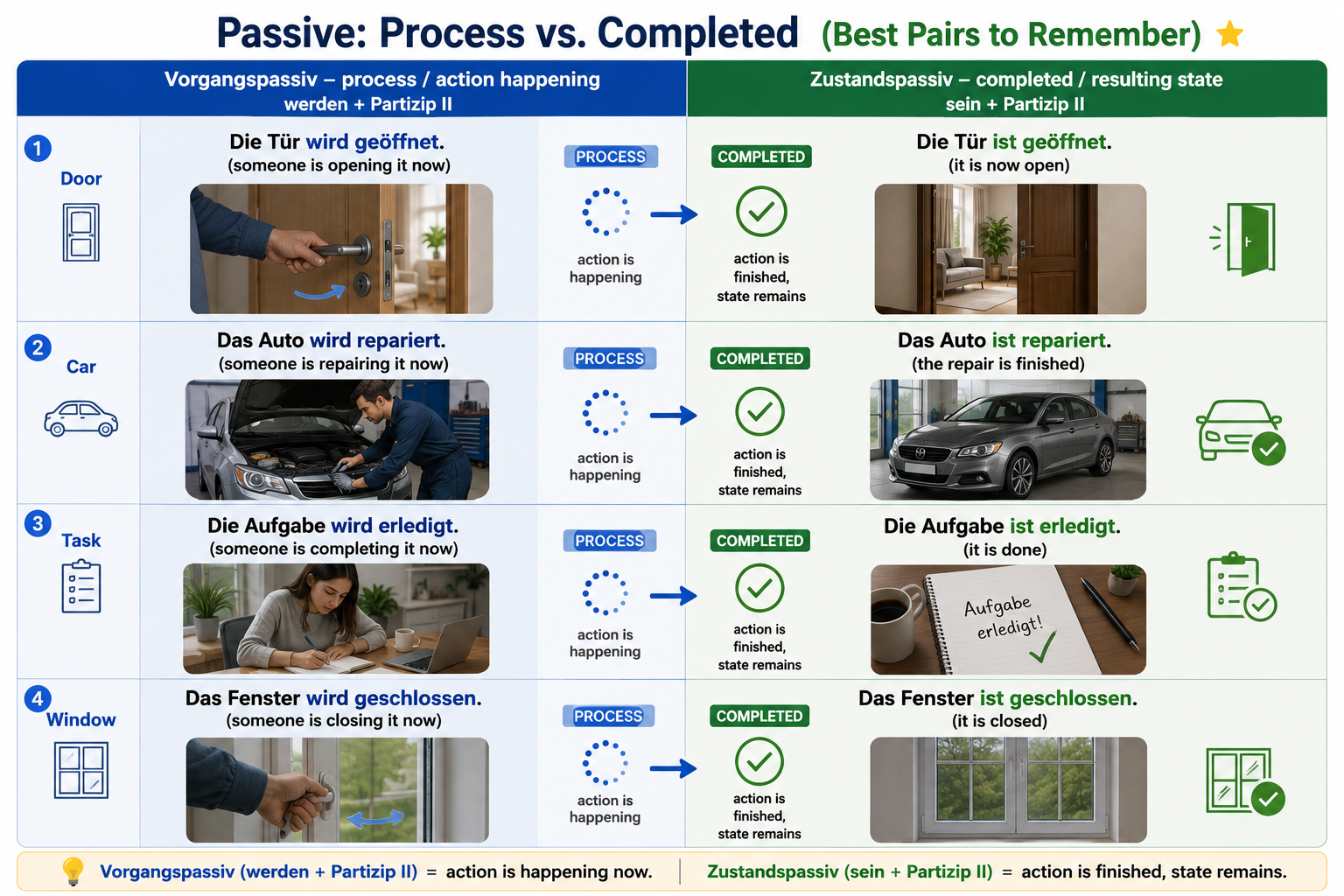
| Vorgangspassiv (action / process) | ENglish | Zustandspassiv (result / state) | |
|---|---|---|---|
| Die Tür wird geöffnet. | someone is opening it | Die Tür ist geöffnet. | it is open |
| Das Essen wird gekocht. | someone is cooking it | Das Essen ist gekocht . | it is cooked / ready |
| Das Auto wird repariert. | someone is repairing it | Das Auto ist repariert . | the repair is finished |
| Das Fenster wird geschlossen. | someone is closing it | Das Fenster ist geschlossen . | it is closed |
| Das Haus wird gebaut . | someone is building it | Das Haus ist gebaut . | it has been built |
| Die Straße wird gesperrt . | someone is blocking it | Die Straße ist gesperrt . | it is blocked |
| Der Brief wird geschrieben . | someone is writing it | Der Brief ist geschrieben . | it has been written |
| Die Aufgabe wird erledigt . | someone is doing it | Die Aufgabe ist erledigt . | it is done |
| Die Tür wird geschlossen . | someone is closing it | Die Tür ist geschlossen . | *it is closed * |
| Das Zimmer wird gereinigt . | someone is cleaning it. | Das Zimmer ist gereinigt . | it is clean / has been cleaned |
Passiv mit Modalverben
When a modal verb is used with the passive, the modal verb is conjugated, while werden and the main verb remain as infinitives.
Modal Verb take P2 and pushed werder to the end in infinitive form
`werden` (infinitive, goes to the very end) }} $$ 🧠 This pattern (`muss/kann/soll ... + Partizip II + werden`) is extremely common in telc B1 Die Aufgabe **musste** schnell **gelöst** **werden**. - The task had to be solved quickly. *(Präteritum + Modal)* Das Problem **muss** sofort **gelöst** **werden**. - The problem must be solved immediately. **Sprachbausteine**— instructions, rules, and notices are almost always written this way. ### Example: Modal verbs + passive | Aktiv | Passiv | English | |------------------------------------------------|------------------------------------------|--------------------------------| | Man muss das Formular ausfüllen. | Das Formular **muss ausgefüllt werden**. | The form must be filled out. | | Man kann die Tür öffnen. | Die Tür **kann geöffnet werden**. | The door can be opened. | | Man soll die Rechnung bezahlen. | Die Rechnung **soll bezahlt werden**. | The bill should be paid. | | Der Mechaniker muss das Auto reparieren. | Das Auto **muss repariert werden**. | The car must be repaired. | | Die Firma kann das Büro bauen. | Das Büro **kann gebaut werden**. | The office can be built. | | Der Koch soll die Suppe kochen. | Die Suppe **soll gekocht werden**. | The soup should be cooked. | | Die Mitarbeiter müssen die Anfrage bearbeiten. | Die Anfrage **muss bearbeitet werden**. | The request must be processed. | ----------------------------------------------------------------------------------------------------------------------- ## 4. The Agent: `von` vs `durch` vs `mit` | Preposition | Case | Used for | Example | |-------------|-----------|--------------------------------------------|--------------------------------------------------| | **von** | Dativ | The **person/agent** doing the action | Das Buch wird **von der Autorin** geschrieben. | | **durch** | Akkusativ | The **means/cause** (impersonal, indirect) | Die Stadt wurde **durch das Erdbeben** zerstört. | | **mit** | Dativ | The **tool/instrument** | Die Tür wird **mit einem Schlüssel** geöffnet. | 🧠 Most of the time the agent is simply **left out** — passive is most natural when *who* did it is unknown or unimportant: - Das Fenster wurde geöffnet. *(by whom? — doesn't matter)* ---- ## Alternatives to Passive (common paraphrases) ```text Alternatives to Passive │ ├── 1. man + Active Verb │ └── Man repariert das Auto. │ ├── 2. sein + Adjektiv │ └── Die Tür ist offen. │ ├── 3. bekommen / erhalten + Partizip II │ └── Der Kunde bekommt die Rechnung geschickt. │ └── 4. Active sentence with a specific subject └── Der Mechaniker repariert das Auto. ``` | Construction | Example | Meaning | |-----------------------------|---------------------------------------|----------------------------------------------------------| | **man** + active verb | Man repariert das Auto. | (Someone repairs the car.) = Das Auto wird repariert. | | **sich lassen** + Infinitiv | Das Problem **lässt sich** lösen. | The problem can be solved. (= kann gelöst werden) | | **sein...zu** + Infinitiv | Das Formular **ist** **auszufüllen**. | The form is to be filled out. (= muss ausgefüllt werden) | ### 1. man + Active Verb man is used when the person doing the action is unknown, unimportant, or general. | Passive | Alternative with `man` | English | |-----------------------------------|---------------------------------|---------------------------| | Das Formular **wird ausgefüllt**. | **Man füllt das Formular aus.** | The form is filled out. | | Das Auto **wird repariert**. | **Man repariert das Auto.** | The car is repaired. | | Hier **wird Deutsch gesprochen**. | **Man spricht hier Deutsch.** | German is spoken here. | | Die Straße **wird gesperrt**. | **Man sperrt die Straße.** | The road is being closed. | ### 2. sich lassen + Infinitiv = it can be done | `sich lassen` | Passive equivalent | |---------------------------------------|------------------------------------------| | Das Problem **lässt sich lösen**. | Das Problem **kann gelöst werden**. | | Die Tür **lässt sich öffnen**. | Die Tür **kann geöffnet werden**. | | Das Fenster **lässt sich schließen**. | Das Fenster **kann geschlossen werden**. | | Der Fehler **lässt sich vermeiden**. | Der Fehler **kann vermieden werden**. | ### 3. sein + zu + Infinitiv = it must/can be done Sometimes a passive sentence can be expressed naturally with an adjective describing the state. | Passive | Alternative | English | |-------------------------------|-----------------------------|---------------------| | Die Tür **ist geschlossen**. | Die Tür **ist zu**. | The door is closed. | | Das Fenster **ist geöffnet**. | Das Fenster **ist offen**. | The window is open. | | Die Aufgabe **ist erledigt**. | Die Aufgabe **ist fertig**. | The task is done. | ----------------------------------------------------------------------------------------------------------------------- ## 📋 Practice Examples 1. Der Brief wird morgen geschickt. → The letter is being sent tomorrow. 2. Die Rechnung wurde gestern bezahlt. → The bill was paid yesterday. 3. Das Haus ist schon verkauft worden. → The house has already been sold. 4. Die Fenster müssen geputzt werden. → The windows must be cleaned. 5. Es wird heute Abend gefeiert. → There's a celebration tonight. 6. Die Tür ist abgeschlossen. *(Zustandspassiv — it's locked now)* ### 🎯 **Focus per level**: - **A2**: Recognize Präsens Passiv (wird gemacht) - **B1**: Präsens & Präteritum Passiv, Passiv + Modalverben, `von`/`durch`, Zustandspassiv (recognize) - **B2**: Passiv in all tenses, Konjunktiv with Passiv, alternatives (`sich lassen`, `sein...zu`) > **Related:** [Partizip II](/notes/06-Verb/1-Partizip/) · [Verbs](/notes/06-Verb/0-Verb/) · [Tenses](/notes/09-Tense/0-Tense/) · [Konjunktiv II](/notes/13-Konjunktiv/1-Konjunktiv-II/) · [Grammar Roadmap](/notes/00-Overview/0-Syllabus/)