Flying a Drone in Europe 🇪🇺 – EASA Rules Made Simple
Everything you need to know before launching a drone in the EU — clear EASA rules, UAS categories, weight limits, pilot requirements, flight modes, risks, and data protection explained without the legal jargon.
European Union Aviation Safety Agency (EASA )
EU agency whose main activity is the creation of uniform European standards.
- also referred to as the "European Aviation Authority", although this is not formally correct. It currently has 31 member states.
UAS operators and remote pilots Certificate
If you operate an unmanned aircraft that has at least one of the following characteristics , you must register as a UAS operator:
- Maximum take-off weight of more than 250 g
- Impact energy of more than 80 J
- The UAS is equipped with a sensor that allows the recording of personal data such as: Video or infrared cameras, Cameras or Microphones.
EASA Regulatory Categories
| Category | Subcategory | Weight Limit | Operational Conditions | Pilot Requirements | Technical Requirements |
|---|---|---|---|---|---|
| Open | A1 | C0: ≤ 250 g C1: ≤ 900 g | - Can operate in densely populated areas - No flights over crowds | C0: No qualification C1: Online training and exam | - C0: Flight altitude limit (120 m) - C1: Remote identification, geo-awareness system, altimeter required |
| Open | A2 | C2: ≤ 4 kg | - Must maintain safe distance from people - Slow flight: 5 m, Normal flight: 30 m | Online course, practical self-training, on-site theory test | - C2: Remote identification, geo-awareness, altimeter, slow flight mode |
| Open | A3 | C3/C4: ≤ 25 kg | - Minimum 150 m from residential, industrial, or recreational areas - No bystanders | Online training and exam | - C3/C4: Remote identification, geo-awareness, and altimeter required |
| Specific | N/A | N/A | - Operations outside Open category, such as BVLOS, operations above 120 m | Risk assessment-based authorization | - Based on specific operational risk |
| Certified | N/A | N/A | - High-risk operations: transport of people, dangerous goods, flights over crowds | Certification similar to manned aviation | - Certified UAS, similar to manned aircraft standards |
⚠ The 120 m applies to all Open category flights, not only C0.
Technical Classes (C0 - C4)
UAS are classified based on their weight and technical capabilities, each assigned to corresponding subcategories:
-
C0:
- weight ≤ 250 g
- A1 operations (no pilot qualification required).
- uninvolved persons will be flown over.
- maximum speed of 19 m/s each
- maximum achievable flight altitude 120 m
-
C1
- weight ≤ 900 g
- A1 operations (requires online training and exam).
- no uninvolved persons will be flown over.
- maximum speed of 19 m/s each
- maximum achievable flight altitude 120 m
-
C2:
- weight ≤ 4 kg.
- A2 operations with specific safety distances.
- no speed limit
- minimum horizontal distance of 30 m (5 m in slow flight mode)
- maximum achievable flight altitude 120 m
-
C3 & C4:
- Up to 25 kg. A3 operations, requiring larger safety distances.
- no bystanders are endangered
- no speed limit
- at least 150 m away from residential areas, industrial facilities, recreational facilities and the like.
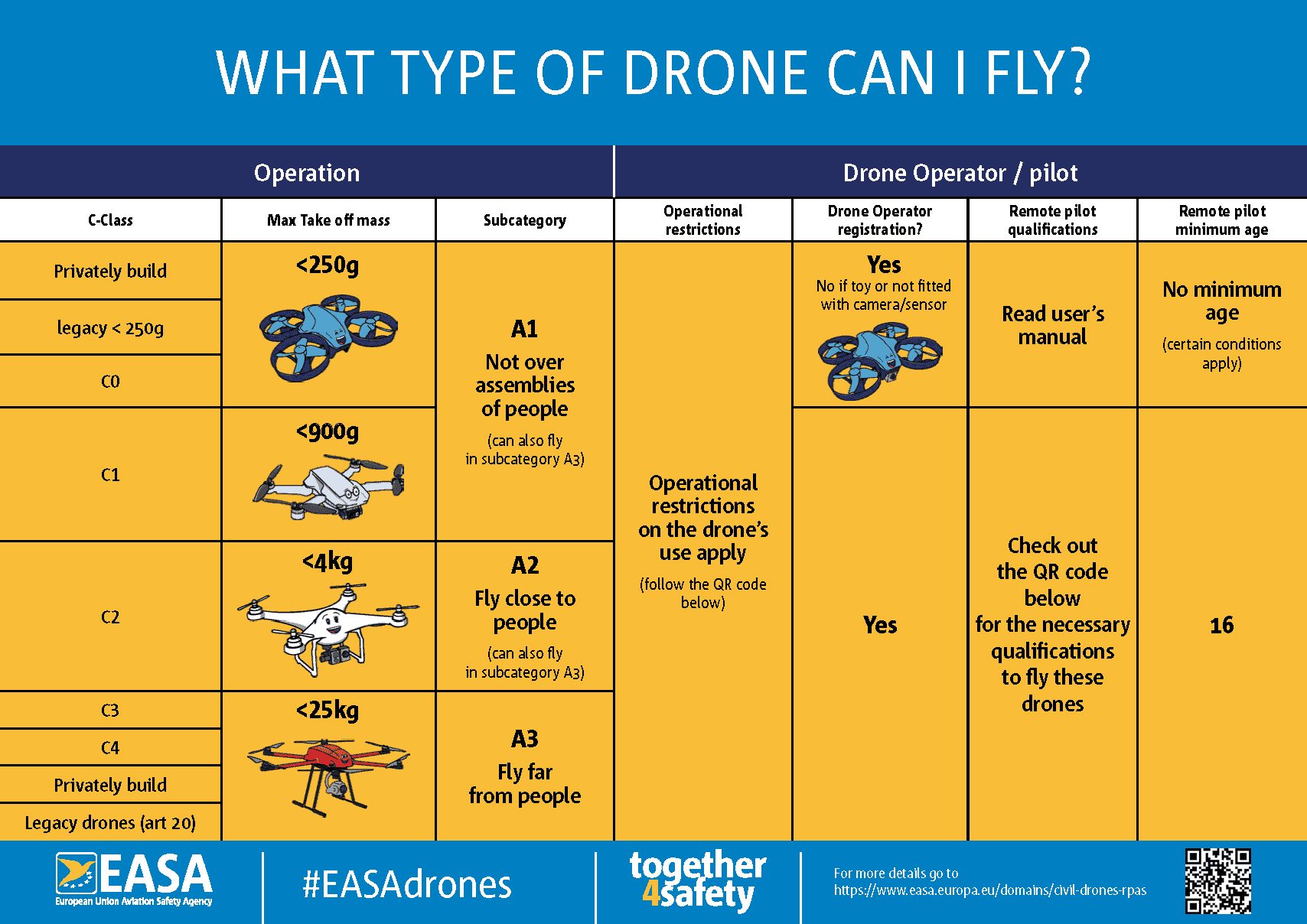
1. Open Category (OPEN)
- Weight < 25 kg.
- Not conducted over assemblies of peoples (defined as densely packed groups where individual movement is restricted).
- Altitude not exceed 120 meters Above Ground Level (AGL).
- Operated within the direct Visual Line of Sight (VLOS)
- No Transport of Dangerous Goods or People
1.1 Subcategory A1:
Operations: Permits UAS flights in densely populated areas and over isolated people (excluding assemblies of peoples).
Weight Limits:
- C0 Class:
< 250 g(no pilot qualification required). - C1 Class:
< 900 g(requires online training and exam).
1.2 Subcategory A2:
Operations: Allows operation near people with larger UAS (up to 4 kg).
Safety Distances:
- Slow Flight (< 3 m/s): Minimum 5 meters from people.
- Normal Flight: Minimum 30 meters from people.
Pilot Requirements:
- online course and exam.
- Undertake practical self-training.
- Pass an on-site theory test.
- Technical Requirements: Must belong to Class C2.
1.3 Subcategory A3:
Operations: Permits flights in areas with low population density.
- UAS up to 25 kg (Classes C3 and C4)
- Safety Distance: Minimum 150 meters from residential, industrial, recreational areas, etc.
- Altitude: Maximum 120 meters AGL.
Pilot Requirements
- Online training and exam.
2. Specific Category (SPECIFIC)
-
weight > 25 kg,
-
120 m AGL or in special airspace
-
outside of the direct line of sight – in English Beyond Visual Line of Sight (
BVLOS). -
Operations that present higher risks not covered by the Open category.
-
Requires authorization based on a risk assessment.
3. Certified Category (CERTIFIED)
- High-risk operations, such as transporting people or dangerous goods.
- Requires certification similar to manned aviation.
UAS: Unmanned Aircraft System
Operazion
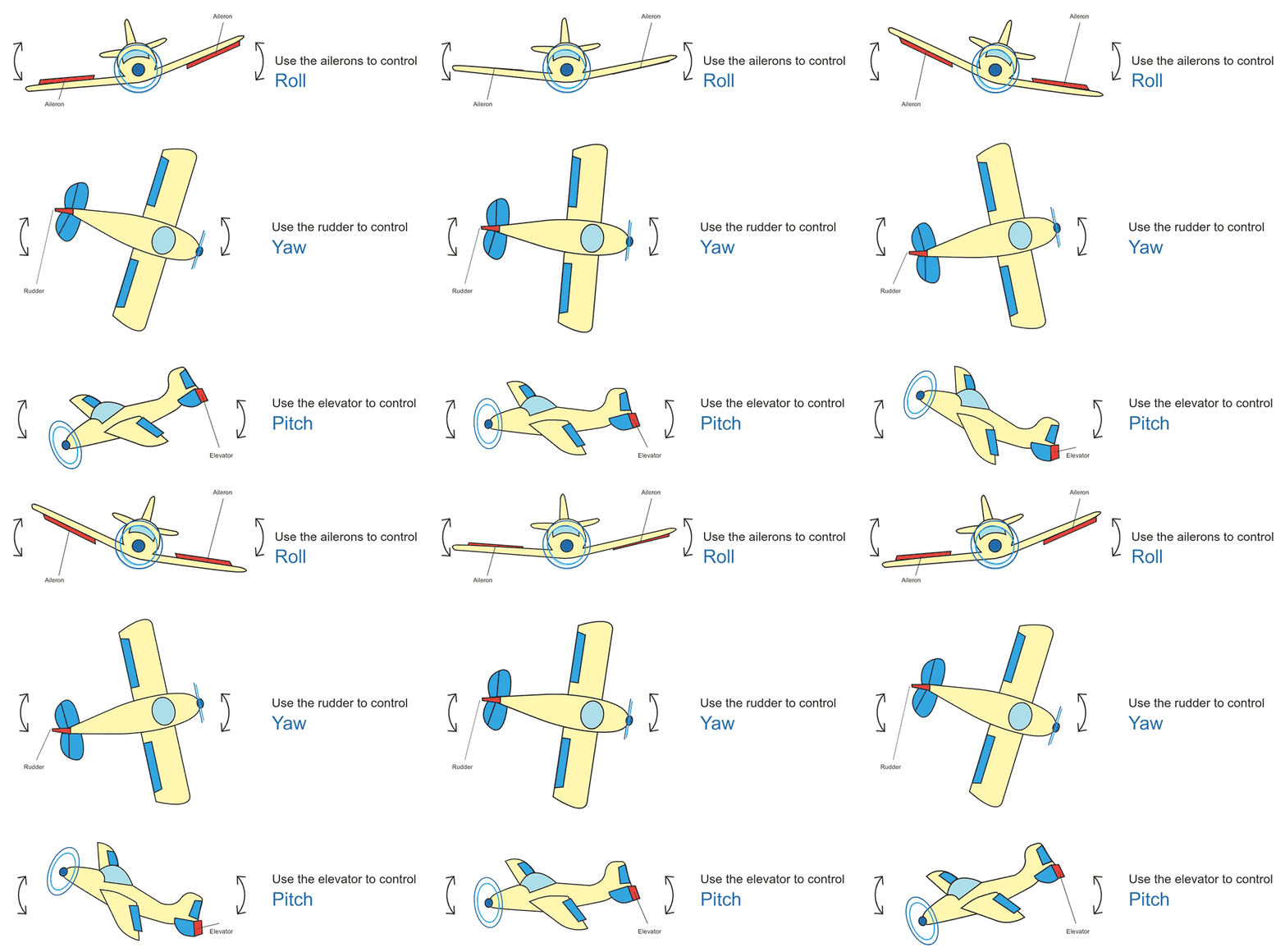
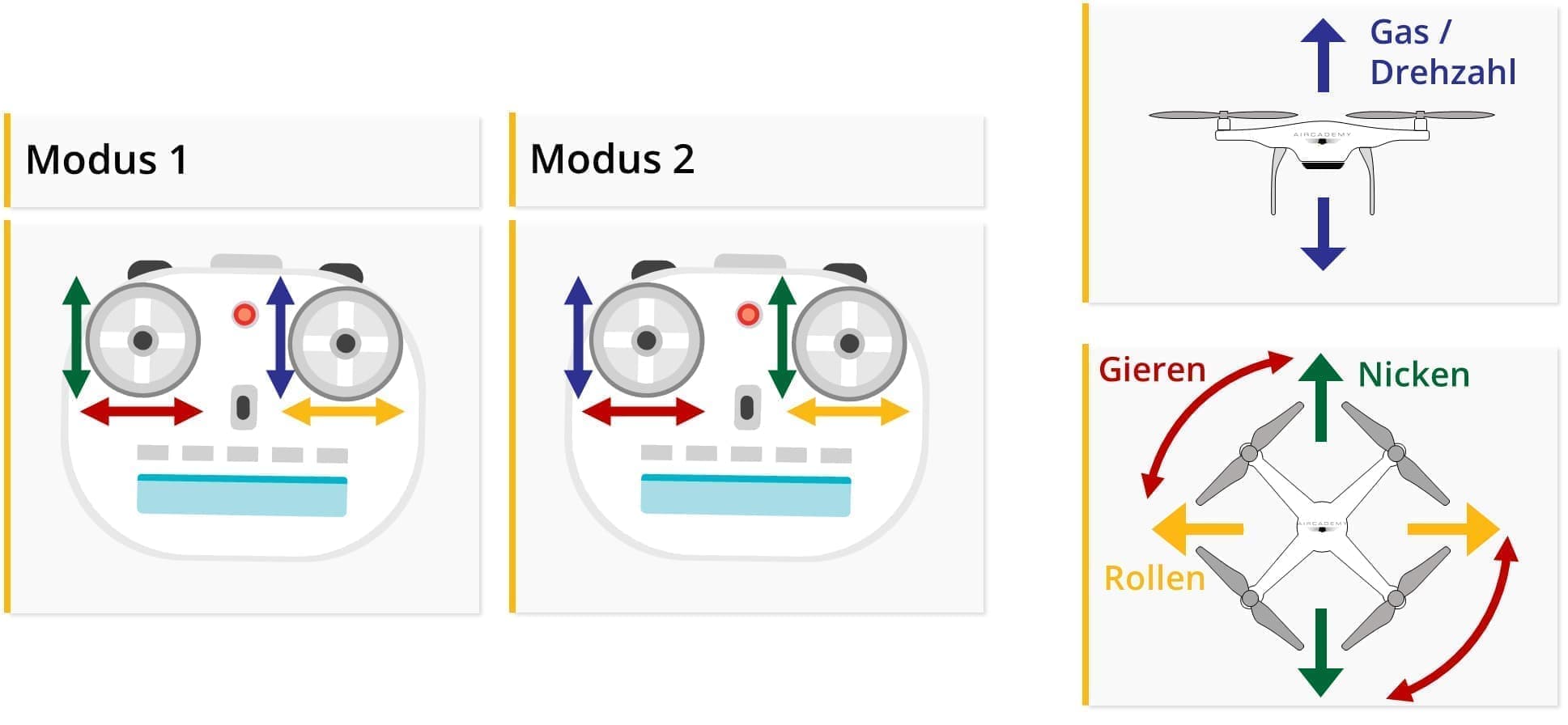
The Unmanned Aircraft System (UAS) can be controlled via the following four primary channels:
- Throttle / Speed (all rotors) ⬆️⬇️: Controls the ascent or descent of the UAS by adjusting the speed of all rotors.
- Effect: Makes the UAS climb or descend.
- Yaw ↩️↪️: Controls the rotation of the UAS, allowing it to turn in place.
- Effect: turns the aircraft's nose left or right, Rotates the UAS clockwise or counterclockwise in place.
- Pitch ↖️↘️: Controls the tilt of the UAS forward or backward, allowing it to move in those directions.
- Effect: raises or lowers the aircraft's nose. Initiates forward or backward flight.
- Roll ↔️: Controls the tilt of the UAS to the left or right, enabling lateral movement.
- Effect: Initiates sideways flight
Flight modes
-
Manual Flight Mode 🕹️
The UAS stays stable, but wind and gravity affect its position. The pilot controls everything manually, which is important to practice, especially in case the sensors fail. -
Stabilized Flight Mode 🚁
- Altitude Mode 🎯: The UAS keeps its height but may drift due to wind.
- GNSS (GPS) Mode 🛰️: The UAS holds its position and altitude using GPS, but only works if enough satellites are available.
-
Pre-Programmed Mode 📍
The UAS follows pre-set waypoints, useful for tasks that need precise positioning, like surveys or circling a structure. -
Automatic Flight Mode ✈️
The UAS takes off, flies, and lands automatically, but the pilot can take control at any time. Full autonomy (without pilot control) is not allowed.
Human Perception
- In the dark, the eyes need about 30 minutes to adjust to the environment.
- green light appears brighter than red light, which can give the impression that the green light source is closer. Red light, on the other hand, appears darker, giving the illusion of being further back.
- anemic hypoxia: carbon monoxide poisoning caused by smoking or inhaling exhaust fumes can negatively affect night vision
**I'M SAFE Checklist **
Ifor Illness:Mfor MedicationSfor Stress or psychological pressure?ANo Alcohol in the last 8-24 hours?Ffor FatigueEfor emotion
Departure procedures
Height of about 2 meters: test all the functions of the remote control, as well as the correct functioning of the payload, telemetry and control.
Risks
ground risk
colliding with people or objects on the ground.
- most of these crashes are due to technical equipment failures.
air risk
collision with other airspace users, such as an airplane or helicopter.
- low-flying police and emergency service helicopters
- Dont fly UAS near accidents, riots or fires.
Flight log
- keeping a flight log or repair and maintenance log is strongly recommended.
- Easier to plan regular maintenance and calculate the lifespan of parts. - It also enables general traceability of flights
Security vs. Safety
Security
Refers to protection from intentional interference (e.g., terrorism, criminal acts).
- Legality and purpose of the flight.
- Risk to others, including privacy.
- Possible interference with authorities: prohibited to fly a UAS into or approach areas where an emergency operation is taking place -
Safety
Protection against accidental and unwanted sources of danger, (e.g., equipment failure, loss of control).
- Drive failure,
- Loss of orientation,
- Control failure or the Failure of the energy source.
Data protection
UAS operator must register whenever the UAS is equipped with sensors that can record personal data Sensosr:
- Video cameras
- Cameras
- Microphones
- Infrared cameras
- Thermal imaging cameras
Insurance
Operating UAS involves risks. Liability insurance is required in most countries for UAS operators. Coverage typically includes damage to third parties or other aircraft. Remote pilots should ensure:
- Liability insurance is valid and meets national regulations.
- Flights comply with legal requirements (e.g., visual line of sight), as non-compliance may void insurance.
In Germany and Austria, insurance for UAS with a take-off mass under 500 kg must cover at least 750,000 SDR (€918,10).
- Proof of insurance must be carried during operations.