Multi-Agent Systems in Agentic AI
Learn how multiple AI agents collaborate to solve complex tasks through specialization, coordination, and delegation. Explore multi-agent architectures, communication patterns, manager-worker systems, and best practices for building scalable Agentic AI applications.
Multi-Agent Systems in Agentic AI 🪅
Rather than relying on one agent to do everything, we create a team of agents that collaborate to solve a problem.
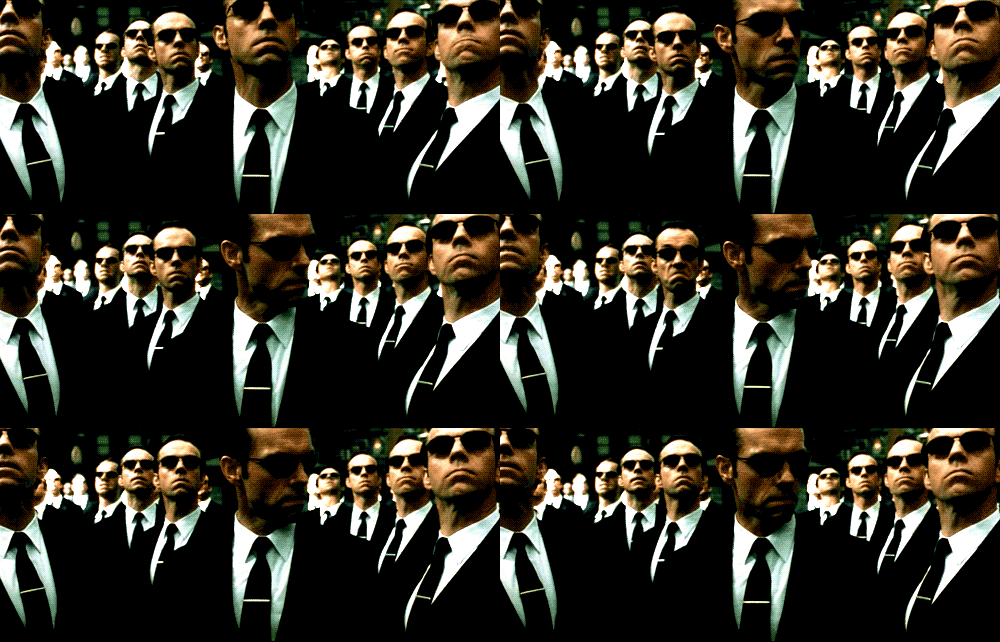
When One Agent Isn't Enough
Most Agentic AI applications begin with a single agent.
graph LR
    A[User Request]
    --> B[Agent]
    --> C[Response]
For simple tasks, this works well.
However, as tasks become more complex, a single agent can become overloaded with responsibilities:
At some point, it becomes useful to split the work across multiple specialized agents.
This approach is known as a Multi-Agent System (MAS).
Why Use Multiple Agents?
When developers first encounter multi-agent systems, a common question is:
Why do I need multiple agents if they're all powered by the same LLM?
A useful analogy comes from software engineering.
Even though a computer may have a single CPU, we still organize applications into:
- Processes
- Threads
- Services
- Microservices
Not because the CPU requires it, but because decomposition makes systems easier to build, maintain, and scale.
The same principle applies to AI agents.
When to Use Multi-Agent Systems
Multi-agent architectures work best when:
- Tasks naturally decompose into sub-tasks
- Different skills are required
- Different tools are needed
- Teams want modular ownership
👍 Benefits of Specialized Agents
1. Modularity
Instead of improving one massive prompt:
Improve Entire Agent
we improve independently.
Research Agent

Graphic Designer Agent

Writer Agent
This creates cleaner development workflows.
2. Agent Reusability
Once an agent exists, it can often be reused.
For example:
Graphic Designer Agent
could be used for:
- Marketing brochures
- Social media posts
- Website graphics
- Product advertisements
The agent becomes a reusable building block.
👎🏻 Potential Drawbacks
Multi-agent systems are not always better.
Challenges include:
1. Increased Complexity
More agents mean more communication.
2. Higher Cost
More LLM calls.
3. Longer Latency
Multiple execution steps.
4. Coordination Overhead
Agents may disagree or produce inconsistent outputs.
Because of these trade-offs, simple tasks often work better with a single agent.
Three communication topologies
1. Blackboard architecture
All agents share a single structured data store (the blackboard).
No agent talks directly to another; instead they post partial results and read what others have written.
A scheduler or implicit triggering mechanism decides which agent acts next.
Classic for knowledge-intensive problems (speech recognition pipelines, planning).
Advantage
loose coupling — agents don't need to know each other exists.
Disadvantage
The blackboard becomes a bottleneck and a single point of failure.
flowchart TD

    Agent1[Agent A]
    Agent2[Agent B]
    Agent3[Agent C]

    SharedMemory[Blackboard <br/>Shared Memory]
    Agent1--> SharedMemory
    Agent2--> SharedMemory
    Agent3--> SharedMemory
2. Direct message passing
agents communicate by sending structured messages peer-to-peer, synchronously (blocking RPC-style) or asynchronously (fire and forget, with a reply address).
- This maps onto agent communication languages like
FIPA-ACLorKQML. - The key structural idea is that no shared memory is required; all coordination happens through the message exchange itself.
Advantage
explicit, traceable coordination.
Disadvantage
agents must know who to address, and the message overhead can grow as the system scales.
Example : Sequential Flow
The simplest multi-agent architecture is sequential.
graph LR

    A[Research Agent]

    A --> |message| B[Graphic Designer]
    B --> |message|C[Writer]
    C --> |message|D[Final Brochure]
Execution flow:
- Research agent gathers information
- Designer creates visuals
- Writer produces final content
Each agent consumes the output of the previous one.
Example : Collaborative flow
graph LR

    A[Agent A]
    A --> B[Agent B]
    B --> C[Agent C]
    B-->A
    C-->B
3. Hierarchical (orchestrator/sub-agent)
a manager agent decomposes a goal into sub-tasks and delegates them downward.
- This is the dominant pattern in modern LLM-based multi-agent systems (AutoGPT, LangGraph, Anthropic's agent architectures).
The Manager Agent
The manager acts similarly to a project manager.
The manager does not perform the work directly.
Instead, it delegates.
Responsibilities:
- Create plans
- Delegate tasks
- Review outputs
- Coordinate execution
Example prompt:
You are a marketing manager.

You have access to:

- Research Agent
- Graphic Designer Agent
- Writer Agent

Create a plan and coordinate
their work.
Sub-agents
- Sub-agents can themselves be orchestrators for their portion of the tree.
- Results aggregate back up.
graph TD

    M[Manager Agent]

    M --> R[Research Agent]
    M --> G[Graphic Designer]
    M--> W[Writer Agent]
Instead of agents communicating directly, a manager orchestrates the workflow.
Advantage
clear accountability and parallelism.
Disadvantage
The orchestrator is a single point of failure and a cognitive bottleneck for task decomposition quality.
Example: Hierarchical
graph TD

    M[Manager]

    M --> S1[Sub-Manager 1]

    S1 --> S2[Sub-Manager 2]

    S2 --> S3[Sub-Manager 3]

    S1 --> W1[Worker 1]

    S2 --> W2[Worker 2]

    S3 --> W3[Worker 3]
The communication structure often has more impact than the individual agents themselves.
Example: Marketing Campaign Agent Team
Suppose we need to create a summer marketing brochure for sunglasses.
We can design three specialized agents.
graph TD

    A[Research Agent]
    A --> B[Graphic Designer Agent]
    B --> C[Writer Agent]
Each agent has a specific responsibility.
Agent 1: Researcher 👨🏻🔬
Responsibilities:
- Analyze market trends
- Research competitors
- Identify customer preferences
Required tools:
- Web Search
- Market Research APIs
- Knowledge Bases
Example system prompt:
You are a market research expert.

Analyze sunglasses market trends,
competitor offerings,
and customer preferences.
Agent 2: Graphic Designer 🎨
Responsibilities:
- Create charts
- Generate product imagery
- Design marketing visuals
Tools:
- Image Generation
- Image Editing
- Code Execution
- Visualization Libraries
Example prompt:
You are a graphic designer.

Create visual assets
for marketing materials.
Agent 3: Writer 💻
Responsibilities:
- Create marketing copy
- Combine research and visuals
- Produce final brochure
Required tools:
- LLM Text Generation
Example prompt:
You are a marketing copywriter.

Transform research findings
into compelling content.
Notice how each agent is optimized for a specific role.
Key Takeaways
- Multi-agent systems divide complex tasks among specialized agents.
- Specialized agents often mirror human job roles.
- Common roles include researchers, writers, designers, analysts, and reviewers.
- Linear workflows pass outputs sequentially between agents.
- Manager-agent architectures introduce coordination and delegation.
- Agents themselves can become callable tools for other agents.
- Multi-agent systems improve modularity, reusability, and maintainability.
- Communication patterns are one of the most important design decisions.
The evolution of agent architectures can be summarized as:
As Agentic AI systems become more sophisticated, multi-agent collaboration is increasingly becoming the preferred approach for solving complex, real-world problems at scale.
Related Posts
- Optimizing Agentic AI Systems — the single-agent techniques this multi-agent coordination builds on
- Understanding Model Fusion in AI Systems — combining multiple models' outputs, a related technique to multi-agent coordination