Anomaly Detection Using Multivariate Gaussian Distribution
Learn anomaly detection using multivariate Gaussian distribution to identify unusual patterns and correlated outliers in datasets. Understand covariance matrices, parameter estimation, probability density functions, and threshold-based anomaly detection techniques used in machine learning systems.
Anomaly Detection Using Gaussian Distribution in Machine Learning
Recommender Systems: Collaborative Filtering, Content-Based Filtering, and Hybrid Approaches
Multivariate Gaussian Distribution
The multivariate Gaussian distribution is an extension of the normal (Gaussian) distribution to multiple variables.
It is commonly used in:
- anomaly detection
- probabilistic modeling
- Gaussian mixture models
- Bayesian ML
- Kalman filters
Motivation
Suppose we are monitoring machines in a data center.
Features:
| Feature | Meaning |
|---|---|
| CPU Load | |
| Memory Usage |
Most machines behave normally:
High CPU  ↔ High Memory
Low CPU   ↔ Low Memory
The features are correlated.
Problem with Basic Gaussian Anomaly Detection
Earlier anomaly detection assumed:
meaning:
- features are independent
Why This Fails
Suppose we observe:
CPU Load   = Very Low
Memory Use = Very High
Individually:
- CPU value looks normal
- Memory value looks normal
But together:
- this combination is strange
Visual Intuition
Normal data may lie along a diagonal trend:
Low CPU  → Low Memory
High CPU → High Memory
An anomalous point:
Low CPU + High Memory
lies far away from the normal pattern.
Basic Gaussian fails because it ignores feature correlation.
Solution: Multivariate Gaussian
Instead of modeling each feature separately:
we model:
all together.
Multivariate Gaussian Formula
The probability density is:
No need to memorize this formula.
Parameters
1. Mean Vector
Represents the center of the distribution.
Example:
means:
- centered at origin
2. Covariance Matrix
An matrix describing:
- variances
- correlations
Covariance Matrix Structure
For 2 features:
1. Diagonal Entries
Represent variance of each feature.
Example:
means:
- both features have equal variance
- no correlation
2. Off-Diagonal Entries
Represent correlation between features.
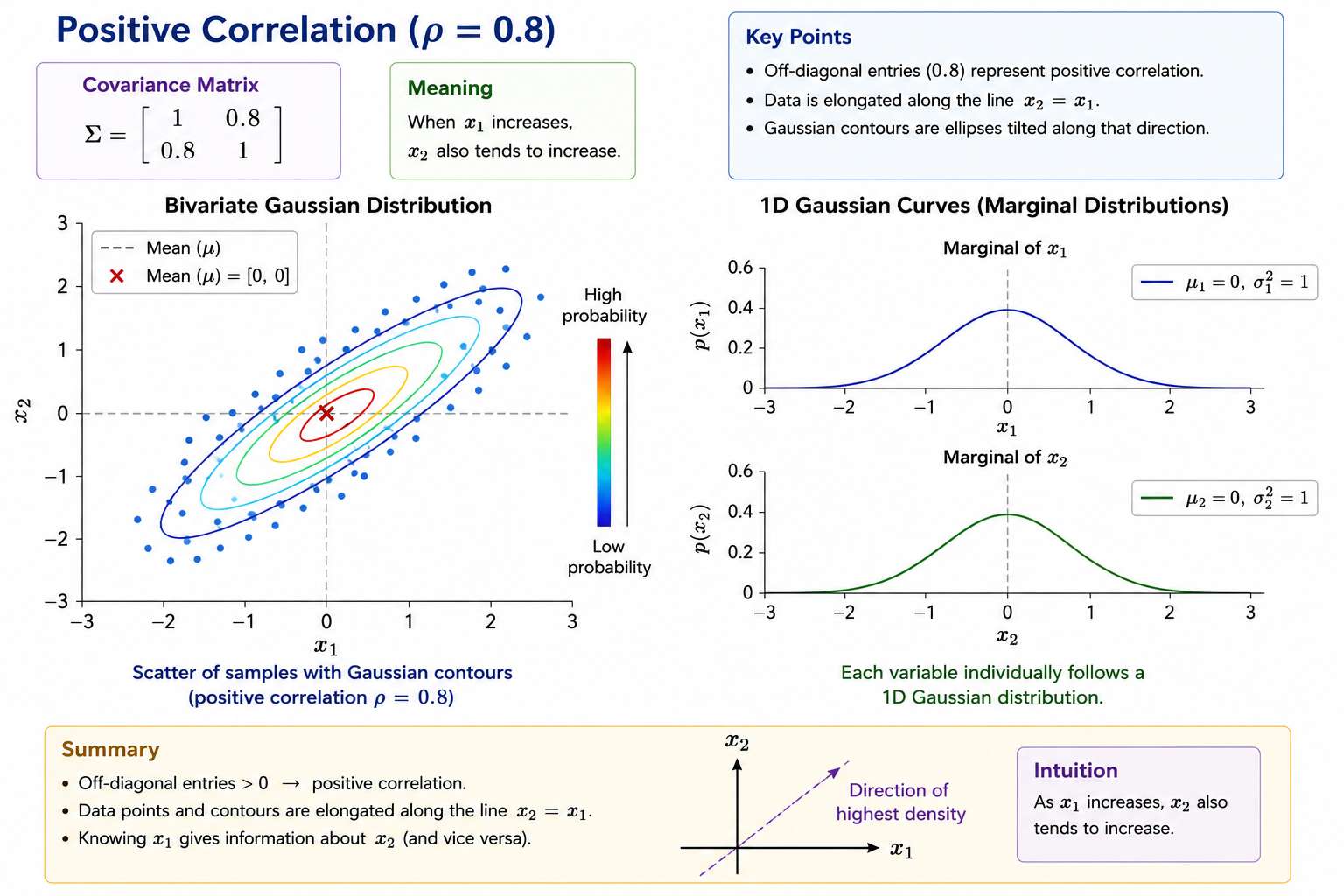
Positive Correlation
Example:
Meaning:
When x1 increases
x2 also tends to increase
Probability mass lies near:
Visual Shape
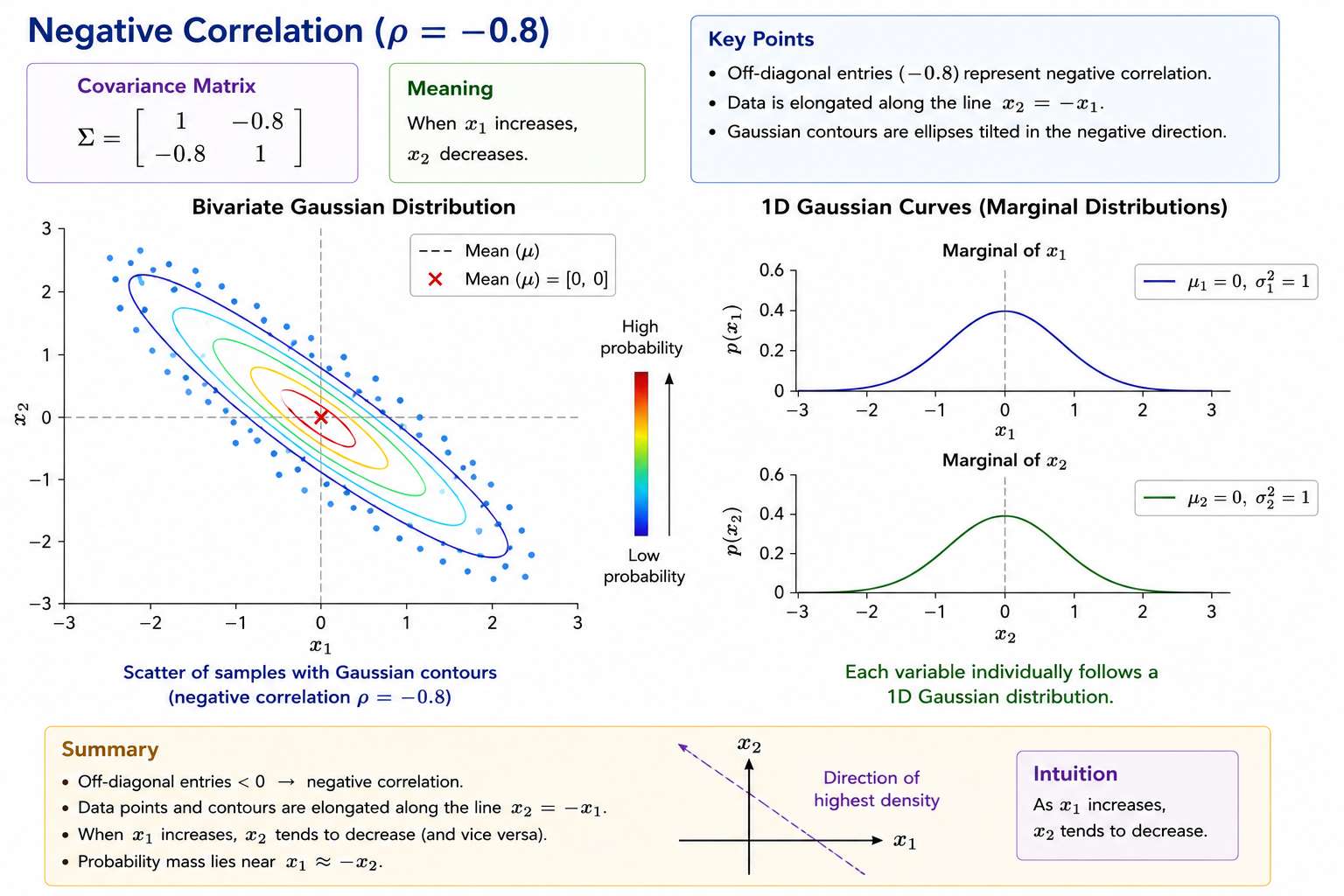
Negative Correlation
Example:
Meaning:
When x1 increases
x2 decreases
Probability mass lies near:
Visual Shape
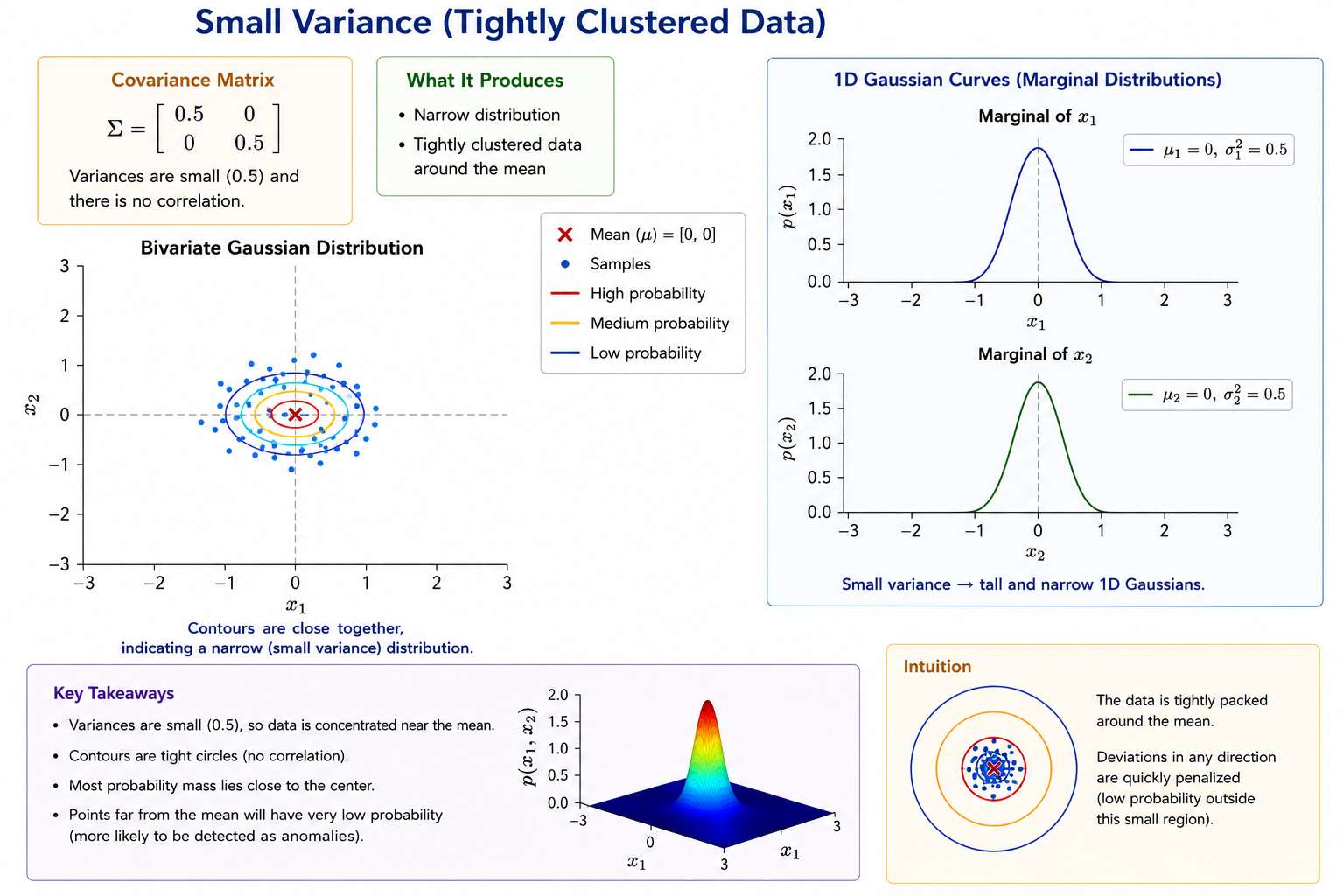
3. Effect of Variance
Small Variance
Produces:
- narrow distribution
- tightly clustered data
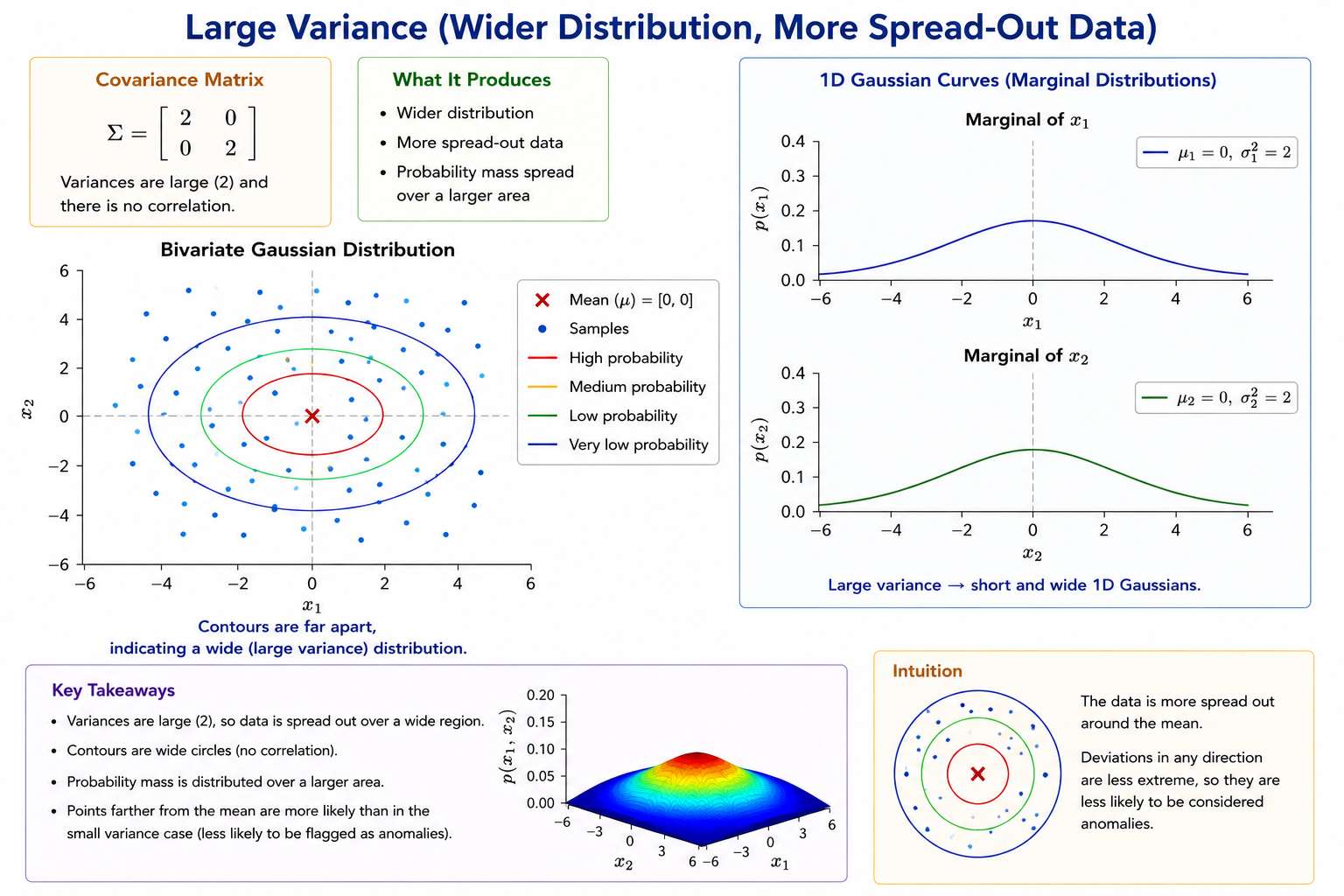
Large Variance
Produces:
- wider distribution
- more spread-out data
Geometric Interpretation
Multivariate Gaussian creates:
Elliptical Probability Regions
High Probability
    ↓
   ****
 ********
**********
 ********
   ****
Points near center:
- high probability
Points far away:
- low probability
Anomaly Detection
Compute:
If:
then:
x is an anomaly
Why Multivariate Gaussian Is Better
Basic Gaussian:
- assumes features independent
Multivariate Gaussian:
- models correlations
This helps detect anomalies like:
Low CPU + High Memory
even if each feature individually looks normal.
Comparison
| Method | Assumes Independence? | Captures Correlation? |
|---|---|---|
| Basic Gaussian | Yes | No |
| Multivariate Gaussian | No | Yes |
Visual Comparison
Basic Gaussian
Circular contours
Assumes equal independent spread.
Multivariate Gaussian
Tilted elliptical contours
Captures relationships between variables.
Mean Shifts Distribution
Changing:
moves the center.
Example:
shifts peak to:
x1 = 1.5
x2 = -0.5
Complete Anomaly Detection Pipeline
flowchart TD
    A[Collect Normal Data]
    --> B[Estimate μ and Σ]
    --> C[Compute p(x)]
    --> D[{p(x) < ε ?}]
    -->|Yes| E[Anomaly]
    -->|No| F[Normal Example]
Advantages
Captures Correlations
Very important for real-world systems.
More Expressive
Can model:
- tilted distributions
- elongated regions
- correlated variables
Disadvantages
Needs more data.
Why?
Because covariance matrix has many parameters:
For large (n):
- expensive
- harder to estimate reliably
Practical Rule
Use Basic Gaussian When
- features mostly independent
- small dataset
- high dimensionality
Use Multivariate Gaussian When
- features strongly correlated
- enough training data available