Generative Adversarial Networks (GANs) Explained
Learn how Generative Adversarial Networks (GANs) work, including generators, discriminators, adversarial training, minimax optimization, image synthesis, and modern generative AI applications.
Generative Adversarial Network (GAN)
Deep learning architecture where two neural networks compete against each other to generate realistic synthetic data.
- Introduced by Ian Goodfellow in 2014.
- Research paper: Generative Adversarial Nets
- From GAN to WGAN
A GAN is a neural network system where:
- one model generates fake data,
- another model detects fake data,
- and both improve through adversarial competition.
Popular GAN Variants
| Variant | Purpose |
|---|---|
DCGAN |
CNN-based GAN |
CycleGAN |
Image translation |
StyleGAN |
High-quality face generation |
Conditional GAN |
Controlled generation |
Wasserstein GAN (WGAN) |
Stable training |
GANs in the Generative AI Landscape
1. GAN (Generative Adversarial Network )
GAN models are known for potentially unstable training and less diversity in generation due to their adversarial training nature.
flowchart TD

    A[Data X] --> B["Generator (GAN)"]

    B --> C[Generated Data x']

    C --> D["Discriminator (GAN)"]

    D --> E{Real or Fake?}

    E -->|Real| F[Correct Classification]

    E -->|Fake| G[Generator Improves]
2. VAE (Variational Autoencoders)
Variational Autoencoders are more stable but often produce blurrier outputs compared to GANs.
- VAEs encode input data into a latent space and decode it while maximizing a variational lower bound, though they often produce lower-quality images compared to GANs.
flowchart TD

    A[Data X] --> B["Encoder (VAE)"]

    B --> C[Latent Space z]

    C --> D["Decoder (VAE)"]

    D --> E[Generated Data x']
3. Flow models
Flow-based models use invertible transformations to map data to a latent space, allowing for exact likelihood estimation and easy sampling.
- Have to use specialized architectures to construct reversible transform .
flowchart TD

    A[Data X] --> B["Flow Model f(X)"]

    B --> C[Latent Space z]

    C --> D["Flow Model Inverse f^(-1)^(z)"]

    D --> E[Generated Data x']
4. Diffusion models
Are more stable and produce higher quality outputs, but are slower to generate content.
GAN vs Diffusion Models
| GAN | Diffusion Models |
|---|---|
| Faster generation | Slower generation |
| Harder training | More stable |
| Sharp outputs | Better diversity |
| More instability | Higher realism |
flowchart TD

    A[Data X] --> B["Diffusion Model"]

    B --> C[Noisy Data]

    C --> D["Denoising Process"]

    D --> E[Generated Data x']
Applications of GANs
- Image Generation
- Human faces
- Art
- Landscapes
- Avatars
- Deepfakes
- AI Art
- Super Resolution: Improve image resolution and quality.
- Image-to-Image Translation
- Sketch → Photo
- Day → Night
- Black & White → Color
- Data Augmentation: Generate synthetic training datasets.
GAN Architecture
flowchart TD

    A[Random Noise z] --> B[Generator]

    B --> C[Generated Fake Image]

    C --> D[Discriminator]

    E[Real Image Dataset] --> D

    D --> F{Real or Fake?}

    F -->|Real| G[Correct Classification]

    F -->|Fake| H[Generator Improves]
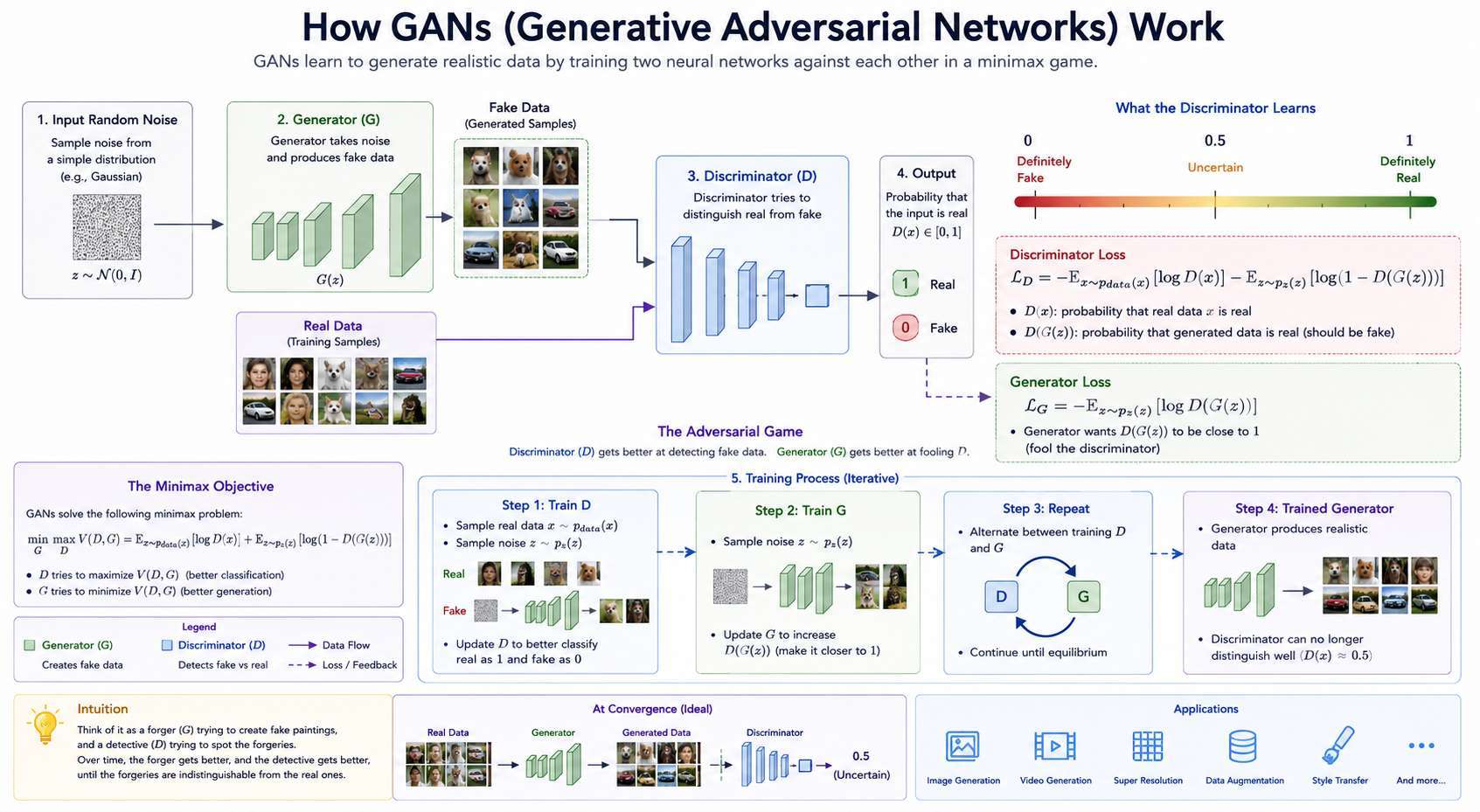
Core Components
| Component | Role |
|---|---|
| Generator | Creates fake/generated data |
| Discriminator | Detects whether data is real or fake |
Generator Objective
Generator = Counterfeit Artist
Example: The artist improves fake currency generation.
The Generator tries to create realistic synthetic data.
Where:
- = Random latent vector
- = Generated fake sample
Discriminator Objective
Discriminator = Police Detective
Example: The detective improves fake detection.
The Discriminator classifies whether data is real or fake.
Where:
- = Fake
- = Real
GAN Minimax Objective Function
GAN training is a minimax optimization problem.
Where:
- = Generator
- = Discriminator
- = Real data sample
- = Random noise vector
- = Real data distribution
- = Noise distribution
GAN Training Flow
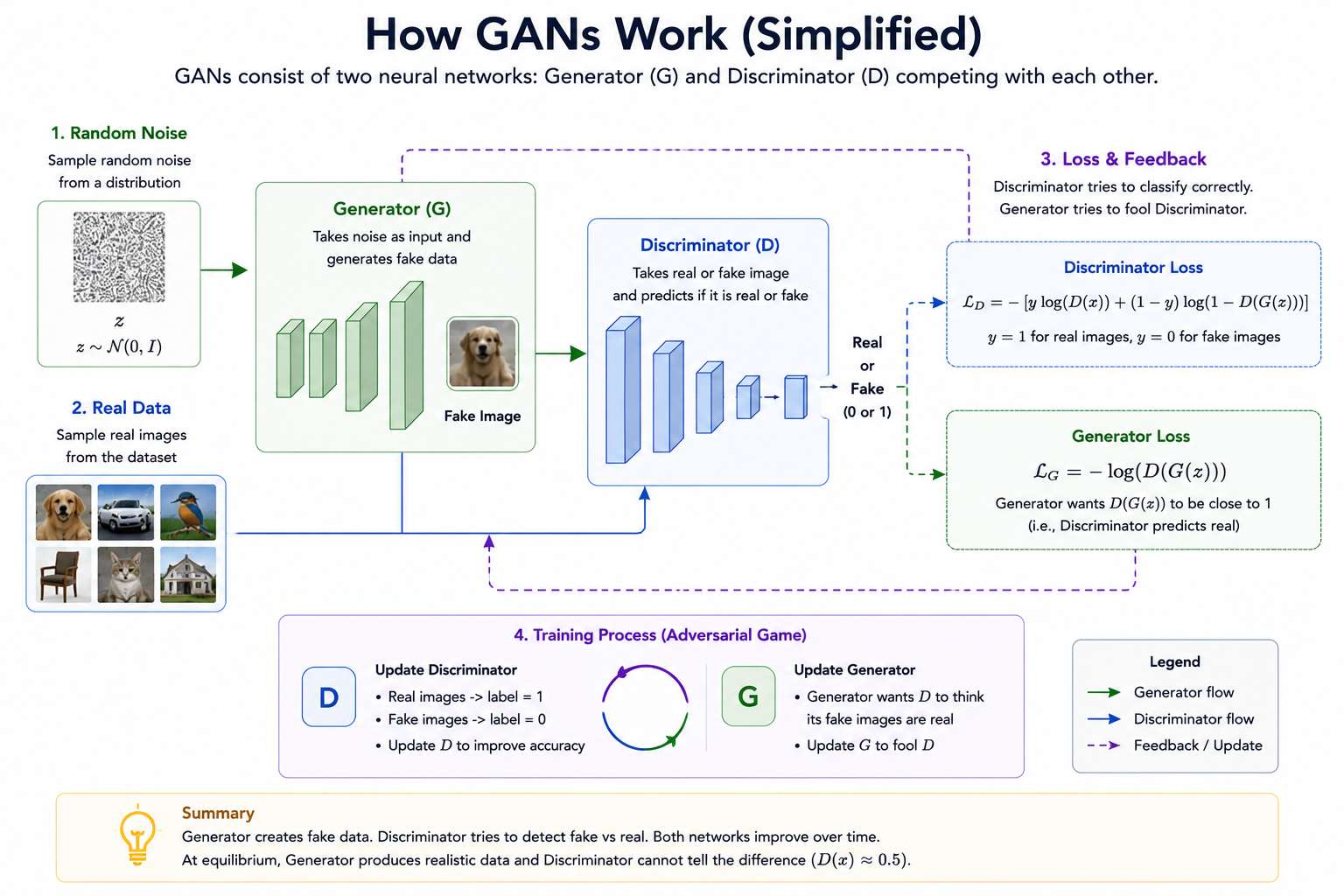
sequenceDiagram

    participant Z as Random Noise
    participant G as Generator
    participant D as Discriminator

    Z->>G: Generate Fake Sample

    G->>D: Fake Image

    D->>D: Predict Fake

    Note over D: Train Discriminator

    D-->>G: Feedback / Gradient

    Note over G: Improve Generator
Step 1: Train Discriminator
- Feed real images
- Feed fake/generated images
- Learn classification
Step 2: Train Generator
- Generate fake images
- Try to fool discriminator
Step 3: Repeat Iteratively
Both networks improve over time.
flowchart LR

    G[Generator] -->|Creates Fake Data| D[Discriminator]

    D -->|Detects Fake Data| G

    G -->|Improves Realism| D

    D -->|Improves Detection| G
Challenges in GANs
- Mode Collapse : Generator produces limited variety.
- Training Instability: GANs are difficult to balance and optimize.
- Vanishing Gradients : Discriminator becomes too strong.
- Evaluation Difficulty: Generated quality is hard to measure objectively.