Diffusion Models Explained
Learn how Diffusion Models generate realistic images by progressively adding and removing noise. Explore forward and reverse diffusion processes, U-Net architectures, denoising techniques, latent diffusion, and the foundations behind modern generative AI systems such as Stable Diffusion.
U-Net Explained
NVIDIA Certified Associate Generative AI (NCA-GENL) Practice Questions
Diffusion Models Explained: The Engine Behind Modern Generative AI
The rise of Generative AI has transformed how machines create images, videos, music, and even 3D content. Among the most influential breakthroughs in recent years are Diffusion Models, the technology powering systems such as Stable Diffusion, Midjourney, and DALL·E.
Unlike earlier approaches such as Generative Adversarial Networks (GANs), diffusion models generate content by learning how to gradually remove noise from data.
In this article, we'll explore how diffusion models work, the mathematics behind them, and why they have become the dominant architecture for image generation.
What Are Diffusion Models?
A diffusion model learns to generate images by reversing a process that gradually corrupts images with noise.
The idea is surprisingly simple:
graph LR

    Image[Image Data]
    Image --> AddNoise
    AddNoise --> PureNoise
Then train a neural network to reverse the process:
graph LR

    PureNoise
    PureNoise --> RemoveNoise
    RemoveNoise --> LessNoise
    LessNoise --> Image
The model learns how to transform random noise into realistic images.
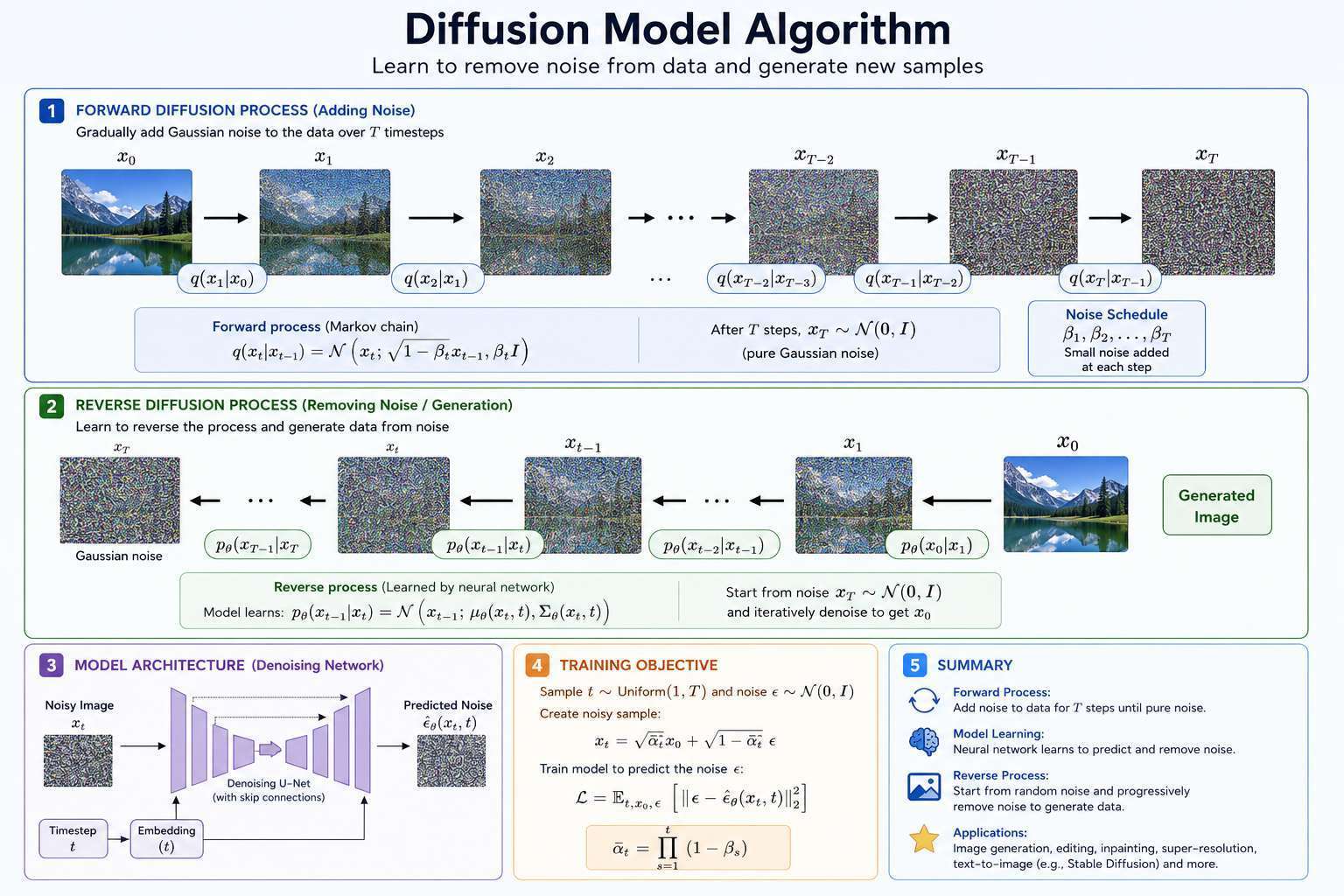
Training follows these steps:
graph TD

    CleanImage

    --> AddNoise

    --> NoisyImage

    --> UNet

    --> PredictNoise

    --> Loss
For every training image:
- Sample a timestep
- Add noise
- Predict noise
- Compute loss
- Update weights
The model gradually learns how noise behaves.
Inspiration from Physics
The term "diffusion" comes from physical diffusion processes.
Imagine dropping ink into water.
Initially:
Ink Drop
Over time:
Ink + Water
Eventually:
Uniform Mixture
Information becomes increasingly dispersed.
Diffusion models apply a similar concept to images.
The Forward Diffusion Process
The forward process gradually adds noise to an image.
graph TD

    Image[Original Image]
    SlightNoise[Slight Noise]
    MoreNoise[More Noise]
    HeavyNoise[Heavy Noise]
    RandomNoise[Random Noise]

    Image --> SlightNoise --> MoreNoise--> HeavyNoise --> RandomNoise


    A[Original Image]

    A--> B[10% Noise]
    B --> C[30% Noise]
    C --> D[60% Noise]
    D --> E[100% Noise]
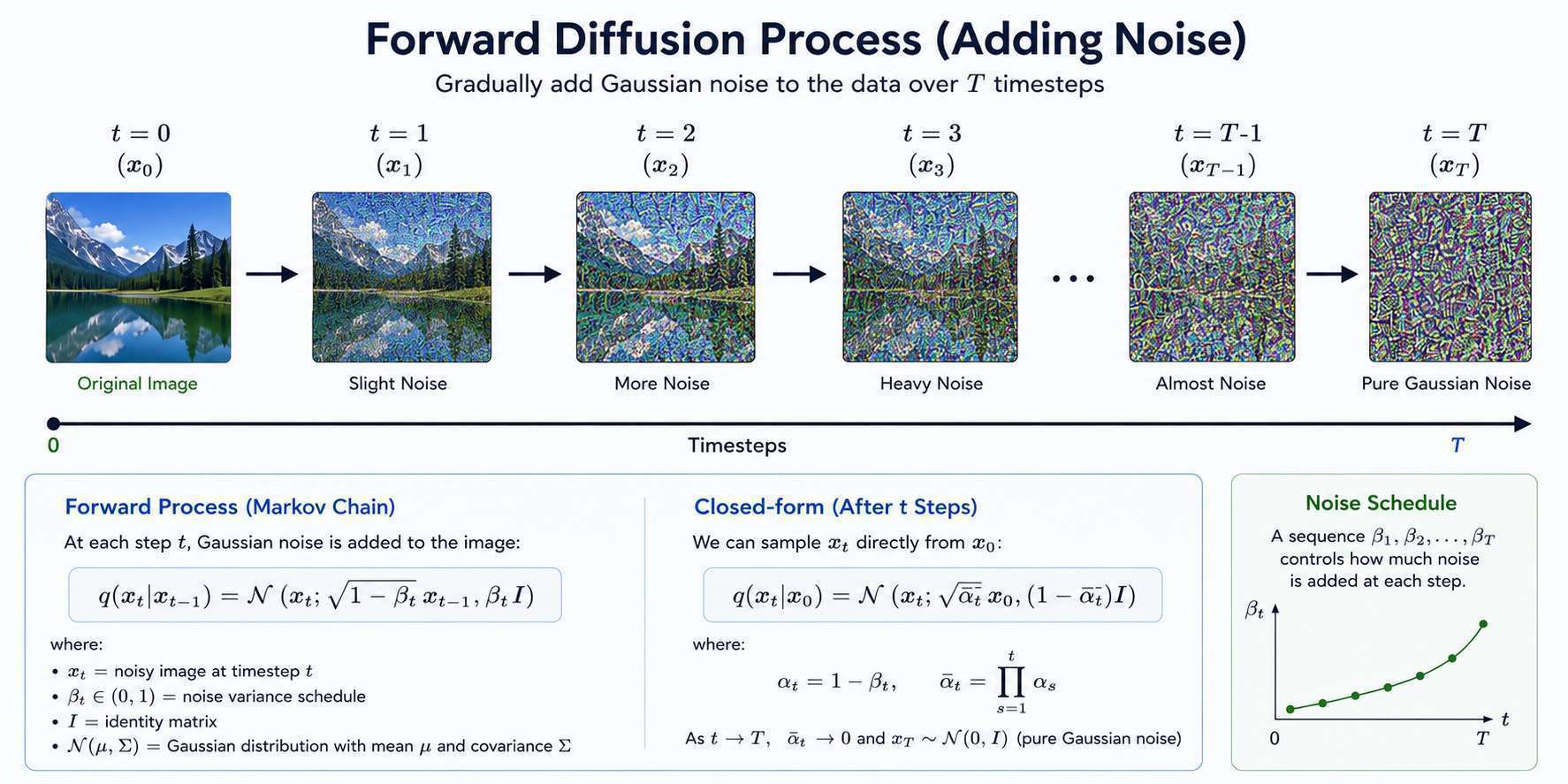
At each step:
Where:
- = image at timestep
- = noise schedule
- = Gaussian noise
After enough steps:
The image becomes pure noise.
The Reverse Diffusion Process
The real magic happens during reverse diffusion.
Starting with random noise:
graph TD

    Noise[Random Noise]
    LessNoise[Less Noise]
    Shape[Emerging Shape]
    Structure[More Structure]
    FinalImage[Final Image]

    Noise --> LessNoise--> Shape--> Structure--> FinalImage
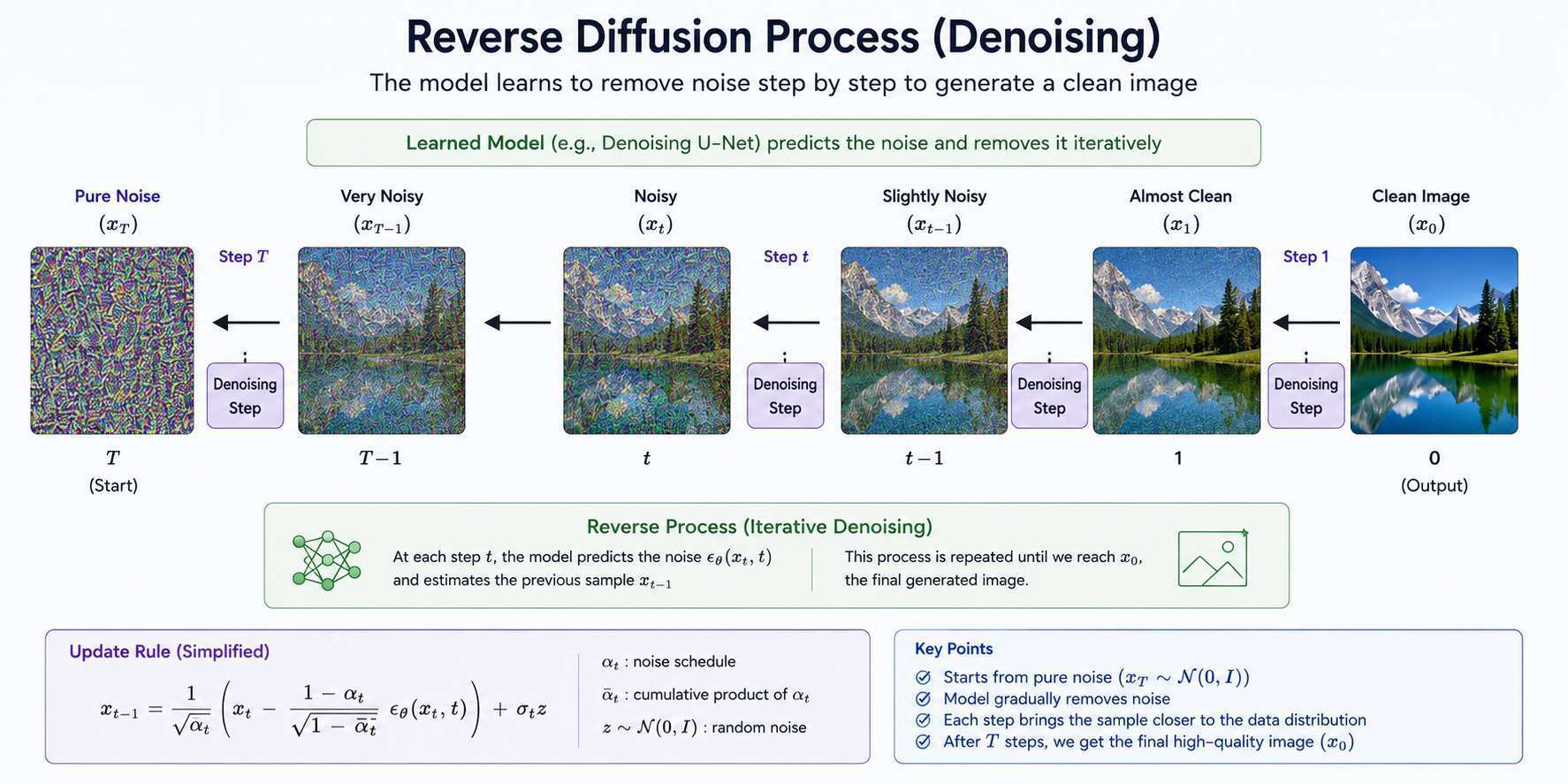
The model predicts what noise should be removed at each step.
Learning to Predict Noise
Instead of directly generating images, diffusion models learn to predict noise.
Input:
: the noisy image at timestep
Output:
: the predicted noise
Architecture:
graph LR

    NoisyImage[Noisy Image]
    UNet[U-Net Algorithm]
    PredictedNoise[Predicted Noise]

    NoisyImage --> UNet --> PredictedNoise
The network learns:
What part is noise?
What part is signal?
Why Predict Noise?
Predicting noise is easier than predicting the entire image.
The training objective becomes:
Where:
- = actual noise
- = predicted noise
This Mean Squared Error (MSE) objective is stable and effective.
Generating Images With UNet
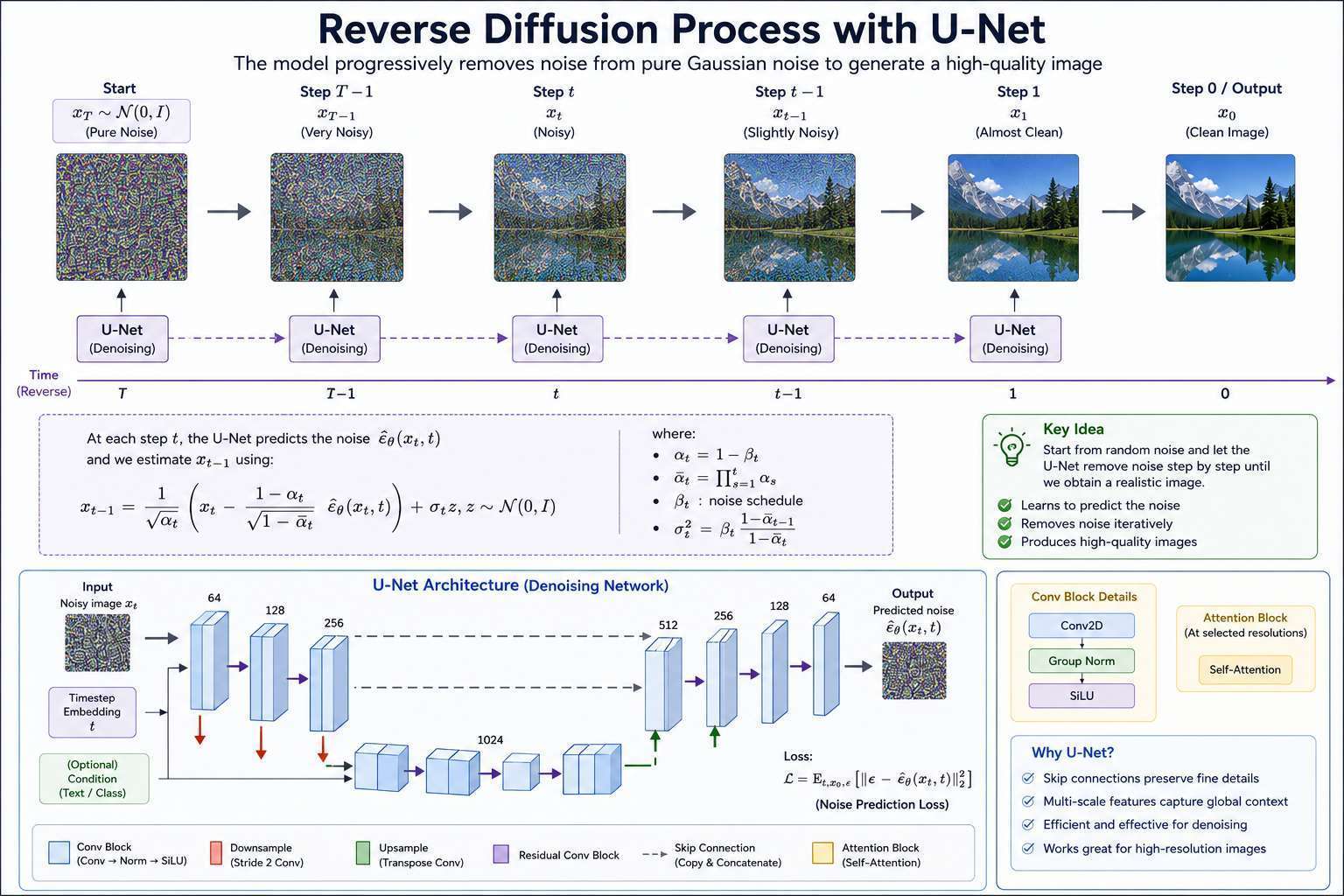
Once trained:
- Start with random noise
- Run reverse diffusion
- Remove noise step by step
- Obtain an image
graph TD

    Noise --> Step_1--> Step_2--> Step_n--> Image
This process can involve hundreds of denoising steps.
The Role of U-Net
Most diffusion models use a U-Net architecture.
graph TD

    Input[Noisy Image]

    Input--> Encoder --> Bottleneck --> Decoder--> Output[Predicted Noise]

    Encoder -. Skip Connections .-> Decoder
Why U-Net?
- Captures global context
- Preserves fine image details
- Works at multiple scales
- Excellent for denoising tasks
Mathematical Objective
The model approximates:
which represents:
How likely is the previous image
given the current noisy image?
By repeatedly applying this estimate, the model reconstructs images.
Conditional Diffusion Models
Modern systems generate images from prompts.
Example:
A futuristic city at sunset
Architecture:
graph TD

    Prompt --> TextEncoder--> Embedding--> DiffusionModel--> Image
The text embedding guides the denoising process.
CLIP and Diffusion
Many systems use CLIP-based text encoders.
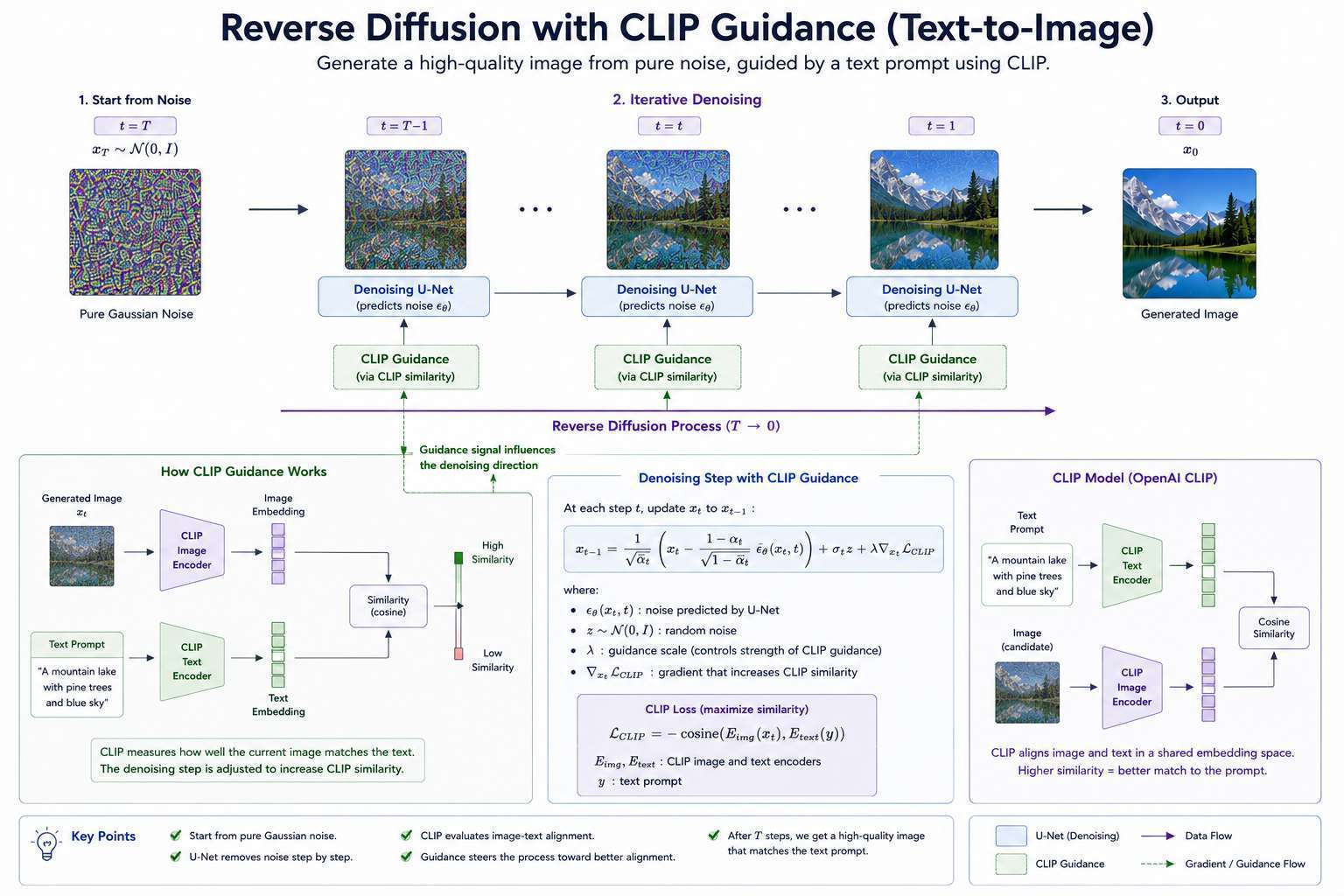
Workflow:
graph TD

    TextPrompt[Text Prompt]
    CLIP[CLIP Text Encoder]
    TextEmbedding[Text Embedding]
    UNet[U-Net Denoiser]
    GeneratedImage[Generated Image]


    TextPrompt --> CLIP --> TextEmbedding --> UNet --> GeneratedImage
The text embedding tells the model:
What should be generated?
The U-Net determines:
How should it look?
Latent Diffusion Models
Running diffusion directly on high-resolution images is expensive.
Instead of operating on images directly, the model operates on latent representations.
Stable Diffusion introduced:
Latent Space
Latent space (also called embedding space) is a compressed, abstract representation of data used by AI and machine learning models
graph TD

    Image--> Encoder --> LatentSpace
So Architecture Becomes:
graph TD

    Image --> Encoder--> LatentSpace --> DiffusionModel --> Decoder--> GeneratedImage
Benefits:
- Faster training
- Lower memory requirements
- Higher resolutions
Why Diffusion Models Replaced GANs
GANs consist of:
Generator
vs
Discriminator
Training can be unstable.
Problems include:
- Mode collapse
- Training instability
- Difficult optimization
Diffusion models offer:
- Stable training
- Better diversity
- Higher image quality
- Strong prompt alignment
GANs vs Diffusion Models
| Feature | GANs | Diffusion Models |
|---|---|---|
| Training Stability | Medium | High |
| Image Quality | High | Very High |
| Diversity | Medium | High |
| Prompt Control | Limited | Excellent |
| Training Complexity | High | Medium |
| Generation Speed | Fast | Slower |
Applications of Diffusion Models
Text-to-Image Generation
Examples:
- Stable Diffusion
- Midjourney
- DALL·E
Image Editing
Tasks:
- Inpainting
- Outpainting
- Style transfer
Video Generation
Generate videos from:
- Text prompts
- Images
- Existing videos
Medical Imaging
Applications:
- MRI reconstruction
- Image enhancement
- Synthetic data generation
Scientific Research
Generate:
- Molecular structures
- Protein conformations
- Material simulations
Challenges
Despite their success, diffusion models have limitations.
1. Slow Inference
Generating an image may require:
20–100 denoising steps
or more.
2. High Compute Requirements
Training large diffusion models often requires:
- Multiple GPUs
- Large datasets
- Significant storage
3. Prompt Sensitivity
Small prompt changes can produce dramatically different outputs.
Future of Diffusion Models
Research is focused on:
- Faster sampling
- Video diffusion
- 3D diffusion
- Audio diffusion
- Real-time generation
Emerging architectures are reducing generation times from minutes to seconds.
Final Thoughts
Diffusion models have fundamentally changed Generative AI.
Their core idea is elegant:
Training teaches the model how noise is added.
Generation teaches the model how noise is removed.
The workflow can be summarized as:
Combined with U-Net architectures and powerful text encoders, diffusion models have become the foundation of modern image generation systems.
From creating art and videos to scientific discovery and medical imaging, diffusion models represent one of the most important breakthroughs in contemporary AI.