Executive Bootcamp — Breaking the Mid-Management Ceiling
Notes from a 5-day leadership bootcamp on why career growth stalls after mid-management, and the different rules that govern the next level.
Executive Bootcamp
Doing your job well and hitting your KPIs is the entry ticket, not the growth engine, once you're past mid-management.
Mini Challenge
Record a video answering:
- Name
- Location
- I have joined the bootcamp because...
- Over the next 5 days, I want to...
Why You Feel Stuck
The Diagnostic Questions
The session opened with three questions almost everyone answers "yes" to:
- Have you seen people less talented or less qualified than you get promoted ahead of you?
- Does it feel like you're working harder than ever, with growth slowing down anyway?
- If you trace the last 2-3 years of your career, is it mostly the same pattern repeating?
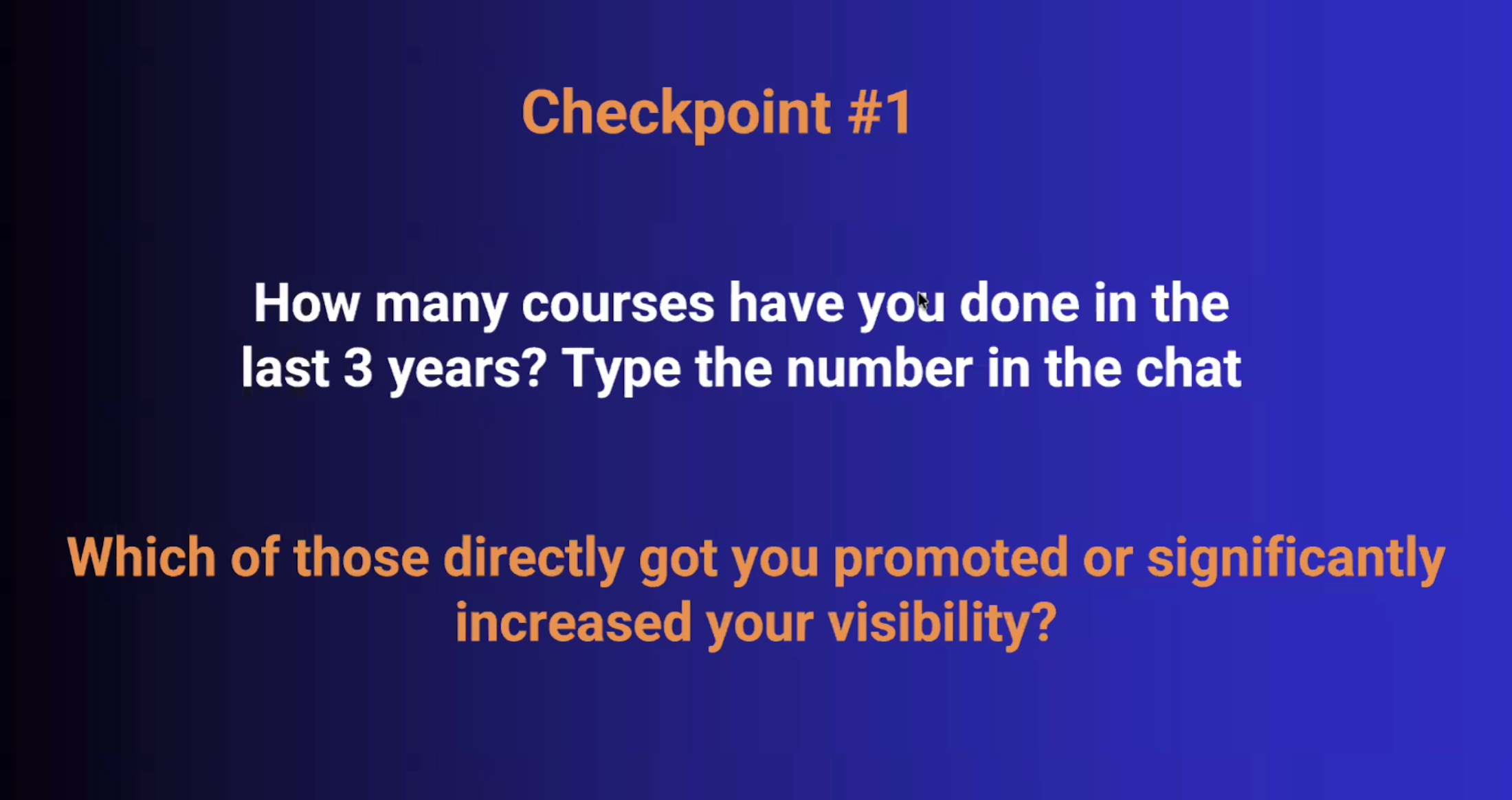
1. Certifications Are Not the Answer
Chasing more certifications, courses, or credentials is usually FOMO, not a growth strategy.
The right move isn't "learn more," it's a gap analysis against the specific next role — what does that role actually require that you don't have today?
No random skill development. Focused leadership skill development only can help g up the ladder.
2. Self-Rating: Functional vs Leadership Skill
Technical skills !== Leadership Skill
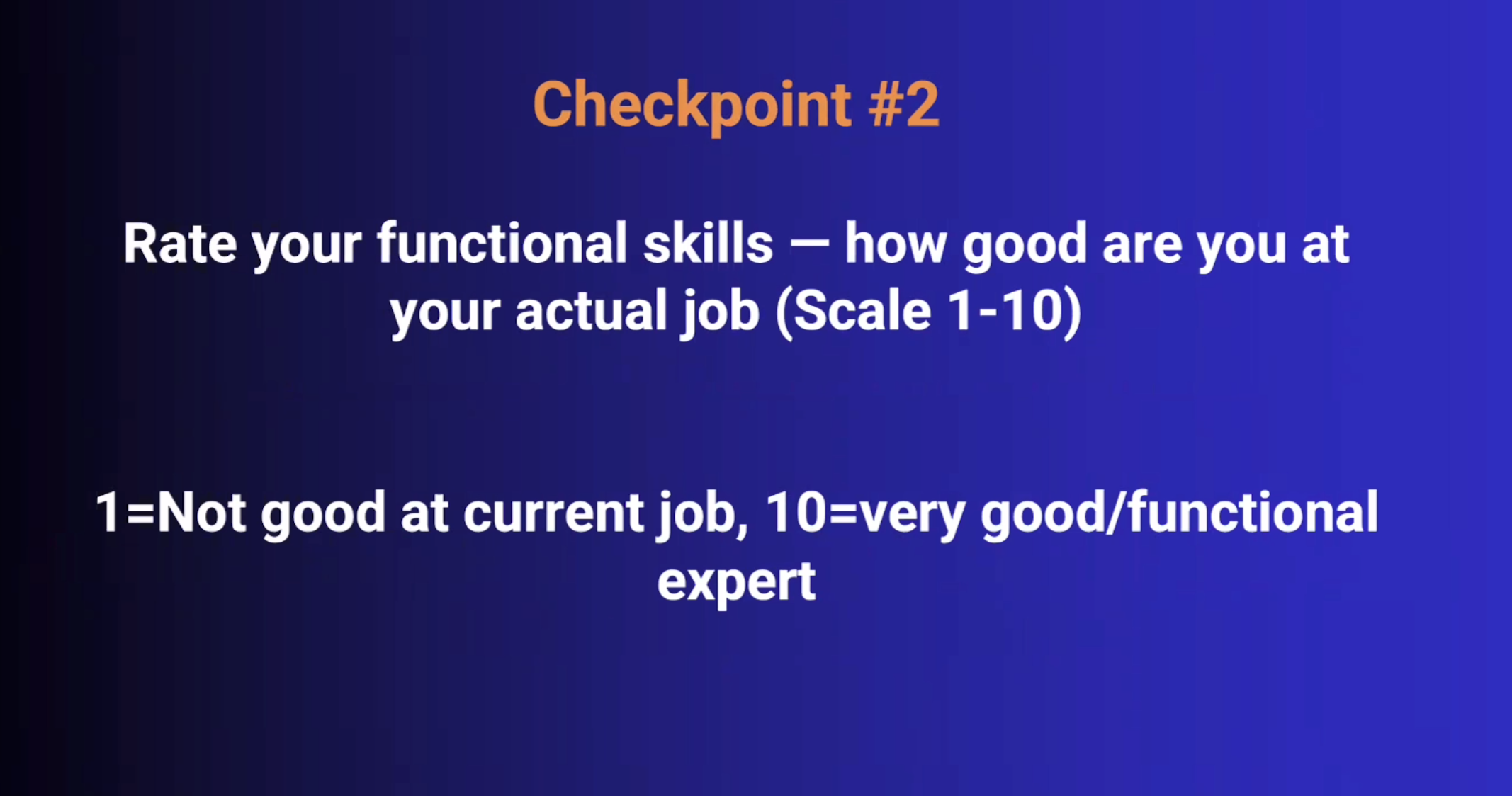
How good am I at my actual job (scale 1→10)?
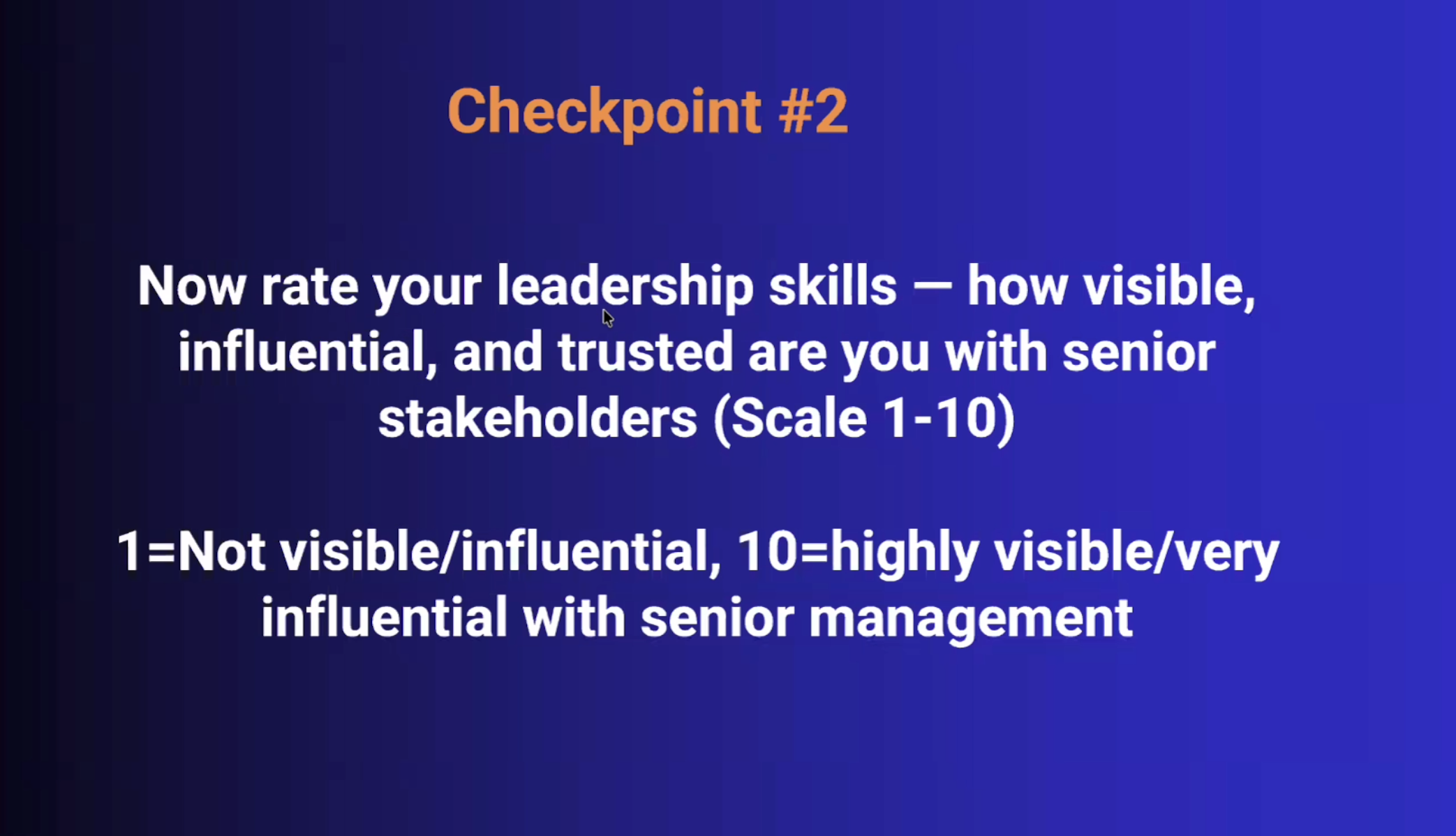
How good is my leadership skill — how visible, influential, and trusted am I?
- Do you know the laws of the land
- Do you have emotional intelligence?
- Do you have ability to speak up with investors, shareholders?
- Can you speak up at executive board?
These two scores are usually very different, and the gap is the whole problem: Phase One rewards the first score, Phase Two rewards the second.
3. "Invisibility" — The On-Camera Drill
A simulation exercise built around being on camera and forced to speak — surfacing how uncomfortable (and unpracticed) most people are at being seen and heard, which is exactly the skill that visibility later depends on.
Everyone in the office is watching you and making a perception about you.
Advocacy and Visibility
Advocacy: who speaks for you when you're not in the room?
If the answer is "no one," you have an advocacy gap regardless of how good your work is.
Visibility isn't given, it's created.
Doing great work and staying quiet about it doesn't count the right people have to actually know.
Ego and office politics were reframed, not as things to avoid, but as skills to build deliberately — navigating them badly is itself a career-limiting move.
Upward Networking — Pull, Not Push
- Build relationships above your current level before you need them, not when a role opens up.
- Promotions are pulled by people who already know, trust, and vouch for you — they are not pushed by asking your manager for one.
- Blind spots: even top performers need an outside coach, the way even the best batter needs a cricket coach watching from behind the nets — you cannot see your own blind spots from inside your own game.
The Cost of Staying Stuck
An exercise to quantify what "staying the same" actually costs:
- Financial: lost raises, bonuses, and multiplier-level jumps compounded over the years you stay stuck.
- Non-financial: energy, morale, confidence, and the ripple effect on family and personal life.
The exercise exists to make inaction feel expensive enough to actually act on.
Phases of a Career
The person who got ahead of you wasn't smarter or more hardworking. They learned the rules of the next phase earlier — often because someone coached them.
You're Playing the Wrong Game
Can you win a game whose rules you don't understand? You can't even play it.
- It's T20 vs Test cricket — same sport, completely different rules. You cannot play a T20 innings with Test-match strategy.
- Or: give someone a year to master 10th-standard books, and they'll pass the 10th-standard exam. Give them five more years of the same 10th-standard books, and they still won't pass the 12th-standard exam. The curriculum changed — no amount of effort on the old syllabus closes that gap.
- All the hard work that built a strong Phase One career is real — but it's evidence of Phase One skill only. Evaluators aren't crediting it as Phase Two readiness.
The Multiplier Effect
- In Phase One, salary grows incrementally — roughly 10-30% per step.
- In Phase Two, each level is a multiplier, not a percentage bump — 5x, 7x, 10x.
- Example given: the jump from SVP to MD at Goldman Sachs was roughly a 5x salary increase — not 5%, not 50%, 500%.
- The real economic upside of a career sits entirely in the Phase Two part of the pyramid.
Why Being "Great" at Your Job Can Work Against You
- If you're the go-to problem-solver at your current level, your manager has no incentive to move you — moving you creates a gap they now have to fill.
- Being excellent at your current role, with nothing to show for the next one, creates a specific perception: great at this level, unproven at the next — which is a harder trap to escape than being merely average.
Direction vs Speed
What matters more — direction or speed? Most people are running at full speed in the wrong direction.
- Feels like running on a treadmill: fully exhausted, sweating, and standing in exactly the same place.
- The point of resetting direction first is that effort only compounds once it's pointed at the right target.
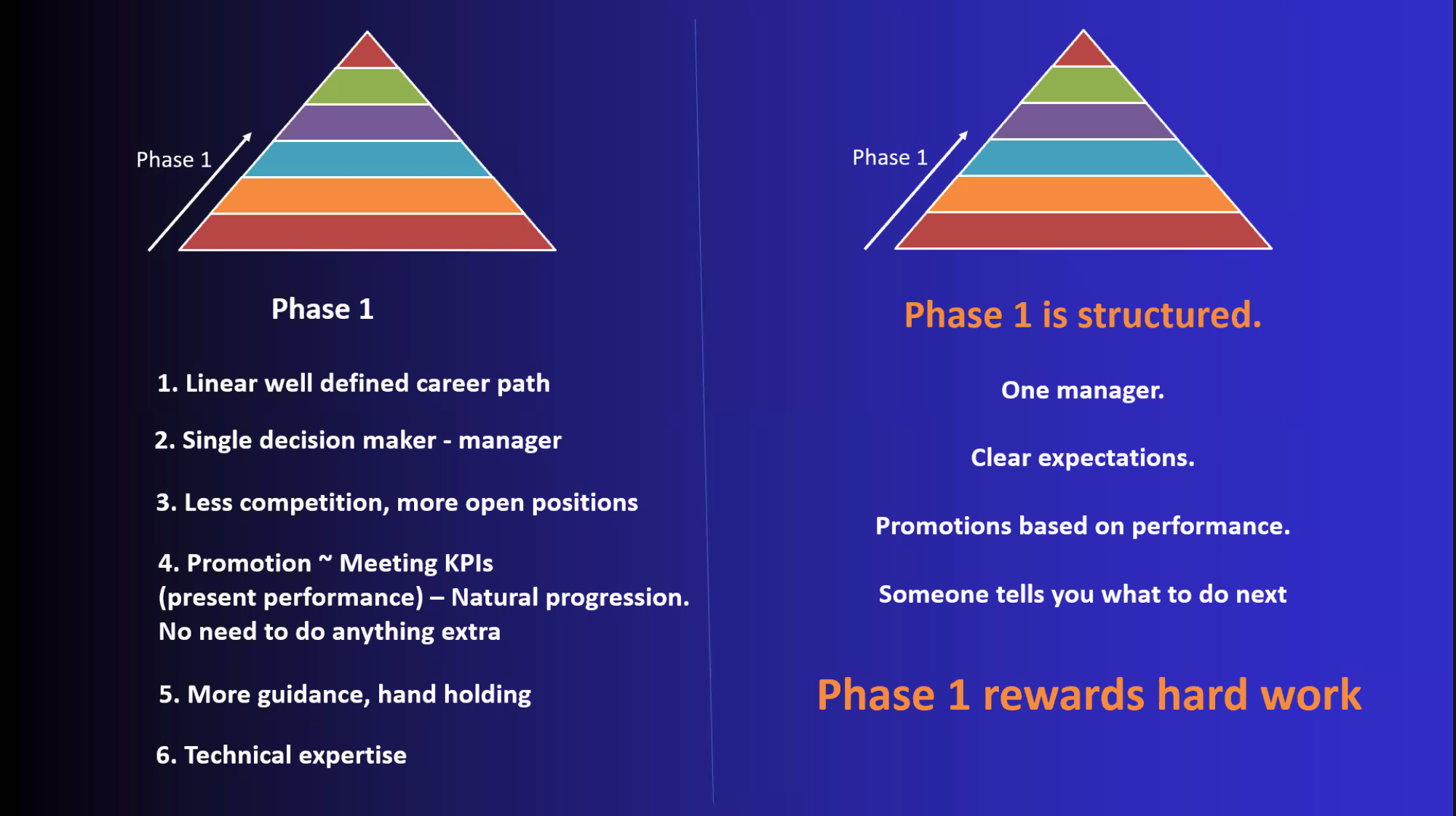
1. Phase I 👨🏻💻
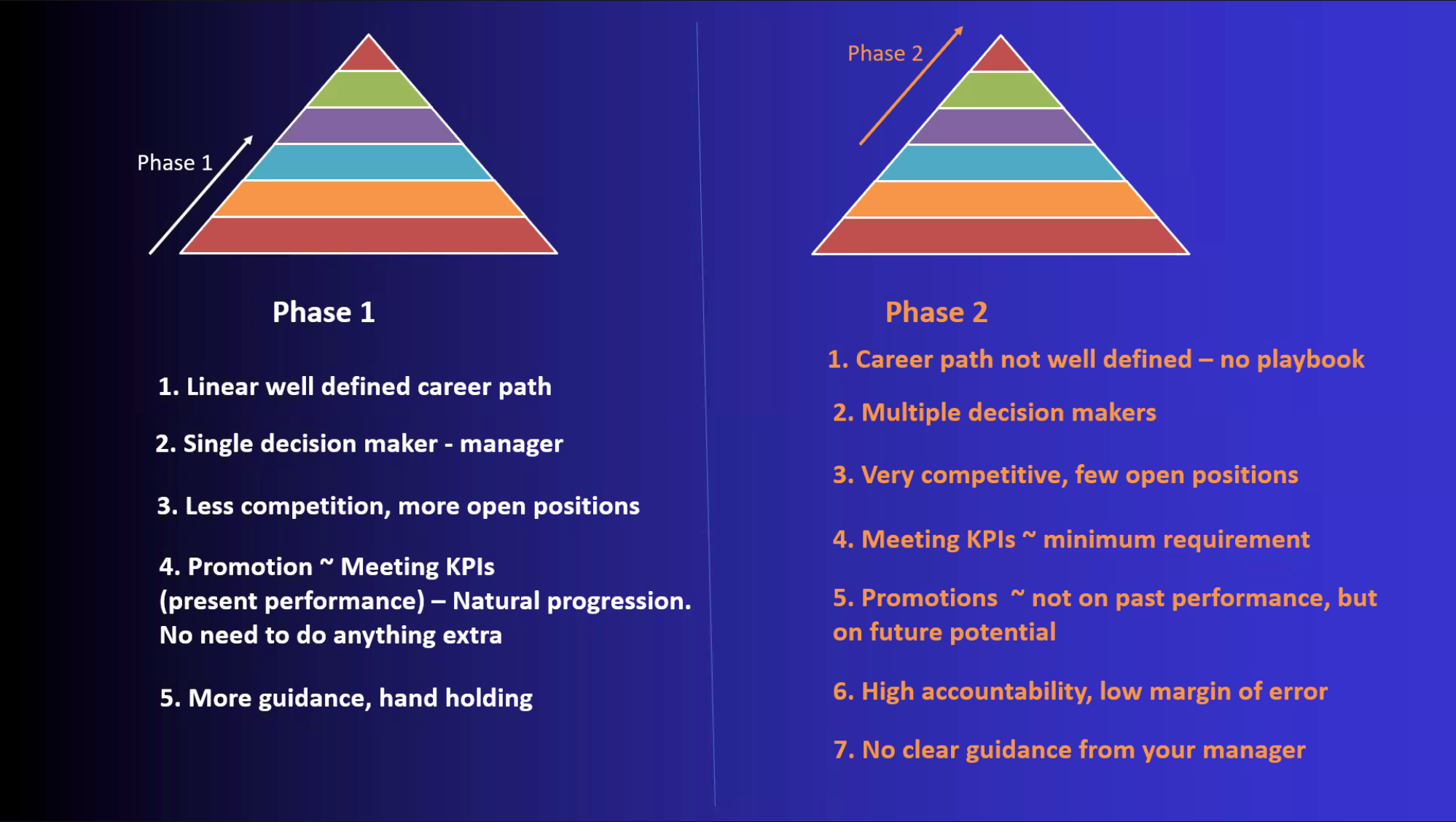
Phase One is from the start of your career to wherever you are today.
Career path is clearly defined and linear
analyst → associate → team lead → manager, roughly every 2-3 years.
Your manager is the only decision-maker for your promotion.
More open roles, less competition — even average performers grow up to a point.
Meeting your KPIs is enough. Nothing else required.
Lots of hand-holding: regular feedback, mentors, manuals, room to make mistakes and course-correct.
Rewards hard work and building deep technical/functional expertise.
2. Phase II 👨🏻💼
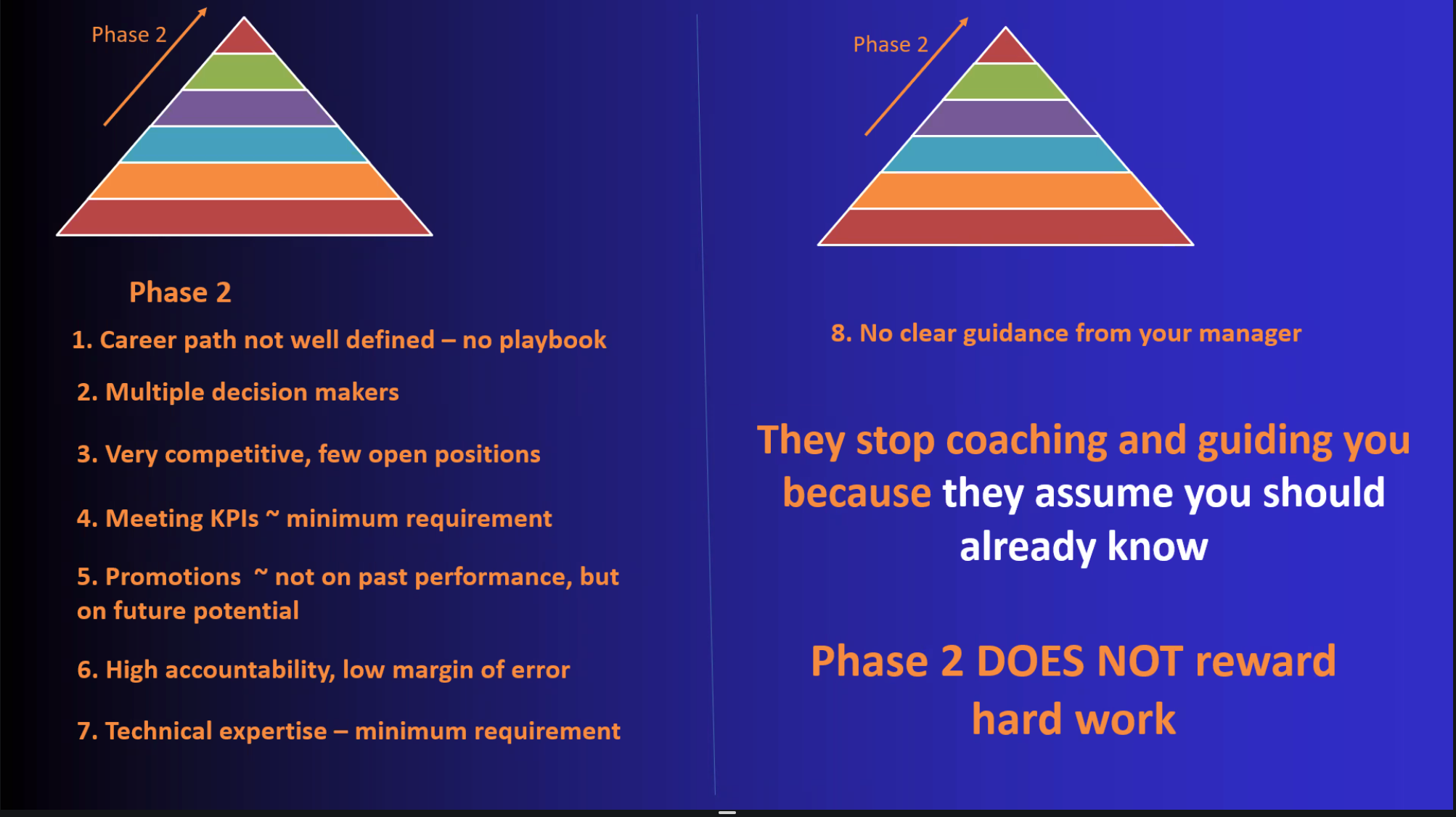
Phase Two is what it takes to break the mid-management ceiling into senior leadership.
Phase One rules don't apply in Phase Two.
Career path is not defined — no company has a checklist for "how to become a VP."
Multiple stakeholders decide, not one manager.
More competition, for fewer positions, against stronger performers.
Meeting your KPIs is just the minimum standard — it earns you nothing extra.
Promotion is based on one factor only: perceived future potential, not current or past performance.
Very low margin for error — every decision about you gets scrutinized because the stakes are higher.
Technical expertise stops mattering — you're already assumed to be an expert; it's the price of entry, not a differentiator.
Your manager stops giving clear feedback : "you've been in the industry 20 years, you should know" becomes the default response.
The 7 Rules of Phase Two
Mid-management is a transition from being rewarded for what you can do to being evaluated on what others believe you can lead.
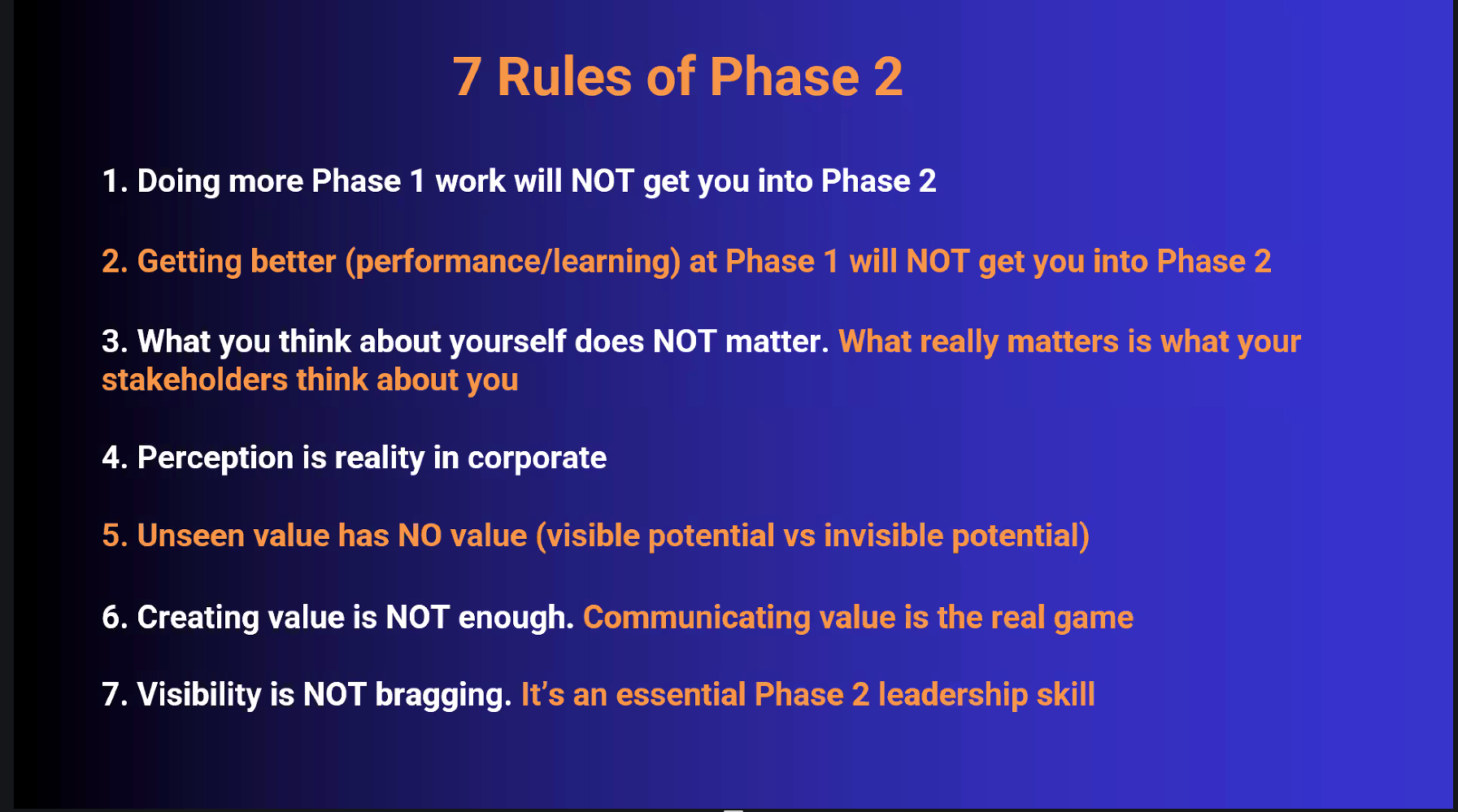
1. Doing more Phase One work will NOT get you into Phase Two.
By definition, the path forward requires doing something different, not more of the same.
2. Getting better at Phase One (performance/learning) will NOT get you into Phase Two.
Depth in your current function doesn't transfer — you need to build skills for Phase Two specifically.
3. Your self-perception doesn't determine your progression.
What you think about yourself does NOT matter.
What really matters is what your stakeholders think about you.
4. Stakeholder perception matters.
Perception is reality in corporate.
5. Invisible value effectively has no organizational value.
visible potential beats invisible potential, every time.
6. Creating value isn't enough. You need to communicate it
Communicating value is the real game.
7. Visibility is a leadership skill, not bragging
It's an essential Phase Two leadership skill.
Unseen value has no value — you can be the best-kept secret in the company and it changes nothing.
Phase I Vs Phase II
| Phase I | Phase II |
|---|---|
| Clear career ladder | Career path is ambiguous |
| Manager decides | Multiple stakeholders decide |
| KPIs are enough | KPIs are the minimum |
| Technical expertise differentiates | Expertise is assumed |
| Hard work is rewarded | Impact must be visible |
| Learn more / perform better | Build next-level capabilities |
| Manager gives feedback | You must manage your own development |
| Performance/past results | Perceived future potential |
Personal Reflection
What is the next role I want to get?
What skills do I have today?
- How good am I at my actual job (scale 1→10)?
- How visible, influential, and trusted am I as a leader?
What skills are needed for that desired level?
- No random skill development — focused skill development against the actual gap.
Phase II Assessment
| # | Dimension | What we're actually testing |
|---|---|---|
| 🧠 1 | Functional excellence | How strong are you at your current role? |
| 🎯 2 | Strategic thinking | Can you shape what should be done, not just how? |
| 🗣️ 3 | Executive communication | Can you communicate complex issues clearly to senior stakeholders? |
| 🤝 4 | Influence & stakeholder management | Can you move people who don't report to you? |
| 👀 5 | Visibility | Do the right people know the value you're creating? |
| 📣 6 | Advocacy | Who speaks for you when you're not in the room? |
| 🚀 7 | Perceived future potential | Do senior stakeholders already see you operating at the next level? |
| PHASE 1: Execution Skills | PHASE 2: Leadership Skills | What Skill to Develop |
|---|---|---|
| Doing your assigned work well | Influencing how decisions are made | Politics, Power & Influence: Understanding corporate politics and how to navigate it |
| Creating PPTs and reports | Storytelling to shape leadership thinking | Executive Storytelling: Structuring narratives that influence leadership decisions |
| Completing tasks on time | Driving outcomes through people | Situational Leadership: Adapting your leadership style to different situations and stakeholders |
| Managing your team | Managing upward and sideways | Stakeholder Management: Building alignment with managers, peers and senior stakeholders |
| Sharing updates | Creating executive presence | Executive Communication: Speaking with clarity, structure and confidence |
| Learning technical tools | Learning perception, influence and strategy | Perception Management: Understanding how stakeholders perceive you and deliberately shaping that perception |
| Working hard | Being seen as leadership-ready | Promotion Campaign: Creating a formal promotion plan for 2026 |
| Solving problems | Anticipating problems | Big-Picture Thinking: Moving from solving problems to anticipating systemic and future problems |
| Being reliable | Being influential | Politics, Power & Influence: Building credibility, influence and organizational leverage |
| Delivering today's work | Preparing for tomorrow's role | Strategic Thinking: Developing future-oriented decision-making and strategy |
Phase 1 vs Phase 2 Thinking
| PHASE 1 Execution Skills – What Most Professionals Are Good At | PHASE 2 Leadership Skills – What Actually Drives Promotions | Skill to Develop |
|---|---|---|
| Doing your assigned work well | Influencing how decisions are made | Politics, Power & Influence: Understanding corporate politics and how to navigate it |
| Creating PPTs and reports | Storytelling to shape leadership thinking | Art of Storytelling: Building narratives that influence leadership |
| Completing tasks on time | Driving outcomes through people | Situational Leadership: Adapting to different situations and stakeholders |
| Managing your team | Managing upward and sideways | Politics, Power & Influence: Influencing without formal authority |
| Sharing updates | Creating executive presence | Executive Communication: Speaking with clarity, structure and confidence |
| Learning technical tools | Learning perception, influence and strategy | Perception Management: Understanding how stakeholders perceive you |
| Working hard | Being seen as leadership-ready | Promotion Campaign: Creating a formal promotion plan for 2026 |
| Solving problems | Anticipating problems | Big-Picture Thinking: Developing the ability to anticipate and connect problems |
| Being reliable | Being influential | Politics, Power & Influence: Building credibility and organizational influence |
| Delivering today's work | Preparing for tomorrow's role | Strategic Decision-Making & Future Strategy |
Q&A Takeaways
Functional/industry skills are survival skills, not growth skills.
Everyone in the room is upgrading the same skills at the same time — it keeps you relevant, it doesn't differentiate you.
There's no such thing as a "false" perception.
Every perception is valid from the point of view of the person holding it — you can disagree with it, but you can't call it wrong. The only lever is understanding it and working to shift it over time (a deeper Day 3 topic).
"Your manager is not paid to look after your career."
Nobody owns your career strategy but you — waiting to be noticed, mentored, or rescued isn't a plan.
Dropping your ego isn't submission.
Disagreement isn't a yes/no question — it's usually an expectation misalignment to be diagnosed, not a demand to be obeyed.
Communication coaching, applied live:
no "quick question," no "I just wanted to ask" — say it in one sentence. How you speak in the room is itself part of how you're evaluated.
Related Posts
- Leadership Principals — foundational leadership and motivation frameworks this bootcamp builds on