Executive Bootcamp — Executive Presence and the Politics of Visibility
Day 3 notes: the three-skill executive presence framework, what visibility actually is (and isn't), real HR case studies on why functional excellence alone stalls out, and how perception and office politics really work.
Executive Presence and the Politics of Visibility
If the right decision-makers don't know you, and don't think highly about you, will they ever promote you? Never — no matter how much good work you do.
Day 3 notes, building on Executive Bootcamp — Breaking the Mid-Management Ceiling, where Phase One vs Phase Two and the 7 Rules of Phase Two were covered.
What Visibility Actually Is (and Isn't)
Visibility is not:
- Relying on one-to-one meetings only, and waiting for your turn to speak in them.
- Bragging or boasting.
- Giving monthly, quarterly, or yearly updates and hoping people remember you.
Visibility is built at the intersection of how you think, how you communicate, and how you influence — consistently, at every opportunity, not just when a meeting happens to be scheduled.
Insight, Not Updates
A live coaching moment from the session: stop giving updates, start giving insight.
- An update is "here's what I did."
- An insight is one sentence of what you actually think — a read on the situation, a recommendation, a connection nobody else made.
- The instruction given live: "I want everybody to now stop giving updates, start giving insight — one sentence."
Visibility is not built in one day. It's not like you can say "this week I won't do it, I'll take a break." Every opportunity is a strategic opportunity to position yourself.
The Executive Presence Framework
A proprietary three-skill framework: demonstrate all three and you demonstrate executive presence, which in turn brings visibility.
One without the others doesn't work. Focusing on the message without the stakeholder, or the stakeholder without the substance, puts you at a disadvantage either way.
1. Communication
How you say it
Dynamic across audiences — a different style with your team, your peers, and your senior stakeholders, even when the subject is the same |
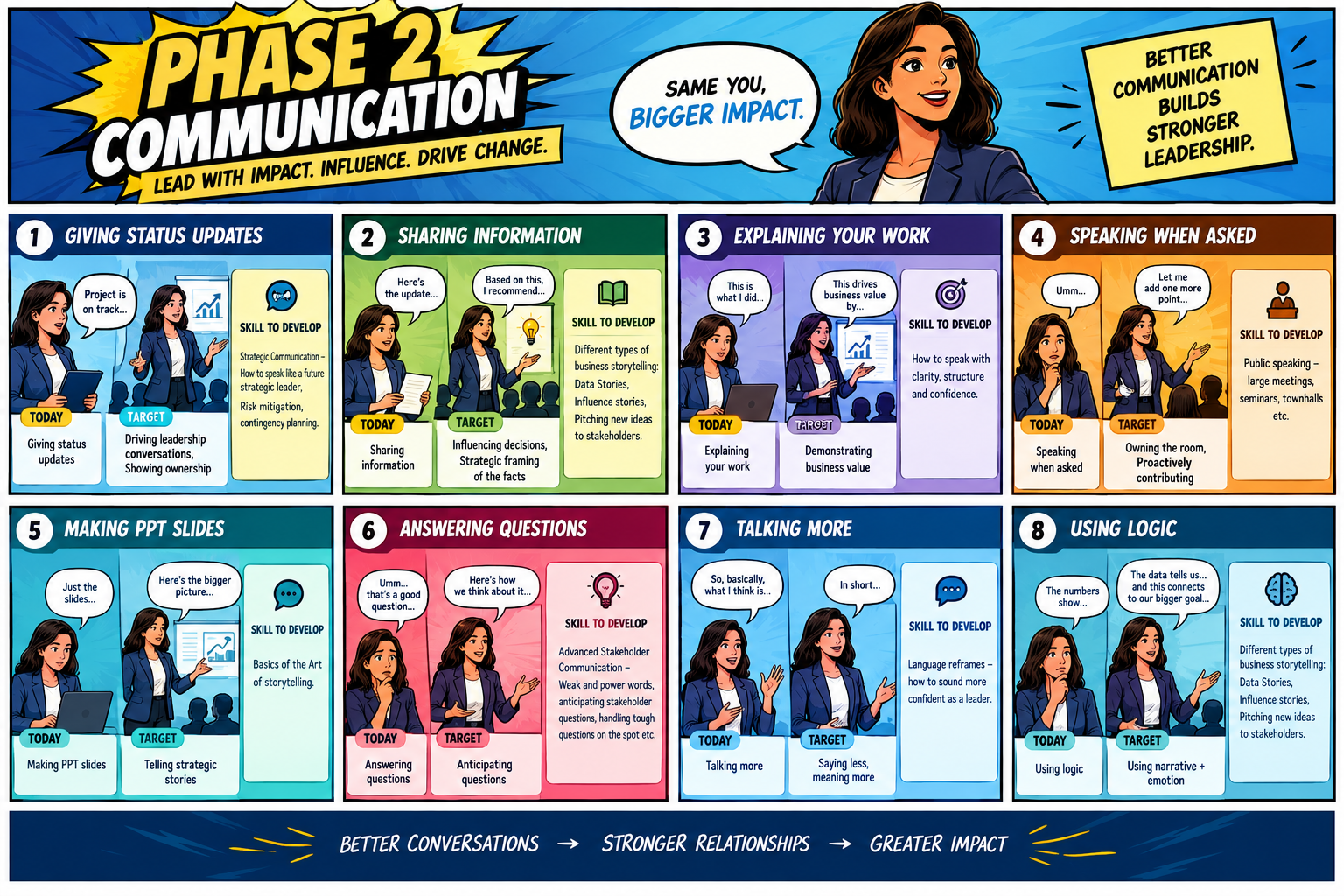
| # | Phase One behavior (today) | Phase Two behavior (target) | Skill to Develop |
|---|---|---|---|
| 1 | Giving status updates | Driving leadership conversations, Showing ownership | Strategic Communication – How to speak like a future strategic leader, Risk mitigation, contingency planning |
| 2 | Sharing information | Influencing decisions, Strategic framing of the facts | Different types of business storytelling: Data Stories, Influence stories, Pitching new ideas to stakeholders |
| 3 | Explaining your work | Demonstrating business value | How to speak with clarity, structure and confidence |
| 4 | Speaking when asked | Owning the room, Proactively contributing | Public speaking – large meetings, seminars, townhalls etc |
| 5 | Making PPT slides | Telling strategic stories | Basics of the Art of storytelling |
| 6 | Answering questions | Anticipating questions | Advanced Stakeholder Communication – Weak and power words, anticipating stakeholder questions, handling tough questions on the spot etc |
| 7 | Talking more | Saying less, meaning more | Language reframes – how to sound more confident as a leader |
| 8 | Using logic | Using narrative + emotion | Different types of business storytelling: Data Stories, Influence stories, Pitching new ideas to stakeholders |
2. Stakeholder Management
Who you speak to
Identify the right people in your hierarchy — most influential by experience, title, or designation — and build real relationships with them
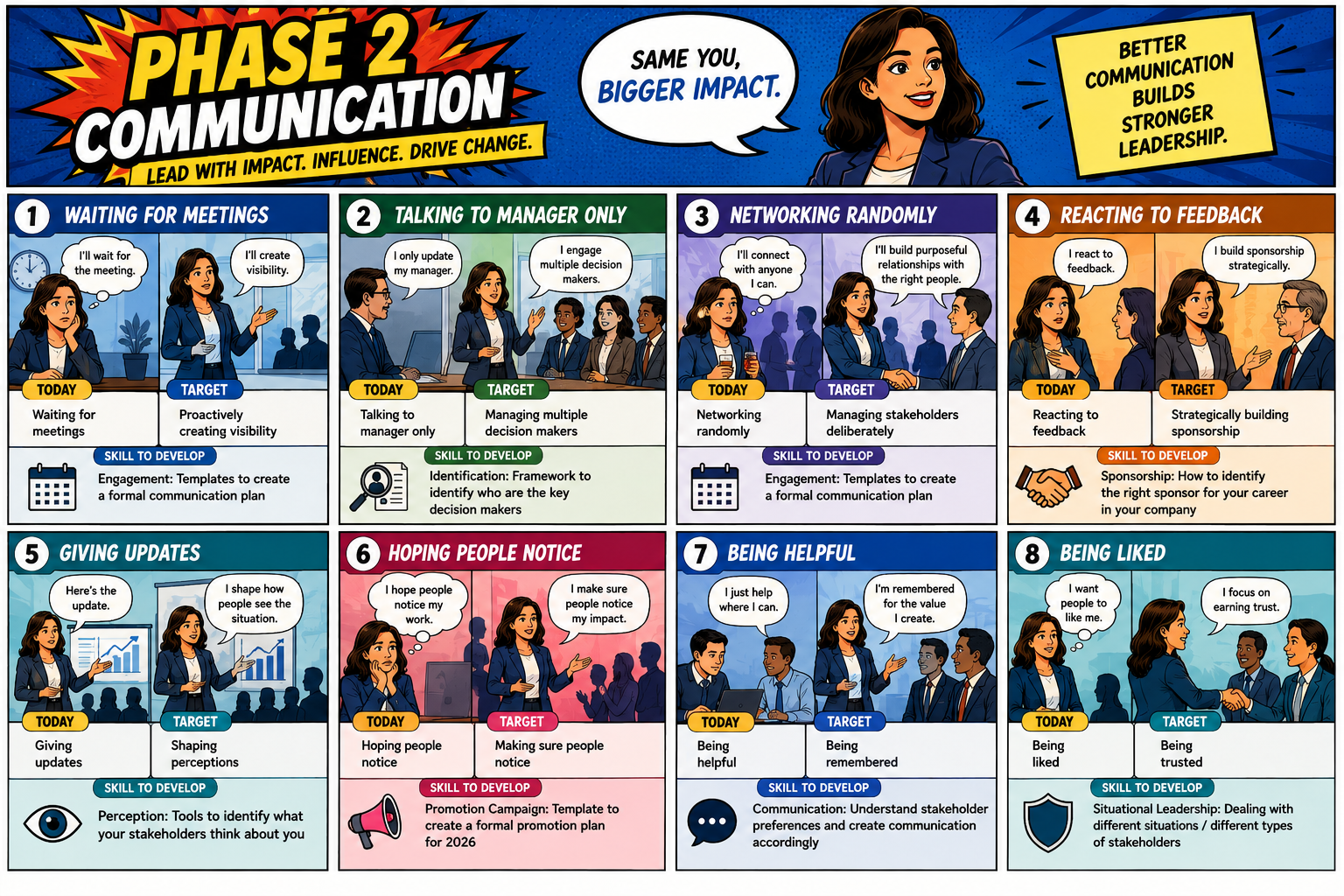
| # | Phase One behavior (today) | Phase Two behavior (target) | Skill to Develop |
|---|---|---|---|
| 1 | Waiting for meetings | Proactively creating visibility | Engagement: Templates to create a formal communication plan |
| 2 | Talking to manager only | Managing multiple decision makers | Identification: Framework to identify who are the key decision makers |
| 3 | Networking randomly | Managing stakeholders deliberately | Engagement: Templates to create a formal communication plan |
| 4 | Reacting to feedback | Strategically building sponsorship | Sponsorship: How to identify the right sponsor for your career in your company |
| 5 | Giving updates | Shaping perceptions | Perception: Tools to identify what your stakeholders think about you |
| 6 | Hoping people notice | Making sure people notice | Promotion Campaign: Template to create a formal promotion plan for 2026 |
| 7 | Being helpful | Being remembered | Communication: Understand stakeholder preferences and create communication accordingly |
| 8 | Being liked | Being trusted | Situational Leadership: Dealing with different situations / different types of stakeholders |
3. Strategic Thinking
What you see
Ideas, market trends, thought leadership, the big picture and future purpose — not just your own function
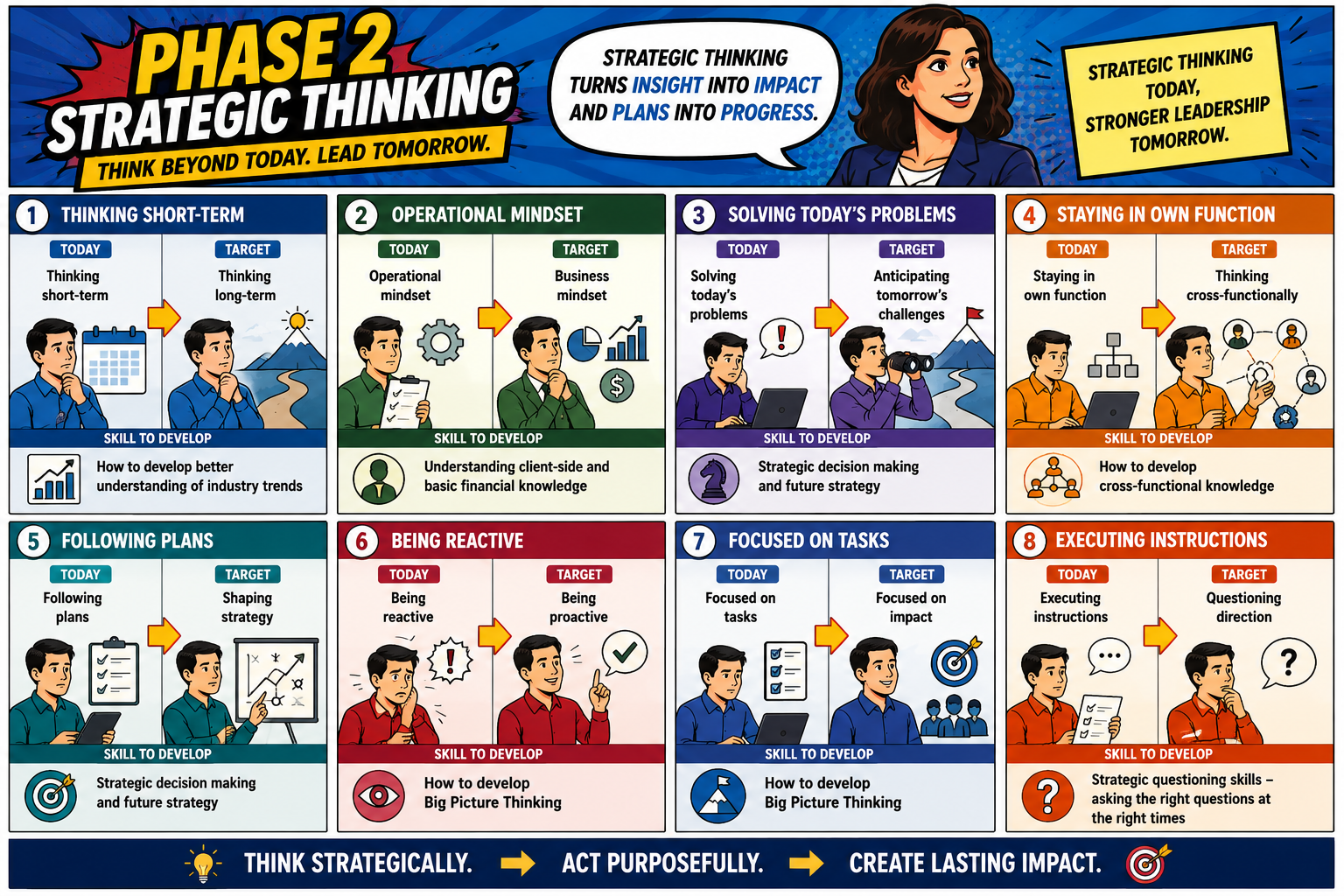
| # | Phase One behavior (today) | Phase Two behavior (target) | Skill to Develop |
|---|---|---|---|
| 1 | Thinking short-term | Thinking long-term | How to develop better understanding of industry trends |
| 2 | Operational mindset | Business mindset | Understanding client-side and basic financial knowledge |
| 3 | Solving today’s problems | Anticipating tomorrow’s challenges | Strategic decision making and future strategy |
| 4 | Staying in own function | Thinking cross-functionally | How to develop cross-functional knowledge |
| 5 | Following plans | Shaping strategy | Strategic decision making and future strategy |
| 6 | Being reactive | Being proactive | How to develop Big Picture Thinking |
| 7 | Focused on tasks | Focused on impact | How to develop Big Picture Thinking |
| 8 | Executing instructions | Questioning direction | Strategic questioning skills – asking the right questions at the right times |
Don't fall into the trap of going back to what you're comfortable doing — reporting execution and data points is still Phase One. Phase Two means shaping perception and influencing people to accept your recommendations.
The Business-Impact Reframe
A live example from the session: a participant's update was "we discussed the global VAT and saved 50%, about £150,000." The coaching:
- Don't stop there — that's still Phase One reporting.
- Tie it to the bigger picture: how does this connect to your department's goal, your unit's goal, your boss's KPI, or their boss's KPI?
- Connect the dots all the way up, so it makes sense to everyone in the room, not just at your level.
When you do this — when your update is framed at two levels higher than your own — the stakeholder stops treating you as someone who reports to them, and starts consulting you instead. That shift, from reporting to being consulted, doesn't happen overnight, but it's the actual target.
The same reframe applies to reports and updates generally: move from reading the data on the slide ("this is the number, we did well, we didn't do well") to storytelling — what's behind the data, what it implies, what you'd recommend. Everything you say should shape a narrative or help a decision-maker arrive at a decision, not just relay a status.
Also: start a second list, alongside the people you manage — a list of who you need to manage upward. Who in the hierarchy is your sponsor, your advocate, the person who will vouch for you at the next level?
Build Your Roadmap
A structured way to avoid getting overwhelmed by "I have 50 skills to develop":
- For each area (communication, stakeholder management, strategic thinking), mark what you need most right now.
- Color-code a plan: short-term (blue), mid-term (yellow), long-term (green).
- Focus on what you can start demonstrating immediately, even while you're still learning the rest.
Right now it may look like a crazy 50-skill plan. Don't get overwhelmed — take one step at a time, and how much you take every day and every week will matter more than trying to do it all at once.
Leader X vs Leader 10X
A comparison used to make the stakes concrete:
| Leader X | Leader 10X | |
|---|---|---|
| Functional skills | Strong | Strong (same) |
| Work experience | Great | Great (same) |
| Articulates with confidence | No | Yes |
| Visible with the right stakeholders | No | Yes, has a seat at the table |
| Consulted for ideas, thoughts, purpose | No | Yes |
Same functional base, same experience — but Leader 10X is the one who gets promoted, because visibility and executive presence are the actual differentiators once functional skill is a given.
A reflective question, not to answer out loud: how long do you want to be seen as a Phase One manager, and how long do you want to remain here? The day you decide to move is the day the shift in identity starts — but only once you start demonstrating it.
The Insider View — What HR Actually Asks For
Real, anonymized examples of what organizations privately tell an executive coach about their own leaders:
- A senior director in digital transformation — thought he was in line for promotion. HR's actual note: cannot communicate upward with impact, not persuasive, not able to influence decisions, not collaborative, doesn't convey urgency, doesn't get the team aligned around the bigger picture.
- A CISO at a financial services firm — had board backing, consistent feedback that she was "technically exceptional." But also: comes across as uncollaborative, rigid, blunt, unwilling to move, needs to be more accessible to her own teams.
- A major IT company — asked for all of their directors and VPs, some with 20+ years of experience, to be coached, because despite deep functional strength they still couldn't demonstrate executive presence, storytelling, or presentation skills.
- A CEO — mandated that his own successor slate go through executive presence training before being considered, covering relationship-building, negotiation, business storytelling, emotional intelligence, and strategic workforce planning.
- A company whose CEO left with no clear successor — brought in a strategy workshop specifically to help the board identify who on the next-in-line bench actually had the leadership presence to take over.
None of these people were bad at their jobs. They were very good. What was missing wasn't functional skill — it was Phase Two skill. And notably: nobody asked for AI, Power BI, coding, or automation training. At this level, the ask is always about communication, collaboration, influence, and vision.
"Should We Invest in You, or Your Competitor?"
- Organizations aren't debating whether executive presence matters — they already know it does. The real question they're asking is where to place the investment: in you, or in someone else.
- If your organization isn't developing you, it's developing somebody else for the same next-level slot — and that person has now become your direct competitor, whether you think of them that way or not.
- A good relationship with a stakeholder only has career value if it translates into advocacy. If they never advocate for you, the relationship is one-sided — they're getting their work done through you, but they don't see you as ready for more.
Perception Is a Role You've Been Assigned
- Perception isn't just a first impression — over time, people mentally assign you a role: "hardworking," " reliable," "a good manager," "the firefighter." Every future decision about you gets filtered through that role.
- If the role people have assigned you is "solid manager, never seen operating at the next level," that's the lens every promotion conversation about you runs through — regardless of what you've actually been capable of.
- Shifting an assigned perception isn't a single conversation. It takes consistently different behavior, observed over time, before the role in people's heads updates.
Reframing Office Politics
- Politics is simply the art of dealing with people who are different from you — different opinions, personalities, ambitions, agendas. It is not inherently good or bad; it's the reality of any group of humans, corporate or not (the same dynamics show up in a housing society WhatsApp group).
- Perceptions aren't formed by random gossip. If someone trusts another person's account of you over your own, that's a trust deficit you haven't closed — not an unfair system working against you.
- "The system will not change. You have to learn how to navigate it." — the reframe for the "my manager/management/company is bad" narrative. The same company and management that's supposedly "bad" is the one that hired and promoted others just fine.
- A live tell of communication style: leaders ask "what" and "why." Managers ask "how." Asking "just tell me how to do this" is itself a Phase One signal.
The Course Trap, Revisited
A sharper version of the Day 1 warning: post-COVID, free online courses became a trap. Doing course after course, collecting certificate after certificate, with a resume full of 15-30 courses and zero growth to show for it, isn't a promotion strategy — it's a way of staying busy while feeling like progress is happening.
Stop doing any course that isn't specifically a Phase Two skill. Executive communication, storytelling — those are relevant. Another course adjacent to your current function is not.
Related Posts
- Executive Bootcamp — Breaking the Mid-Management Ceiling — Day 1 and Day 2: why growth stalls, and the Phase One vs Phase Two framework this post builds on
- Executive Bootcamp — Stakeholder Management and Perception Repair — Day 4: the stakeholder self-assessment, the 11-skill plan, and a live perception-repair case study
- Leadership Principals — foundational leadership and motivation frameworks