Stanford AI Scientist Roadmap 2026
A complete self-study roadmap built entirely from Stanford University's publicly available AI courses. Learn mathematics, machine learning, deep learning, reinforcement learning, large language models, AI systems, RAG, agentic AI, and production deployment through a structured path from foundations to real-world AI engineering.
🎓 Stanford AI/ML Scientist Roadmap 2026
📐 Mathematics → 🤖 Machine Learning → 🧠 Deep Learning → 💬 LLMs → 🏭 Production AI Systems
A free, self-study path built entirely from Stanford's publicly available courses. Every course lists its ID, what it covers, where to find the slides, and a direct link to the official lecture videos where one exists.
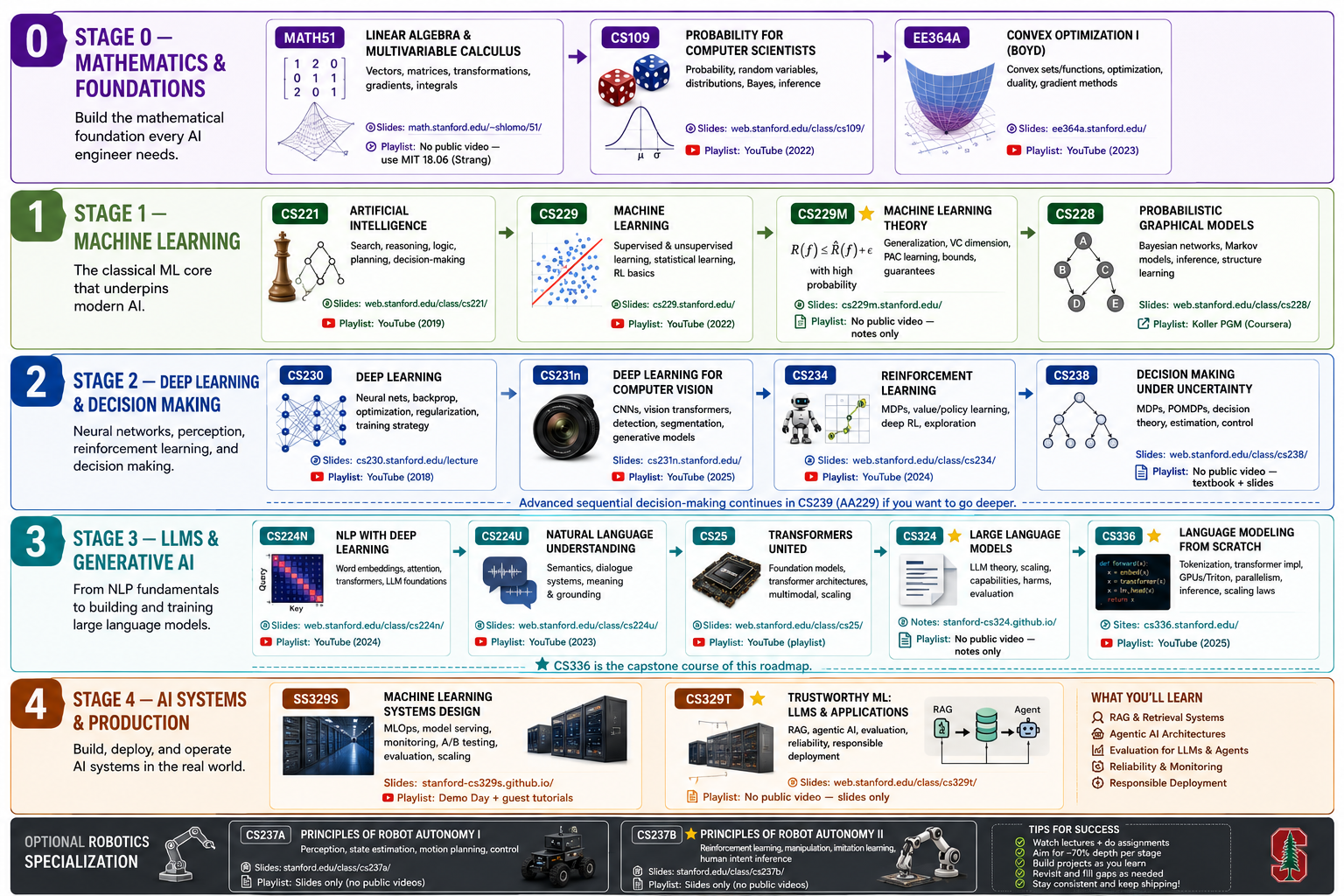
📌 How to use this: Watch lectures + do the public assignments. ~70% depth per stage is enough to advance. Whole path ≈ 9–14 months part-time. Follow the main sequence; use the branches by interest.
Stage 0 — Mathematics & Foundations 📐
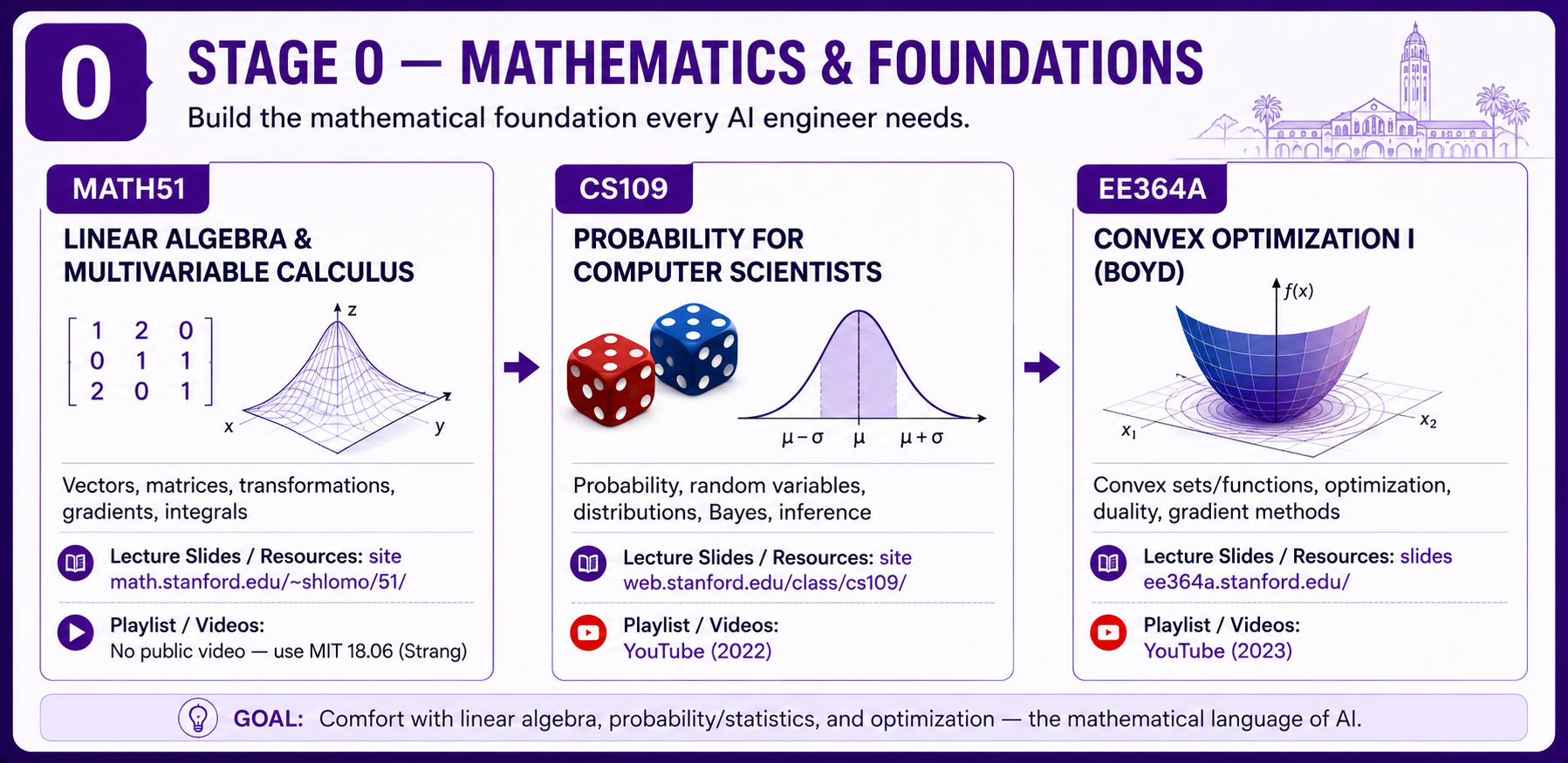
Build the mathematical foundation every AI engineer needs.
| ID | Course | Covers | Lecture Slides | Playlist |
|---|---|---|---|---|
| MATH51 | LINEAR ALGEBRA & MULTIVARIABLE CALCULUS | Vectors, matrices, transformations, gradients, integrals | Site | No public video — use MIT 18.06 (Strang) |
| CS109 | PROBABILITY FOR COMPUTER SCIENTISTS | Probability, random variables, distributions, Bayes, inference | Site | ▶️ YouTube (2022) |
| EE364A | CONVEX OPTIMIZATION I (BOYD) | Convex sets/functions, optimization, duality, gradient methods | Slides | ▶️ YouTube (2023) |
Stage 1 — Machine Learning 🤖
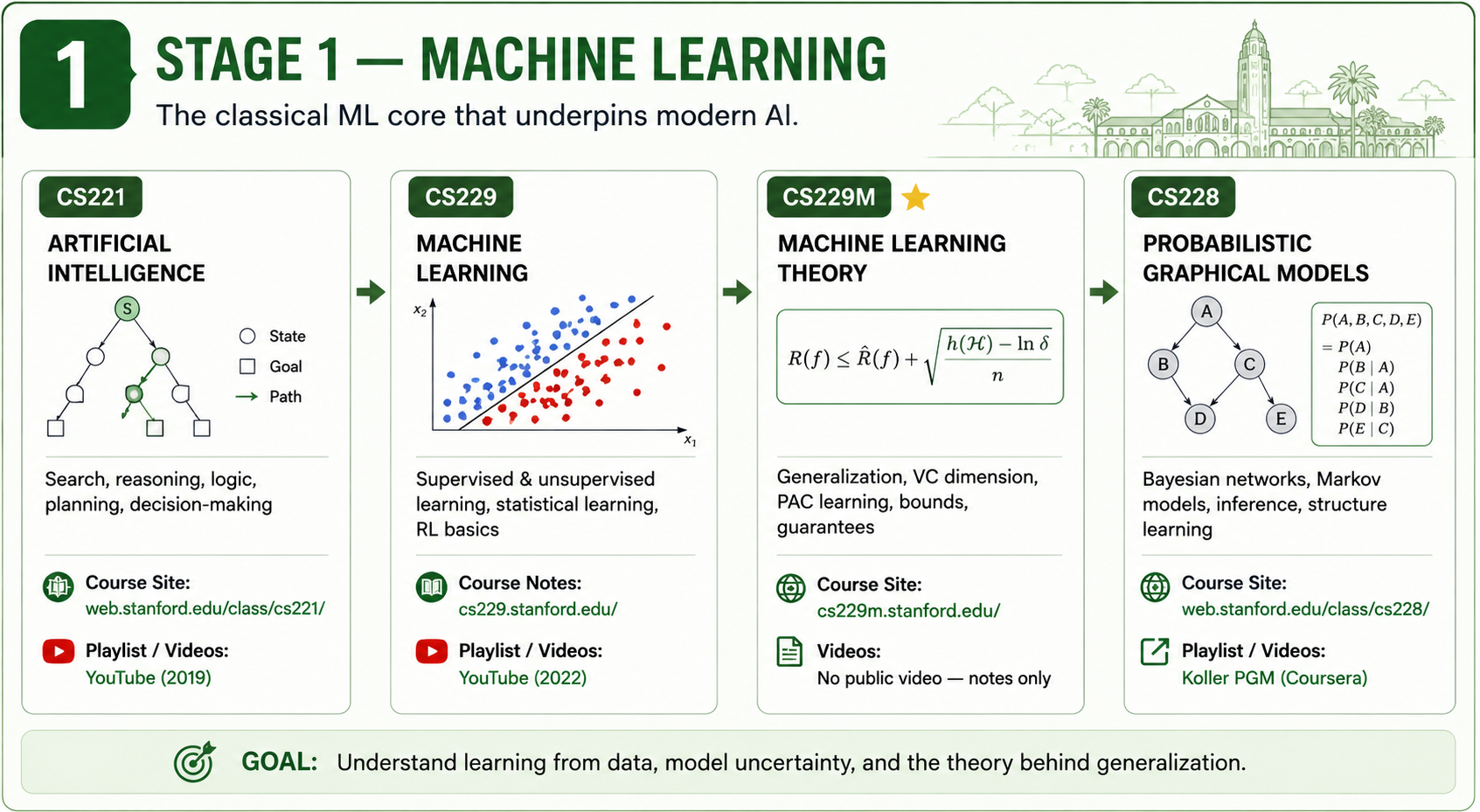
The classical ML core that underpins modern AI.
| ID | Course | Covers | Lecture Slides | Playlist |
|---|---|---|---|---|
| CS221 | ARTIFICIAL INTELLIGENCE | Search, reasoning, logic, planning, decision-making | Site | ▶️ YouTube (2019) |
| CS229 | MACHINE LEARNING | Supervised & unsupervised learning, statistical learning, RL basics | Notes | ▶️ YouTube (2022) |
| CS229M | MACHINE LEARNING THEORY | Generalization, VC dimension, PAC learning, bounds, guarantees | Site | No public video — notes only |
| CS228 | PROBABILISTIC GRAPHICAL MODELS | Bayesian networks, Markov models, inference, structure learning | Site | No Stanford playlist — Koller PGM (Coursera) |
Stage 2 — Deep Learning & Decision Making 🧠
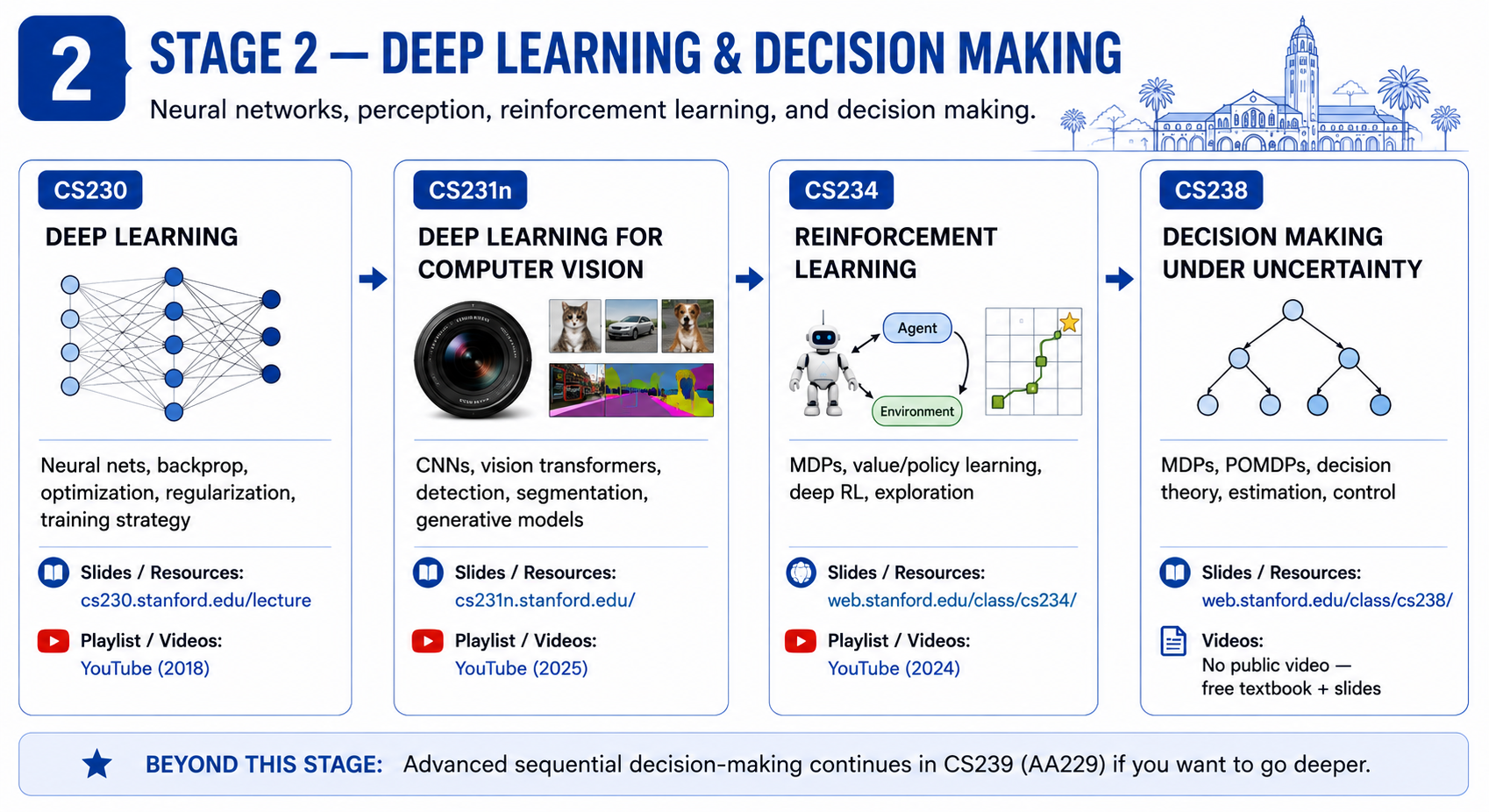
Neural networks, perception, reinforcement learning, and decision making.
| ID | Course | Covers | Lecture Slides | Playlist |
|---|---|---|---|---|
| CS230 | DEEP LEARNING | Neural nets, backprop, optimization, regularization, training strategy | Lectures | ▶️ YouTube (2018) |
| CS231n | DEEP LEARNING FOR COMPUTER VISION | CNNs, vision transformers, detection, segmentation, generative models | Site | ▶️ YouTube (2025) |
| CS234 | REINFORCEMENT LEARNING | MDPs, value/policy learning, deep RL, exploration | Site | ▶️ YouTube (2024) |
| CS238 | DECISION MAKING UNDER UNCERTAINTY | MDPs, POMDPs, decision theory, estimation, control | Site | No public video — free textbook + slides |
Advanced sequential decision-making continues in CS239 (AA229) if you want to go deeper.
Stage 3 — LLMs & Generative AI 💬
From NLP fundamentals to building and training large language models.
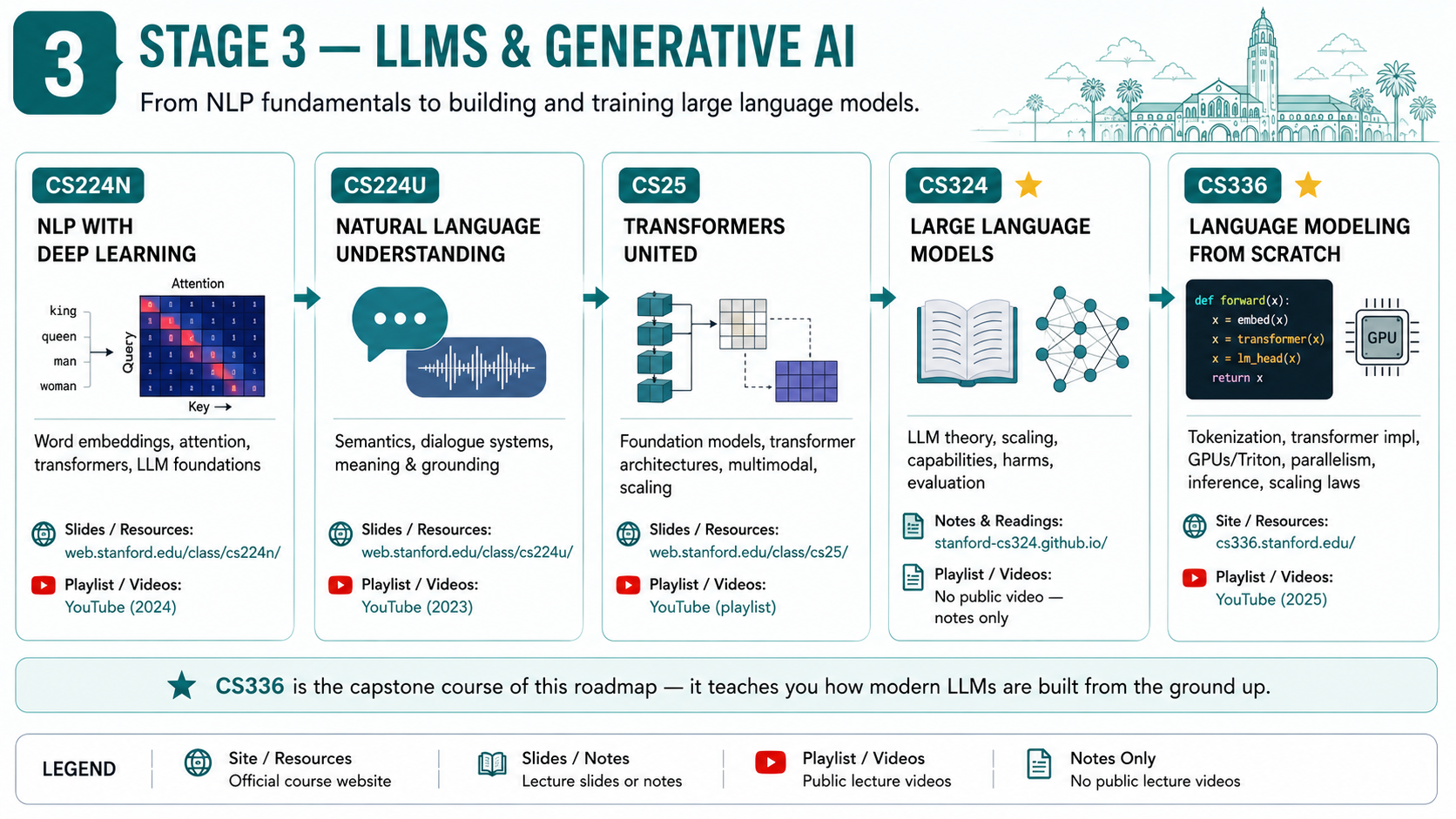
| ID | Course | Covers | Lecture Slides | Playlist |
|---|---|---|---|---|
| CS224N | NLP WITH DEEP LEARNING | Word embeddings, attention, transformers, LLM foundations | Site | ▶️ YouTube (2024) |
| CS224U | NATURAL LANGUAGE UNDERSTANDING | Semantics, dialogue systems, meaning & grounding | Site | ▶️ YouTube (2023) |
| CS25 | TRANSFORMERS UNITED | Foundation models, transformer architectures, multimodal, scaling | Site | ▶️ YouTube |
| CS324 | LARGE LANGUAGE MODELS | LLM theory, scaling, capabilities, harms, evaluation | Notes & readings | No public video — notes only |
| CS336 ⭐ | LANGUAGE MODELING FROM SCRATCH | Tokenization, transformer impl, GPUs/Triton, parallelism, inference, scaling laws | Site · Repo | ▶️ YouTube (2025) |
Stage 4 — AI Systems & Production 🏭
Build, deploy, and operate AI systems in the real world.
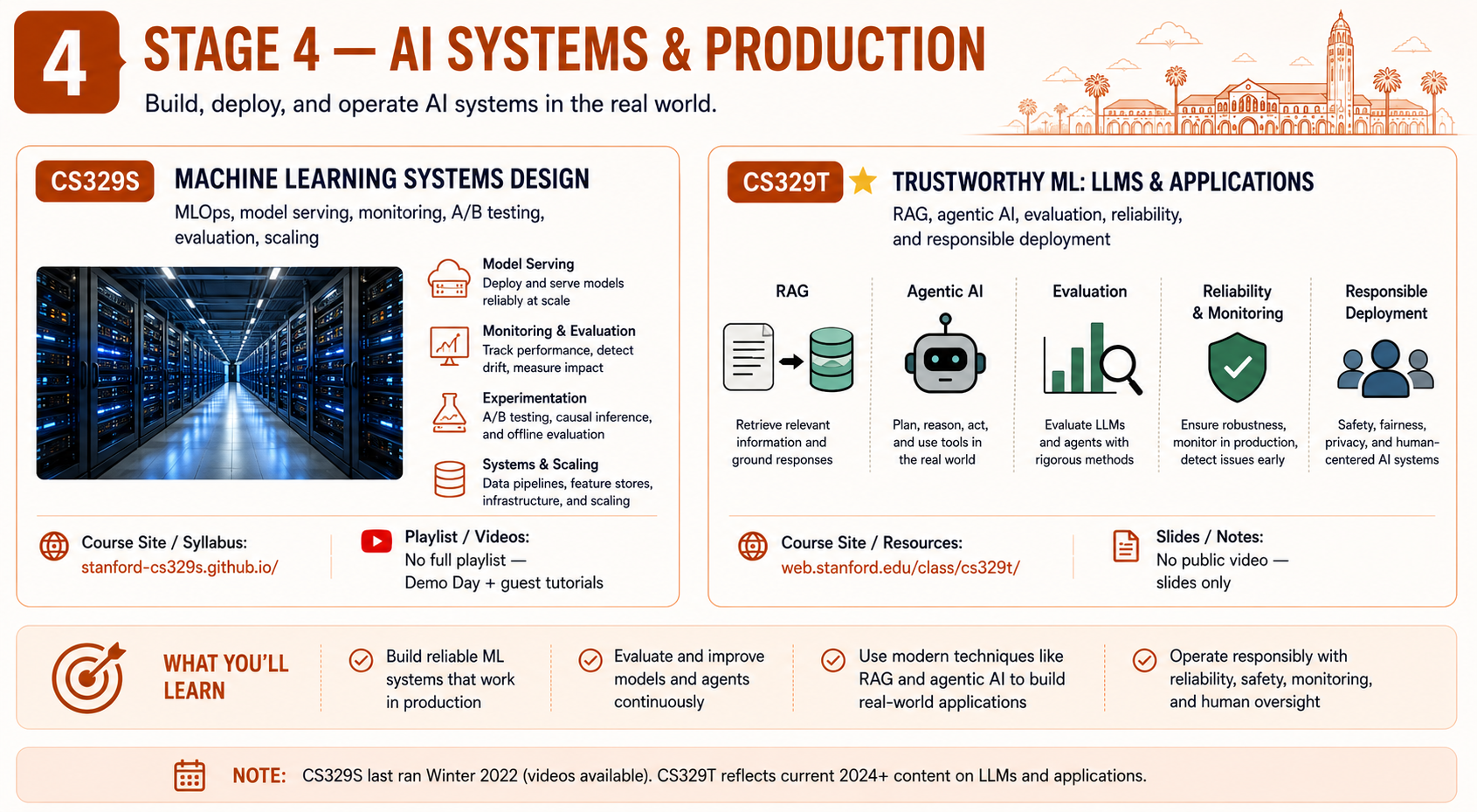
| ID | Course | Covers | Lecture Slides | Playlist |
|---|---|---|---|---|
| CS329S | MACHINE LEARNING SYSTEMS DESIGN | MLOps, model serving, monitoring, A/B testing, evaluation, scaling | Syllabus | No full playlist — Demo Day + guest tutorials |
| CS329T | TRUSTWORTHY ML: LLMS & APPLICATIONS | RAG, agentic AI, evaluation, reliability, responsible deployment | Site | No public video — slides only |
Note: CS329S last ran Winter 2022 — strong on classic MLOps, pre-LLM. CS329T is the modern complement: it's the only course on this roadmap that teaches RAG and agentic AI directly. For anything beyond the courses ( fine-tuning workflows, vLLM/Triton serving, vector DBs), Chip Huyen's AI Engineering (O'Reilly, 2024) is the current reference.
🦾 Optional — Robotics Track
For autonomy / robotics roles. Tangential to a generic AI-engineering path. Both are slides-only (no public video).
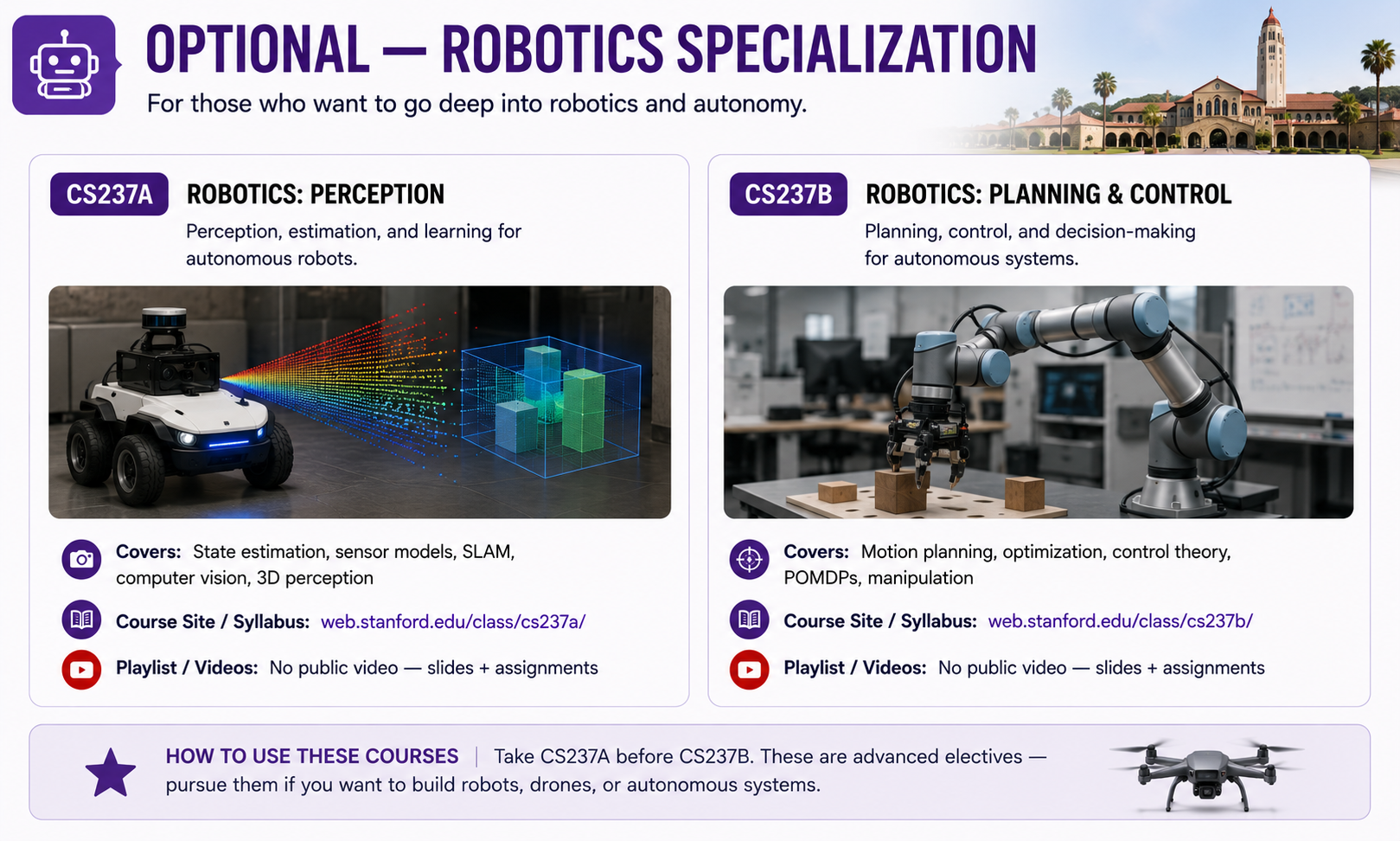
| ID | Course | Covers | Lecture Slides | Playlist |
|---|---|---|---|---|
| CS237A | PRINCIPLES OF ROBOT AUTONOMY I | Perception, localization, planning, control | Site | No public video — slides only |
| CS237B | PRINCIPLES OF ROBOT AUTONOMY II | RL, manipulation, imitation learning, human intent inference | Site | No public video — slides only |
🗺️ Suggested Sequence
Main path: Math → ML → Deep Learning → LLMs → Production
MATH51 / CS109 / EE364A
        │
      CS229 ──► CS229M ──► CS228
        │
      CS230 ──┬── CS231n         (Vision)
              ├── CS234 ──► CS238 (RL / decision-making)
              └── CS224U          (Language)
        │
   converge ►  CS224N ──► CS25 ──► CS324 ──► CS336
        │
      CS329S ──► CS329T          (Production)

Optional branch:  CS237A ──► CS237B   (Robotics)
🔗 Master Link Reference
| ID | Course | Site | Video |
|---|---|---|---|
| MATH51 | LINEAR ALGEBRA & CALCULUS | https://web.stanford.edu/class/math51/ | No public video — use MIT 18.06 (Strang) |
| CS109 | PROBABILITY | https://web.stanford.edu/class/cs109/ | ▶️ YouTube (2022) |
| EE364A | CONVEX OPTIMIZATION | https://ee364a.stanford.edu/ | ▶️ YouTube (2023) |
| CS221 | ARTIFICIAL INTELLIGENCE | https://web.stanford.edu/class/cs221/ | ▶️ YouTube (2019) |
| CS229 | MACHINE LEARNING | https://cs229.stanford.edu/ | ▶️ YouTube (2022) |
| CS229M | MACHINE LEARNING THEORY | https://cs229m.stanford.edu/ | No public video — notes only |
| CS228 | PROBABILISTIC GRAPHICAL MODELS | https://web.stanford.edu/class/cs228/ | No Stanford playlist — Koller PGM (Coursera) |
| CS230 | DEEP LEARNING | https://cs230.stanford.edu/ | ▶️ YouTube (2018) |
| CS231n | DEEP LEARNING FOR CV | https://cs231n.stanford.edu/ | ▶️ YouTube (2025) |
| CS234 | REINFORCEMENT LEARNING | https://web.stanford.edu/class/cs234/ | ▶️ YouTube (2024) |
| CS238 | DECISION MAKING UNDER UNCERTAINTY | https://web.stanford.edu/class/cs238/ | No public video — free textbook + slides |
| CS224N | NLP WITH DEEP LEARNING | https://web.stanford.edu/class/cs224n/ | ▶️ YouTube (2024) |
| CS224U | NATURAL LANGUAGE UNDERSTANDING | https://web.stanford.edu/class/cs224u/ | ▶️ YouTube (2023) |
| CS25 | TRANSFORMERS UNITED | https://web.stanford.edu/class/cs25/ | ▶️ YouTube |
| CS324 | LARGE LANGUAGE MODELS | https://stanford-cs324.github.io/ | No public video — notes only |
| CS336 | LM FROM SCRATCH | https://cs336.stanford.edu/ | ▶️ YouTube (2025) |
| CS329S | ML SYSTEMS DESIGN | https://stanford-cs329s.github.io/ | No full playlist — Demo Day + guest tutorials |
| CS329T | TRUSTWORTHY ML: LLMS & APPS | https://web.stanford.edu/class/cs329t/ | No public video — slides only |
| CS237A | PRINCIPLES OF ROBOT AUTONOMY I | https://web.stanford.edu/class/cs237a/ | No public video — slides only |
| CS237B | PRINCIPLES OF ROBOT AUTONOMY II | https://web.stanford.edu/class/cs237b/ | No public video — slides only |
▶️ = full official lecture playlist, verified. 11 of these 20 courses have public Stanford video; the other 9 were never recorded publicly (slides/notes only, or Canvas-restricted) — those rows point to the best legitimate substitute instead of a fake link.
✨ All courses are free to audit via lecture videos or notes. Enrolled/certificate versions are available through Stanford Online and the Stanford AI Professional Program. 🎯 Follow the sequence. Build projects. Master AI engineering.
Related Posts
- Machine Learning Learning Path — the topic-by-topic study path that fills in this roadmap
- Linear Algebra for Machine Learning — the math foundations this roadmap assumes