Hitesh Sahu
Hitesh SahuHitesh Sahu
  1. Home
  2. β€Ί
  3. posts
  4. β€Ί
  5. …

  6. β€Ί
  7. 2 4 Polynomial Regression

Loading ⏳
Fetching content, this won’t take long…


πŸ’‘ Did you know?

πŸ¦₯ Sloths can hold their breath longer than dolphins 🐬.

πŸͺ This website uses cookies

No personal data is stored on our servers however third party tools Google Analytics cookies to measure traffic and improve your website experience. Learn more

Loading ⏳
Fetching content, this won’t take long…


πŸ’‘ Did you know?

🀯 Your stomach gets a new lining every 3–4 days.
AI-Machine-Learning

    AI-AgenticAI

    AI-DeepLearning

    AI-GenAI

    AI-Infrastructure

    AI-Machine-Learning
    • Machine Learning Learning Path


    • Stanford AI Scientist Roadmap 2026


    • Machine Learning: Introduction and Core Algorithms


    • Linear Regression Explained: Single Variable and Multivariate Models with Gradient Descent


    • Evaluating a Hypothesis in Neural Networks


    • Bias-Variance Dilemma


    • Cost Function Regularization: Balancing Bias and Variance in Machine Learning Models


    • Polynomial Regression


    • Normal Equation in Linear Regression: Formula, Intuition, and Comparison with Gradient Descent


    • Logistic Regression for Classification: Concept, Sigmoid Function, Cost Function, and Implementation


    • Logistic Regression for Classification: Concept, Sigmoid Function, Cost Function, and Implementation


    • Support Vector Machines (SVM): Maximizing Margins for Robust Machine Learning Models


    • XGBoost (Extreme Gradient Boosting) Explained


    • Dimensionality Reduction in Machine Learning


    • Principal Component Analysis (PCA) Explained


    • t-SNE (t-distributed Stochastic Neighbor Embedding) Explained


    • K-Means Clustering


    • Anomaly Detection: Identifying Rare and Unusual Patterns in Data


    • Anomaly Detection Using Gaussian Distribution in Machine Learning


    • Anomaly Detection Using Multivariate Gaussian Distribution


    • Recommender Systems: Collaborative Filtering, Content-Based Filtering, and Hybrid Approaches


    • Collaborative Filtering: Building Recommender Systems with Feature Learning


    • Photo OCR: Sliding Window Detection, Character Segmentation and Recognition


    • Large Scale Machine Learning: Training Models on Massive Datasets


    • Stochastic Gradient Descent (SGD): Efficient Optimization for Large Datasets


    • MapReduce for Large-Scale Machine Learning: Distributed Training at Scale


    • AI-Machine-Learning Index


    AI-Math

    AWS

    Azure

    kubernetes

    Management

    Programming

    Terraform

    Z_Appendix

Cover Image for Polynomial Regression
AI-Machine-Learning

Polynomial Regression

Understand polynomial regression with practical examples.

Polynomial Regression
Bias-Variance Tradeoff
Overfitting
Underfitting
Lasso Regression
Ridge Regression
← Previous

AI/ML Operations

Next β†’

Logistic Regression for Classification: Concept, Sigmoid Function, Cost Function, and Implementation

πŸ“ˆ Polynomial Regression

Polynomial regression is an extension of linear regression where we model a nonlinear relationship between input π‘₯π‘₯x and output 𝑦𝑦y by adding powers of π‘₯π‘₯x.

Sometimes by defining a new feature you might get a better Model that requires less computation

Use case:

When prediction fits Polynomial equation instead of linear equation

For example house price can defined by calculating area instead of creating 2 variable equation we can define one variable equation :
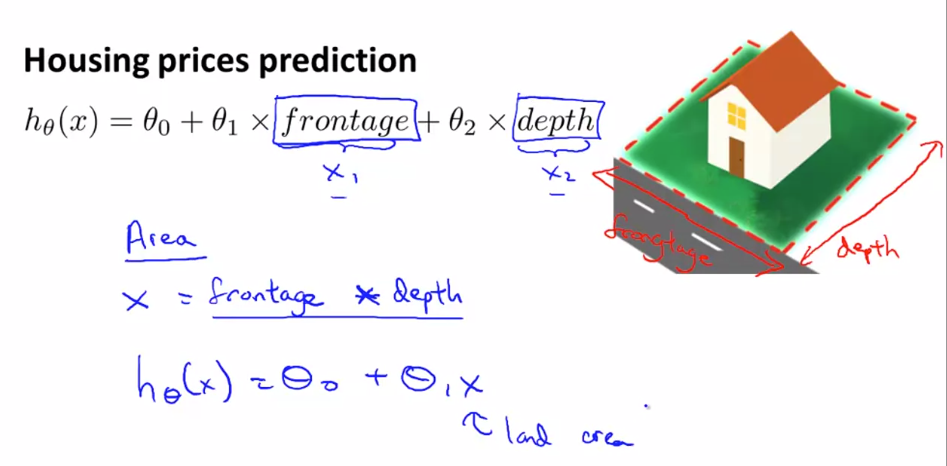
creatingFeature

  • Scaling of feature becomes crucial in Polynomial Regression
  • Some algo can choose feature to fit polynomial curves

Feature engineering

is the process of creating new features from existing ones to improve model performance.

Generic polynomial regression model of degree n:
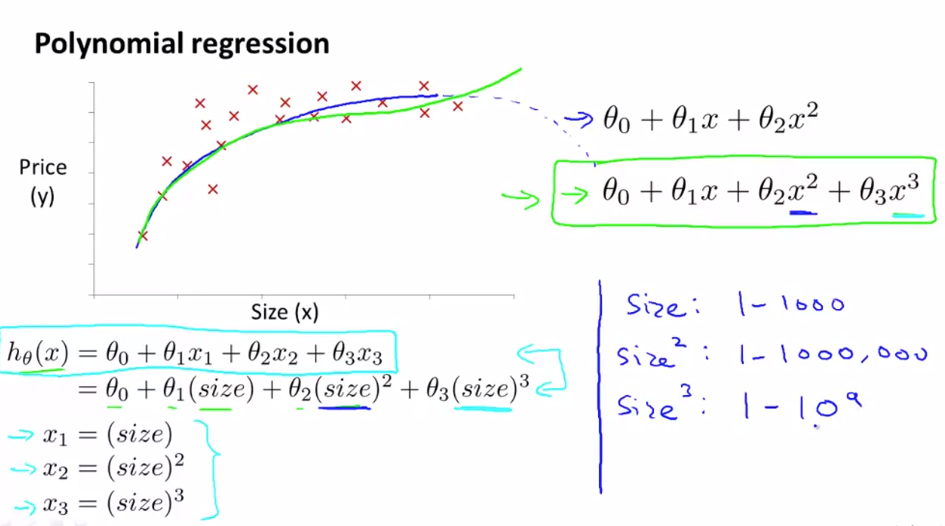
y=ΞΈ0+ΞΈ1x+ΞΈ2x2+ΞΈ3x3+...+ΞΈnxny = \theta_0 + \theta_1 x + \theta_2 x^2 + \theta_3 x^3 + ... + \theta_n x^ny=ΞΈ0​+ΞΈ1​x+ΞΈ2​x2+ΞΈ3​x3+...+ΞΈn​xn

creatingFeature


Related Posts

  • Cost Function Regularization β€” how to tame the overfitting these higher-degree models are prone to
  • Normal Equation in Linear Regression β€” a closed-form alternative to gradient descent for fitting these models

Hitesh Sahu
Written by Hitesh Sahu, a passionate developer and blogger.

Fri Feb 27 2026

Share This on

← Previous

AI/ML Operations

Next β†’

Logistic Regression for Classification: Concept, Sigmoid Function, Cost Function, and Implementation

AI-Machine-Learning/2-4-Polynomial-Regression
Let's work together
hiteshkrsahu@gmail.com
Munich πŸ₯¨, Germany πŸ‡©πŸ‡ͺ, EU
Playstore
Hitesh Sahu's apps on Google Play Store
Need Help?
Let's Connect
Navigation
Β  Home/About
Β  Skills
Β  Work/Projects
Β  Lab/Experiments
Β  Contribution
Β  Awards
Β  Art/Sketches
Β  Thoughts
Β  Contact
Links
Β  Sitemap
Β  Legal Notice
Β  Privacy Policy

Made with

NextJS logo

NextJS by

hitesh Sahu

| Β© 2026 All rights reserved.