Anomaly Detection: Identifying Rare and Unusual Patterns in Data
Learn how anomaly detection models identify unusual data points using statistical methods such as Gaussian distributions. Understand how to detect fraud, system failures, and rare events in real-world datasets.
👁️🗨️ Anomaly Detection
Machine learning technique used to identify unusual data points that do not resemble the majority of the data.
Key Idea
We model normal behavior using Gaussian density estimation.
Any example with very low probability under this model is considered anomalous.
The goal is to detect rare or abnormal events.
It is typically treated as an unsupervised learning problem because:
- You usually have many examples of normal data.
- You rarely have labeled examples of anomalies.
Core Idea
Anomaly detection identifies unusual data points that do not resemble most of the data.
The idea is simple:
- Learn what “normal” looks like.
- Flag anything that looks very unlikely.
The model learns:
- High probability regions → where most normal data lies
- Low probability regions → unusual areas
Anomalies naturally fall into low-density regions.
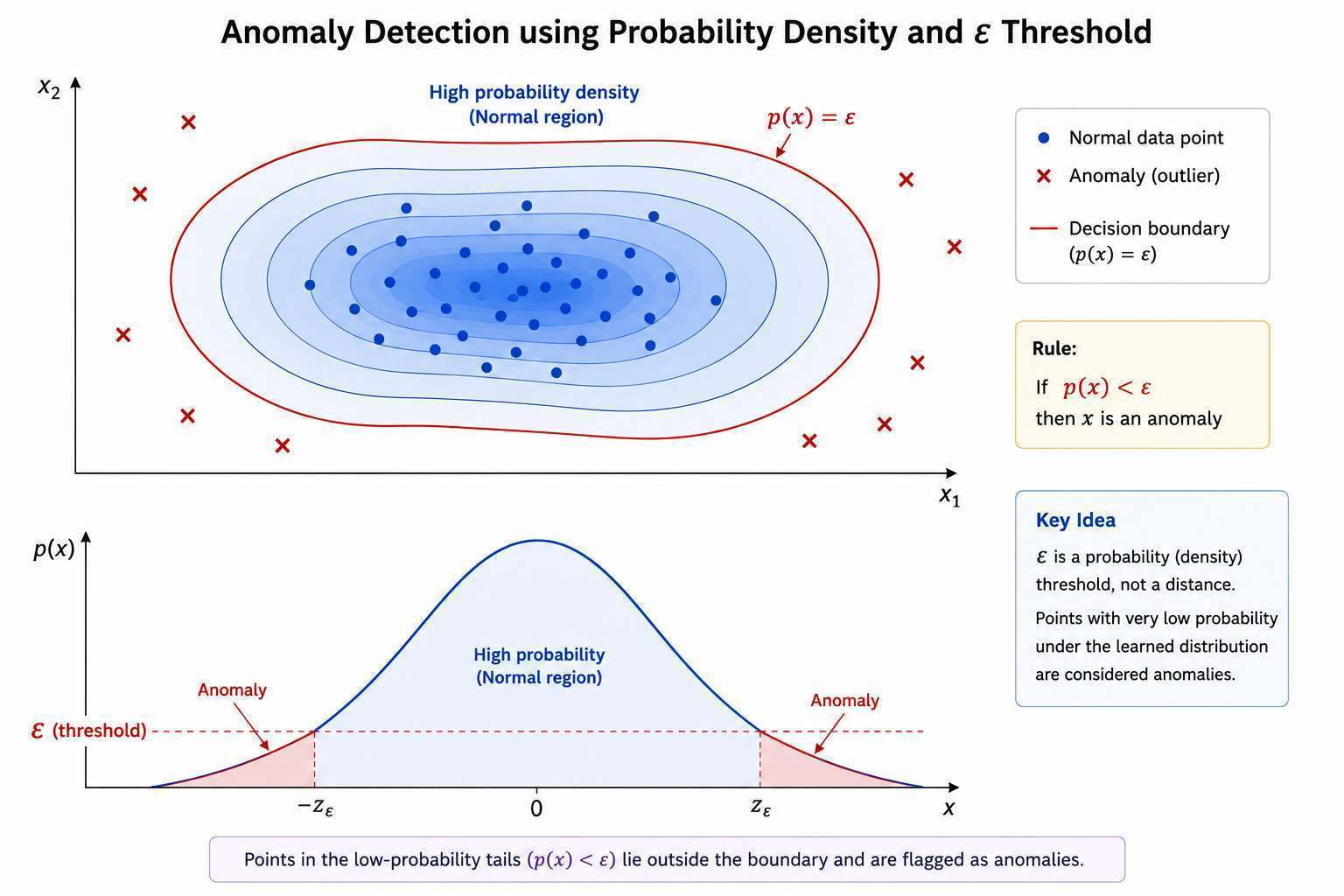
Anomaly Detection Algorithm
Even though anomaly detection is mostly unsupervised,
a small labeled dataset is extremely useful for evaluation and tuning.
1. 📚 Train a Probability Model
Given unlabeled data:
Split the data into
1. Training set 🦾
Used to learn the probability model .
Model the probability distribution of the data:
Find a small number such that:
- If → Anomaly
- Else → Normal
is the threshold for flagging anomalies.
Normal data should have high probability and fit inside distribution, while anomalies should have low probability and come outside distribution.
2. Cross-validation 📋
Used to tune select features
- Fine Tune using Cross-validation set
3. Test sets 🧪
Used for final evaluation only.
- Evaluate the final model on the test set to estimate real-world performance.
- Do not use the test set for tuning or model selection to avoid overfitting.
2. 🔎 Evaluate New Data
Flag a new example as an anomaly if:
Decision rule:
- If → Anomaly
- Else → Normal
Where:
- = probability of the example under the learned model
- = small threshold value
If the probability is very low, the example is considered unusual.
Common Applications
1. Fraud Detection
Used to detect:
- Unusual login behavior
- Suspicious transactions
- Compromised accounts
Possible features:
- Number of logins
- Number of transactions
- Pages visited
- Typing speed
- User activity patterns
2. Manufacturing
Used to detect defective products such as:
- Aircraft engines
- Industrial components
- Hardware parts
3. Data Center Monitoring
Used to monitor server behavior:
Features may include:
- CPU usage
- Memory usage
- Disk activity
- Network traffic
- Derived metrics
Anomaly Detection vs Supervised Learning
| Aspect | Supervised Learning | Anomaly Detection |
|---|---|---|
| Main Goal | Predict known classes | Detect unusual/rare examples |
| Training Data | Labeled data | Mostly normal data |
| Labels Required | Yes | Usually no anomaly labels needed |
| Learns | Decision boundary between classes | What “normal” behavior looks like |
| Mathematical Idea | Learn (P(y \mid x)) | Learn (P(x)) |
| Positive Examples | Need many examples | Often very few or none |
| Works Best When | Classes are well-defined | Anomalies are rare/unpredictable |
| Typical Dataset | Balanced or moderately imbalanced | Highly imbalanced |
| Output | Class label | Anomaly score / probability |
| Example Output | Spam / Not Spam | Normal / Suspicious |
| Handles New Unknown Attacks? | Usually poorly | Better |
| Common Algorithms | Logistic Regression, SVM, Neural Networks | Gaussian Models, Isolation Forest, One-Class SVM |
| Example Use Cases | Spam detection, image classification | Fraud detection, server monitoring |
| Fraud Detection Suitability | Good if many fraud examples exist | Better when fraud patterns constantly change |
| Manufacturing Defects | Less ideal with few defect examples | Very effective |
| Cybersecurity Intrusions | Hard when attacks evolve | Commonly used |
| Data Requirement | Large labeled datasets | Mostly normal operational data |
| Decision Process | Compare classes | Detect deviations from normal |
| Typical Assumption | All classes are represented in training | Normal behavior dominates data |
| Real-World Analogy | “Is this cat or dog?” | “This looks strange.” |
What Comes Next
Typically, anomaly detection uses:
- The Gaussian (Normal) distribution
- Probability modeling techniques
- Threshold selection methods
Next steps usually involve:
- Modeling each feature using a Gaussian distribution
- Combining them into a joint probability model
- Using that model to compute ( p(x) )
Related Posts
- Gaussian Distribution — the probability model used to score each feature; understanding the univariate Gaussian is the prerequisite for anomaly detection
- Multivariate Gaussian Distribution — captures correlations between features for better anomaly detection when features are not independent
- K-Means Clustering — the clustering approach anomaly detection is often contrasted with