K-Means Clustering
K-Means is a powerful unsupervised learning algorithm for clustering data into coherent subsets. It iteratively assigns points to the nearest centroid and updates centroids to minimize distortion, making it widely used in practice.
K-Means Clustering
K- Mean is used to solves the clustering problem:
- one of the most widely used clustering algorithms.
- K-Means is an Iterative Algorithm
It is simple, fast, and widely used in practice.
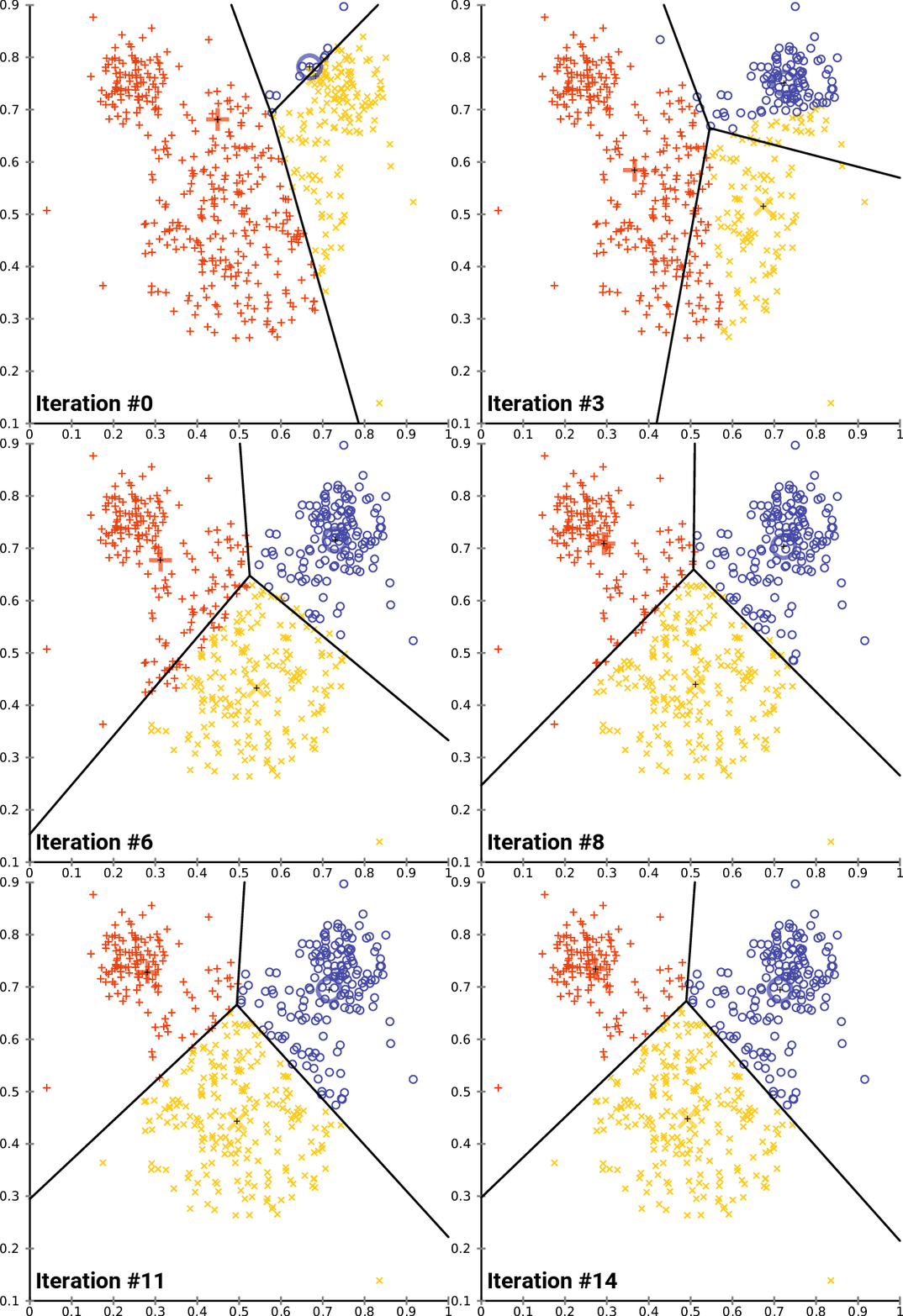
Scikit Learn k-mean example:
from sklearn.cluster import KMeans
import numpy as np

X = np.array([[1, 2], [1, 4], [1, 0],
              [10, 2], [10, 4], [10, 0]])

kmeans = KMeans(
    n_clusters=2,    # Number of Cluster
    random_state=0,  # Dont Starts with random centroid locations
    n_init="auto")   # automatically chooses the number of runs.
    .fit(X)          # Train Model

# print Cluster centers
kmeans.cluster_centers_

# print groups label for data items
kmeans.labels_
Clustering
Given an *unlabeled dataset automatically group the data into coherent subsets, called clusters.
Cluster analysis is a powerful unsupervised learning technique for discovering groups in data.
When K-Means Works Well
K-Means works best when:
- Clusters are roughly spherical.
- Clusters have similar sizes.
- Features are properly scaled.
Feature scaling is important:
Without scaling, features with larger magnitude dominate distance calculations.
When K-Means Struggles
K-Means performs poorly when:
- Clusters are non-convex.
- Clusters have very different densities.
- Data contains significant outliers.
- Clusters are not well separated.
K-Mean Algorithm
K-Means works as follows:
Takes and unlabeled data as input.
Given:
Training set
where .
And number of clusters
Repeats: {
-
Assignment Step
Assign points to nearest centroid.
-
Centroid update step
Move centroids to mean of assigned points.
Minimizes Cost function (Distortion):
}
Stops when assignments stabilize.
Output is cluster assignments for each example and cluster centroids.
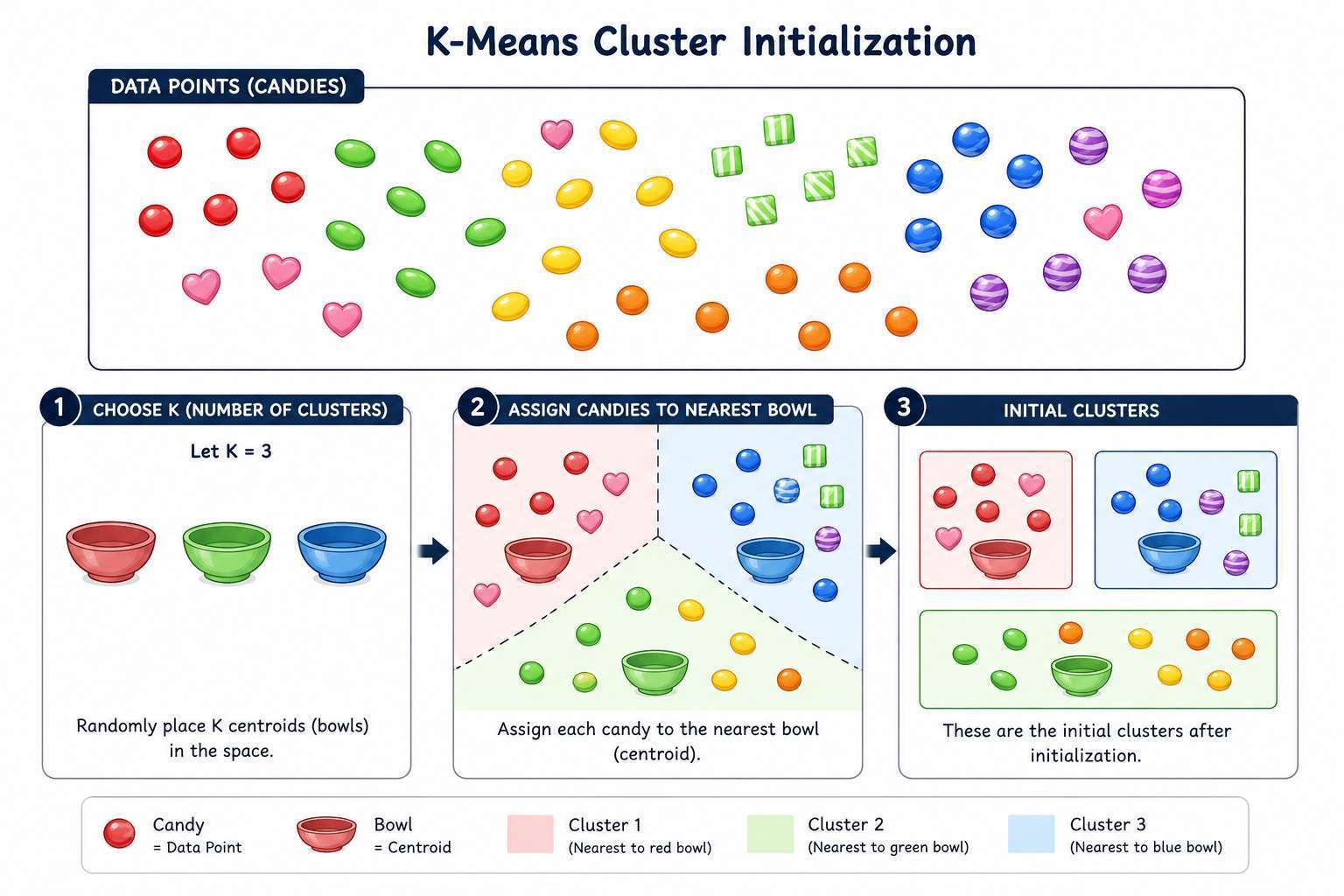
Suppose we want to group data into clusters.
Algorithm
Repeat for :
where T = number of runs
- Randomly initialize centroids
- Run K-Means to convergence
- Compute distortion:
Finally:
Input
- (number of clusters) = 2 in this case
- Dataset , where
- = number of examples
Example: 🍓🍡🍬🍭
Candies scatter on table with bowls to collect them.
1. Initialize Cluster centroids() 🥣
Randmly put 2 Bowls on the table to start collecting candies.
Randomly initialize cluster centroids
Total number of clusters
We have centroids:
- = centroid of cluster
where
- is a point in the same space as the data (i.e., )
Choosing the Number of Clusters (K)
There is no universal rule for choosing .
Proper Random Initialization
When running K-Means:
Where:
- = number of clusters
- = number of training examples
It does not make sense to choose .
Recommended Initialization Method
- Randomly select distinct training examples.
- Set initial centroids equal to those examples:
where are randomly chosen distinct indices.
This ensures centroids start within the data distribution.
Elbow Method
When we increase , distortion decreases because we have more centroids to fit the data.
Idea is to find point where adding more clusters does not significantly reduce distortion.
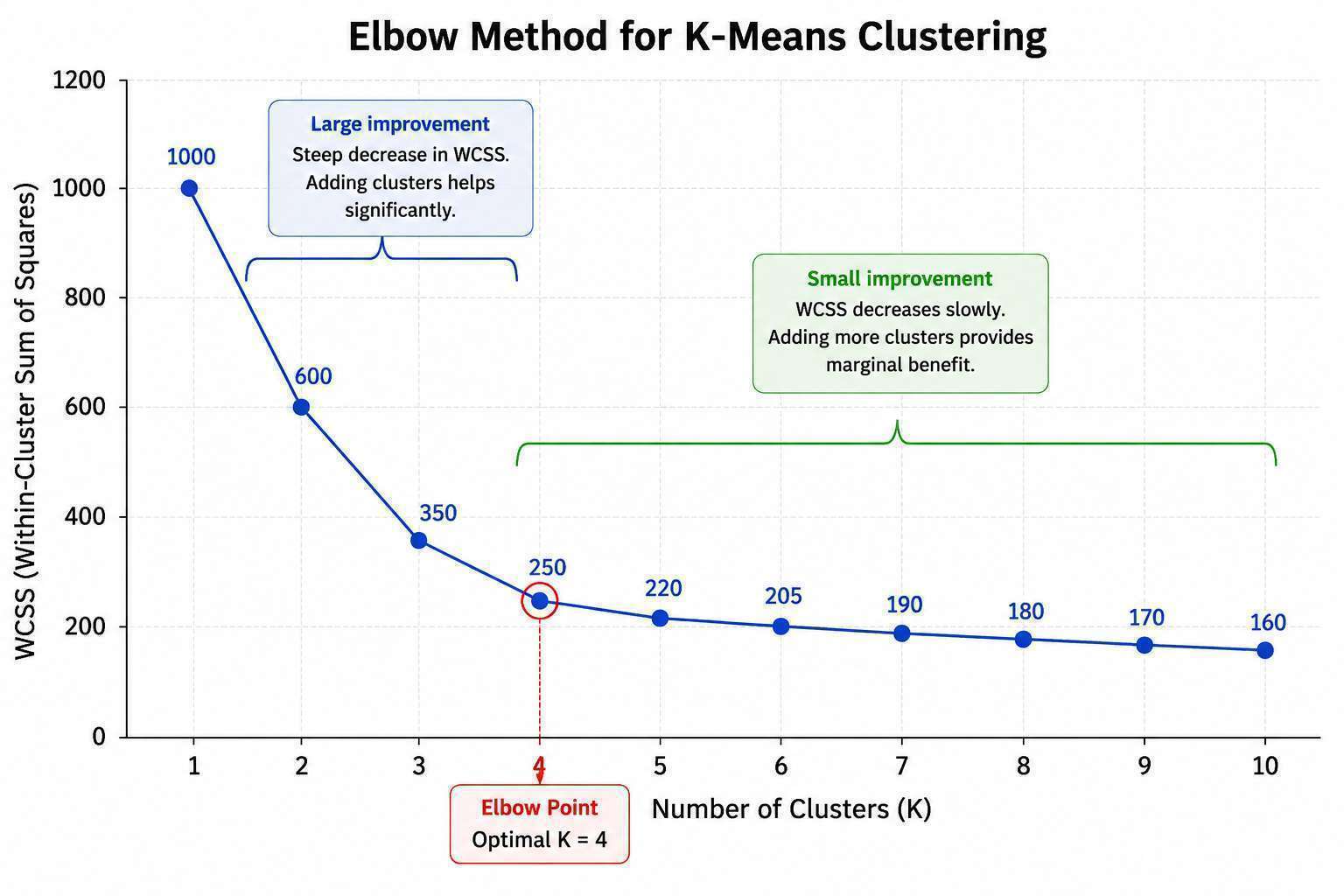
- Run K-Means for different values of .
- Compute distortion for each.
- Plot vs .
- Look for an “elbow” where improvement slows down.
Repeatedly Steps 2-3 until convergence {
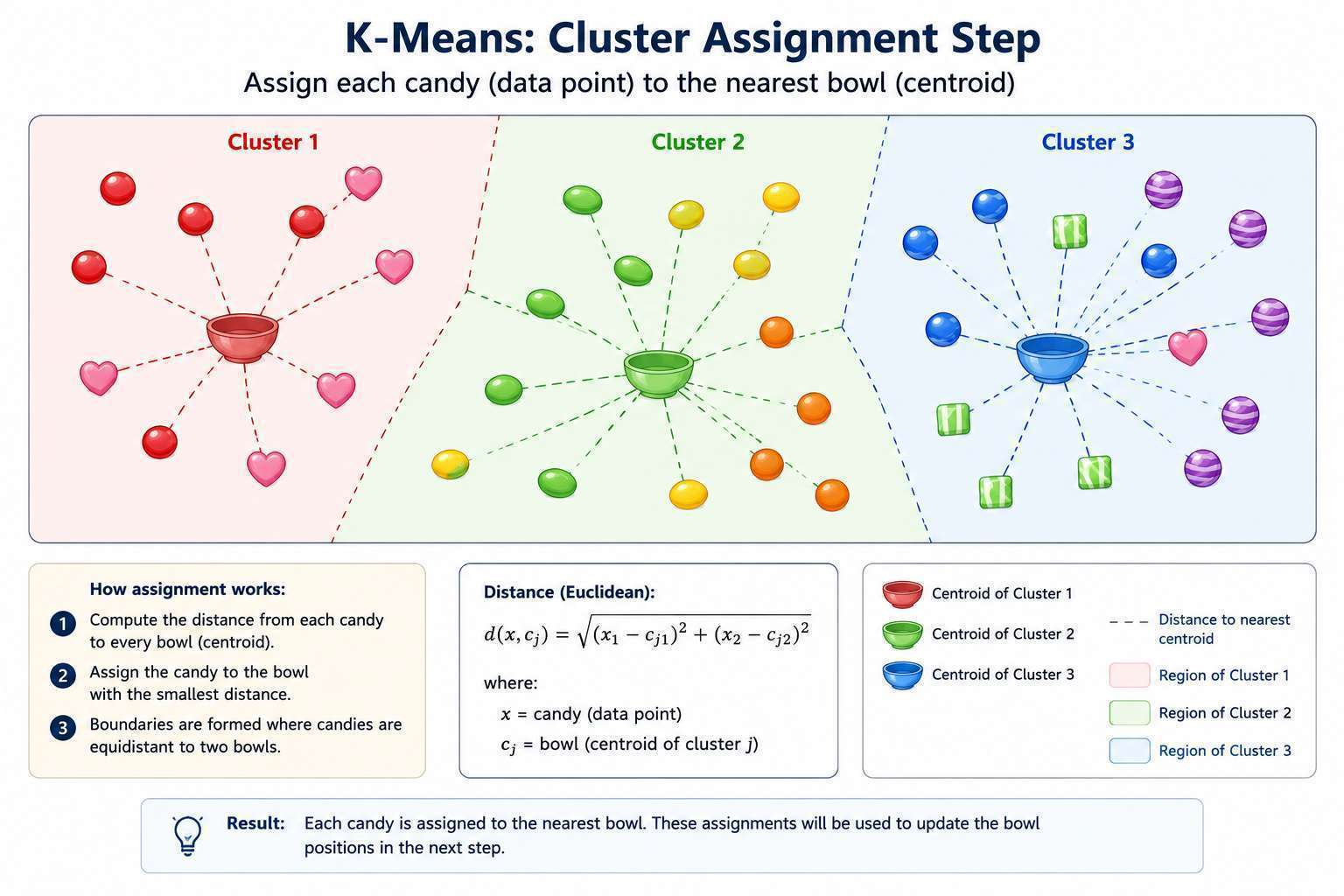
2. 📏 Cluster Assignment Step
For each training example() where :
Assign to the cluster with the closest centroid.
In Mathematical terms:
Index of Cluster
Index of cluster is Centroid closest to in
Examples:
- If is closest to , then
- If is closest to , then
= CLuster centroid of cluster
Value of centroid of cluster assigned to is
- If , then
- If , then
Which can be expressed as:
Formally:
Where:
- = centroid of cluster
- = cluster assigned to example
We typically use squared Euclidean distance.
Example
Given
Centroids:
Training example:
Distance to
Distance to
Distance to
Assigning Cluster
- Distance to : 4
- Distance to : 8
- Distance to : 25
The smallest distance is to so
3. 🧿 Move Centroid Step
For each cluster where :
- = total number of clusters
Update centroid to be the mean of all points assigned to it.
Where:
- = set of points assigned to cluster
- = number of points in cluster
This moves the centroid to the center of its assigned points.
- Each centroid becomes the mean of the points assigned to it.
⛔ Stop Condition
The algorithm converges when:
- Cluster assignments no longer change, or
- Centroids stop moving.
What If a Cluster Gets No Points?
If some centroid has zero assigned points:
- Eliminate the cluster (resulting in clusters), or
- Reinitialize the centroid randomly
In practice, empty clusters are uncommon with reasonable initialization.
💰 Cost Function (Distortion)
Minimize th Distance between points and their assigned centroids.
Or equivalently:
Where:
- = cost function (distortion)
- = number of training examples
- = -th training example
- = centroid of the cluster assigned to
- = index of cluster assigned to
Each iteration consists of:
-
Assignment step
Minimizes with respect to (cluster assignments). -
Centroid update step
Minimizes with respect to (centroid locations).
Since each step does not increase , the algorithm is guaranteed to converge.
Each iteration of K-Means guarantees that does not increase.
However, it may converge to a local minimum, not necessarily the global minimum.
A good solution:
- Each natural cluster is captured by one centroid.
A bad solution:
- Merge two true clusters into one
- Split one true cluster into multiple parts
- Assign very few points to some clusters
All of these correspond to higher distortion:
To reduce the risk of poor local minima:
- Run K-Means multiple times (e.g. 50–1000 runs) with different random initializations
- Compute for each run
- Keep the clustering with the lowest distortion
This is cheap to do for small/medium (2–10 clusters) since each run is fast, and it substantially reduces the chance of settling on a bad local minimum.
Related Posts
- Dimensionality Reduction in Machine Learning — reduce high-dimensional data with PCA before K-means clustering to avoid the curse of dimensionality
- RAG: Retrieval-Augmented Generation — RAG vector stores use approximate nearest-neighbor search that shares mathematical roots with K-means centroid assignment
- t-SNE Explained — often used to visualize the clusters this algorithm finds
- Anomaly Detection — clustering's cousin — flagging points that don't fit any cluster