Fragesätze: Direct Questions (W-Fragen & Satzfragen) ❓
Learn German direct questions: W-Fragen (question words like wer, wo, wann, warum, was für ein) and Satzfragen (yes/no questions), their word order, and welch-/was für ein declension tables with worked examples.
3. Fragesatz (Question Sentence)
Used to ask a question. There are 3 main types:
    Questions (Fragesätze)
        │
        ├── W-Questions (W-Fragen)
        ├── Yes/No Questions (Entscheidungsfragen)
        └── Indirect Questions (Indirekte Fragesätze)
flowchart TD
    A["❓ Fragesätze (Question Sentences)"]
    A --> B["❓ W-Fragen<br/>(Information Questions)"]
    A --> C["✅ Satzfragen<br/>(Yes / No Questions)"]
    A --> D["💭 Indirekte Fragen<br/>(Indirect Questions)"]
%% W Questions
    B --> B1["Pattern<br/><b>W-Word → Verb → Subject → ...</b>"]
    B1 --> B2["Examples<br/>• Wo wohnst du?<br/>• Wann kommst du?<br/>• Warum lernst du Deutsch?"]
%% Yes/No Questions
    C --> C1["Pattern<br/><b>Verb → Subject → ...</b>"]
    C1 --> C2["Examples<br/>• Kommst du morgen?<br/>• Hast du Hunger?<br/>• Kannst du Deutsch?"]
%% Indirect Questions
    D --> D1["With W-Word<br/><b>W-Word → Subject → ... → Verb</b>"]
    D --> D2["With <b>ob</b><br/><b>ob → Subject → ... → Verb</b>"]
    D1 --> D11["Direct<br/>Wo wohnst du?"]
    D11 --> D12["Indirect<br/>Ich weiß nicht,<br/>wo du wohnst."]
    D2 --> D21["Direct<br/>Kommst du morgen?"]
    D21 --> D22["Indirect<br/>Ich weiß nicht,<br/>ob du morgen kommst."]
flowchart TD

    A["❓ Fragesätze (Question Sentences)"]

    A --> B["❓ W-Fragen<br/>(Information Questions)"]
    A --> C["✅ Entscheidungsfragen<br/>(Yes / No Questions)"]
    A --> D["💭 Indirekte Fragen<br/>(Indirect Questions)"]
    A --> E["🔀 Alternative Fragen<br/>(Alternative Questions)"]

%% W Questions
    B --> B1["Pattern<br/><b>W-Word → Verb → Subject → ...</b>"]
    B1 --> B2["Examples<br/>• Wo wohnst du?<br/>• Wann kommst du?<br/>• Warum lernst du Deutsch?"]

%% Yes/No Questions
    C --> C1["Pattern<br/><b>Verb → Subject → ...</b>"]
    C1 --> C2["Examples<br/>• Kommst du morgen?<br/>• Hast du Hunger?<br/>• Kannst du Deutsch?"]

%% Indirect Questions
    D --> D1["With W-Word<br/><b>W-Word → Subject → ... → Verb</b>"]
    D --> D2["With <b>ob</b><br/><b>ob → Subject → ... → Verb</b>"]

    D1 --> D11["Direct<br/>Wo wohnst du?"]
    D11 --> D12["Indirect<br/>Ich weiß nicht,<br/>wo du wohnst."]

    D2 --> D21["Direct<br/>Kommst du morgen?"]
    D21 --> D22["Indirect<br/>Ich weiß nicht,<br/>ob du morgen kommst."]

%% Alternative Questions
    E --> E1["Pattern<br/><b>Option A oder Option B?</b>"]
    E1 --> E2["Examples<br/>• Tee oder Kaffee?<br/>• Kommst du heute oder morgen?<br/>• Fährst du mit dem Bus oder mit dem Zug?"]

    classDef title fill:#1e3a8a,color:#fff,stroke:#1e3a8a;
    classDef section fill:#dcfce7,stroke:#16a34a,color:#000;
    classDef pattern fill:#dbeafe,stroke:#2563eb,color:#000;
    classDef example fill:#fef9c3,stroke:#ca8a04,color:#000;

    class A title;
    class B,C,D,E section;
    class B1,C1,D1,D2,E1 pattern;
    class B2,C2,D11,D12,D21,D22,E2 example;
1. W-Frage (Question word) ❓
These questions start with a W-word such as wo, was, wann, wie, warum, wer, etc.
- 🟥 Akkusativ (Akk) → direct object
- 🟩 Dativ (Dat) → indirect object
- 🟦 Neutral → general usage
W-H question word List
| # | 🇩🇪 German | 🇬🇧 English | 💬 Example | 🧭 Notes |
|---|---|---|---|---|
| 1 | 👤 wer | 🟦 who | Wer bist du? → Who are you? | Used for the subject of a sentence |
| 1.1 | 🧐 wen | 🟥 whom (Akk) | Wen siehst du? → Whom do you see? | Used for the object (Akkusativ) |
| 1.2 | 🤝 wem | 🟩 to whom (Dat) | Wem gibst du das Buch? → To whom are you giving the book? | Used for Dativ (receiver) |
| 1.3 | 🚗 wessen | 🟦 Whose(Genative) | Wessen Auto ist das? → Whose car is that? | Possession / ownership |
| 2 | 📍 wo | 🟦 where | Wo wohnst du? → Where do you live? | Static location (no movement) |
| 2.1 | ➡️ wohin | 🟦 where (to) | Wohin gehst du? → Where are you going? | Direction / destination |
| 2.2 | ⬅️ woher | 🟦 where from | Woher kommst du? → Where do you come from? | Origin / source |
| 3 | 🤔 wie | 🟦 how | Wie geht’s dir? → How are you? | Used for manner / condition |
| 3.1 | 💰 wie viel | 🟦 how much | Wie viel kostet das? → How much does it cost? | For uncountable nouns |
| 3.2 | 🔢 wie viele | 🟦 how many | Wie viele Geschwister hast du? → How many siblings do you have? | For countable nouns |
| 4 | 💁♂️ welche(r/s) | 🟦 which | Welches Buch liest du? → Which book are you reading? | Changes by gender & case |
| 5 | ❓ was | 🟦 what | Was machst du? → What are you doing? | Used for things / actions |
| 5.1 | 📂 was für ein(e) 🟦 | 🟦 what kind of | Was für ein Film ist das? → What kind of movie is that? | Used to ask for type or category |
| 6 | 🤷♂️ warum | 🟦 why | Warum lernst du Deutsch? → Why are you learning German? | Asks for reason |
| 6.1 | 💭 wieso / weshalb | 🟦 How come | Wieso bist du spät? → Why are you late? | Alternative forms of warum |
| 7 | 📅 wann | 🟦 when | Wann hast du Geburtstag? → When is your birthday? | Time reference |
Organized by purpose.
Person Questions 👤
| # | Question | 🇬🇧 English | 💬 Example | 🧭 Case / Notes |
|---|---|---|---|---|
| 👤 | wer | who | Wer bist du? → Who are you? | 👤 Nominative → Subject (Wer?) |
| 🤔 | wen | whom | Wen siehst du? → Whom do you see? | 🎯 Accusative → Direct Object (Wen?) |
| 🎁 | wem | to whom | Wem gibst du das Buch? → To whom are you giving the book? | 🎁 Dative → Indirect Object (Wem?) |
| 👉 | wessen | whose | Wessen Auto ist das? → Whose car is that? | 🧩 Genitive → Possession (Wessen?) |
1. Wer (Who) → 👤 Subject
The person doing the action
flowchart LR

    A["👩 Anna"]
    B["👨 Friend"]

    D["❓ Wer bist du?"]
    E["✅ Ich bin Anna."]

    B -->|"fragt"| D
    D --> E
    E -.-> A

    A -->|"spricht mit"| B

    classDef person fill:#d1fae5,stroke:#16a34a,color:#000;
    classDef question fill:#dbeafe,stroke:#2563eb,color:#000;

    class A,B person;
    class D,E question;
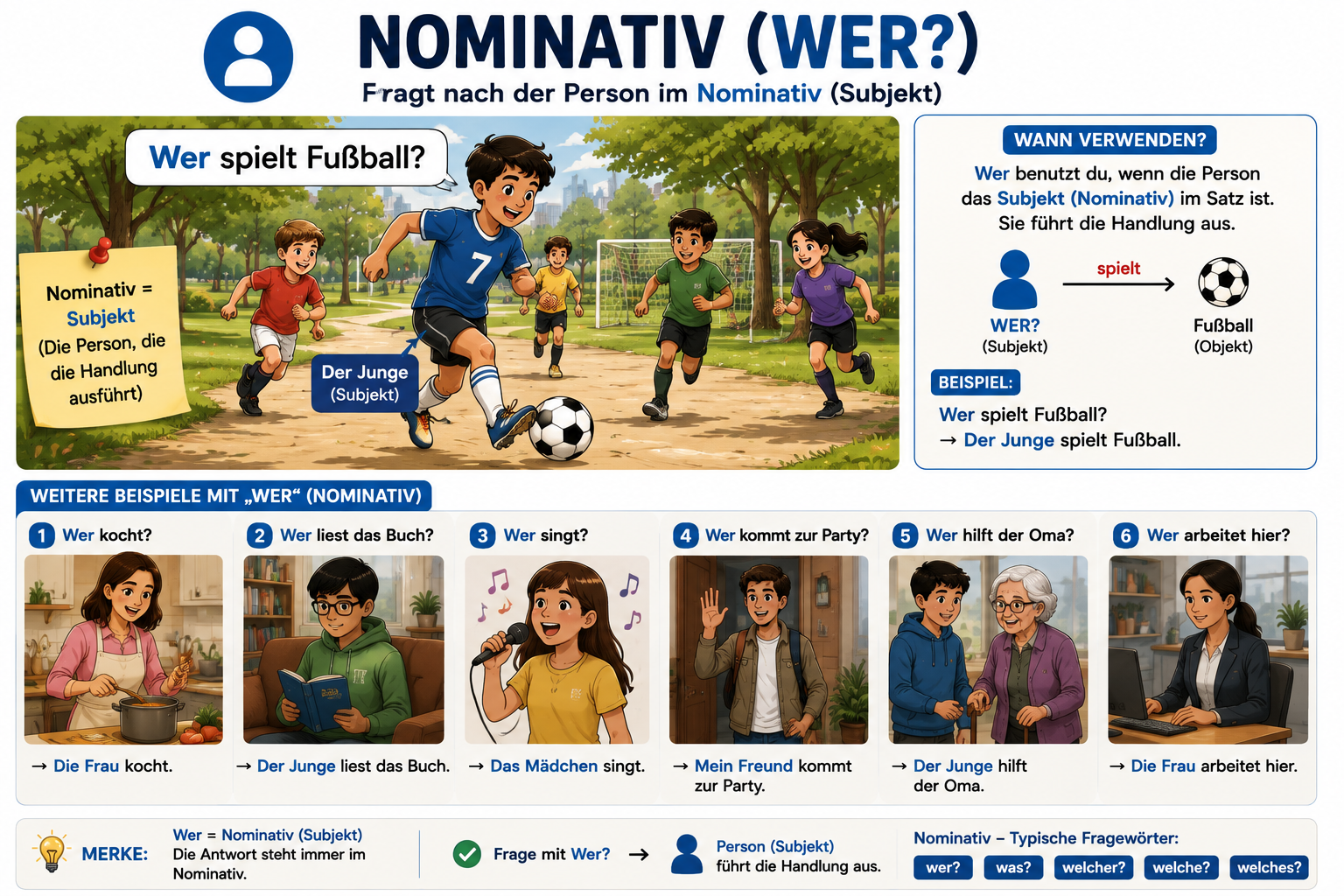
✅ Examples Wer:
| German | English |
|---|---|
| Wer bist du? | Who are you? |
| Wer ist das? | Who is that? |
| Wer heißt Anna? | Who is called Anna? |
| Wer kommt heute? | Who is coming today? |
| Wer wohnt hier? | Who lives here? |
| Wer arbeitet hier? | Who works here? |
| Wer lernt Deutsch? | Who is learning German? |
| Wer spricht Deutsch? | Who speaks German? |
| Wer hilft dir? | Who is helping you? |
| Wer kennt Maria? | Who knows Maria? |
| Wer wartet auf den Bus? | Who is waiting for the bus? |
| Wer spielt Fußball? | Who is playing football? |
| Wer fährt nach Berlin? | Who is traveling to Berlin? |
| Wer kocht heute? | Who is cooking today? |
| Wer macht das? | Who is doing that? |
| Wer hat mein Buch? | Who has my book? |
| Wer hat angerufen? | Who called? |
| Wer öffnet die Tür? | Who is opening the door? |
| Wer bringt den Kuchen mit? | Who is bringing the cake? |
| Wer kann mir helfen? | Who can help me? |
| Wer möchte Kaffee? | Who would like coffee? |
| Wer hat Geburtstag? | Whose birthday is it? / Who has a birthday? |
| Wer gewinnt das Spiel? | Who is winning the game? |
| Wer kommt zuerst? | Who is coming first? |
| Wer ist dein Lehrer? | Who is your teacher? |
2. Wen (whom) → 🎯 Direct Object
(The person receiving the action)
flowchart LR
A["👩 Woman"]
B["👨 Friend"]
C["👦 Boy"]

    D["❓ Wen siehst du??"]
    E["✅ Den Jungen."]

    A -->|"spricht mit"| B
    A -->|"sieht"| C

    B -. Answers .->
    D --> E
    C -.-> E

    classDef person fill:#d1fae5,stroke:#16a34a,color:#000;
    classDef object fill:#fde68a,stroke:#ca8a04,color:#000;
    classDef question fill:#dbeafe,stroke:#2563eb,color:#000;

    class A,B person;
    class C object;
    class D,E question;
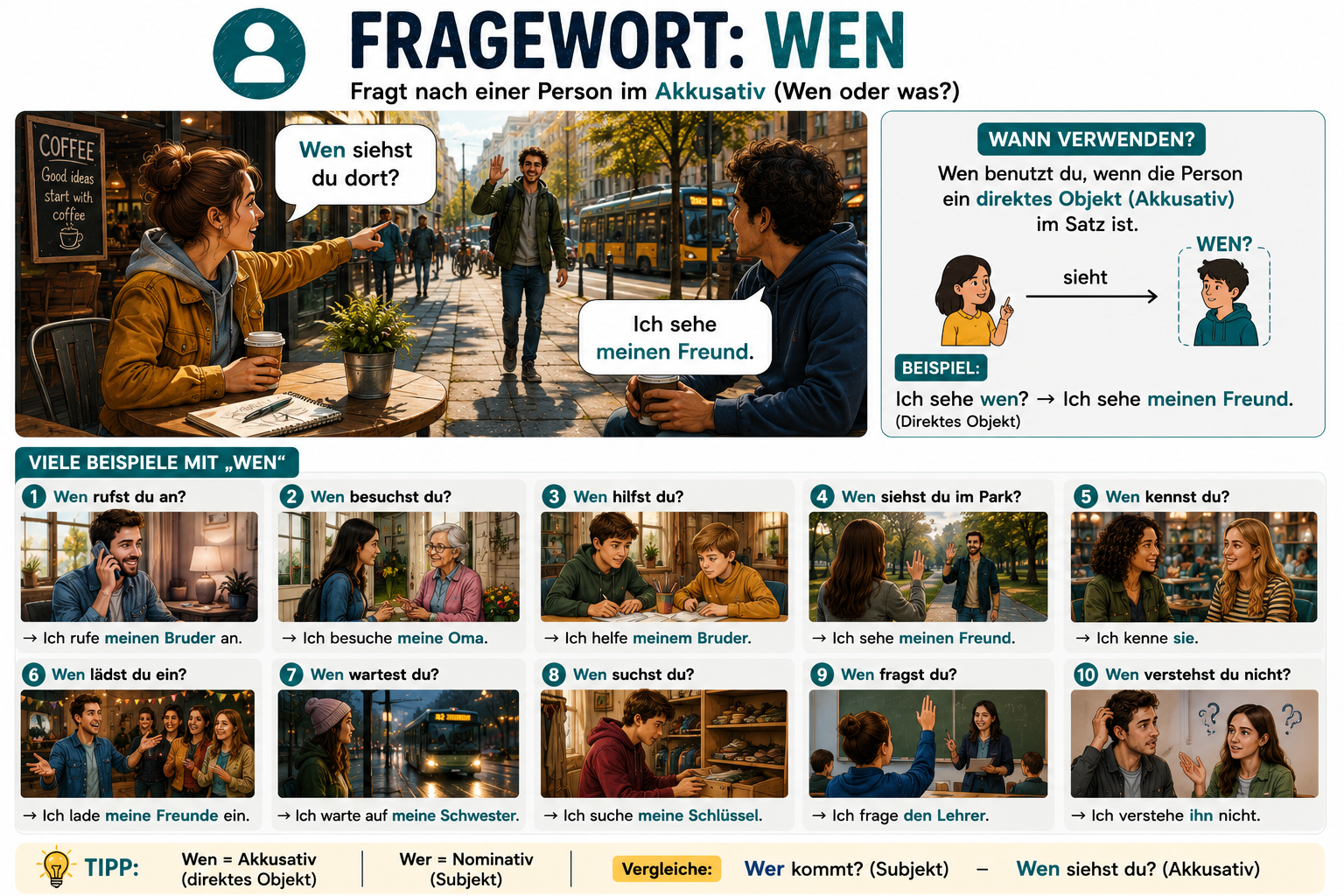
✅ Examples wen:
| German | English |
|---|---|
| Wen siehst du? | Whom do you see? |
| Wen kennst du? | Whom do you know? |
| Wen besuchst du? | Whom are you visiting? |
| Wen rufst du an? | Whom are you calling? |
| Wen triffst du heute? | Whom are you meeting today? |
| Wen liebst du? | Whom do you love? |
| Wen suchst du? | Whom are you looking for? |
| Wen fragst du? | Whom are you asking? |
| Wen lädst du ein? | Whom are you inviting? |
| Wen vermisst du? | Whom do you miss? |
| Wen erwartest du? | Whom are you expecting? |
| Wen fotografierst du? | Whom are you photographing? |
| Wen beobachtest du? | Whom are you watching? |
| Wen hörst du? | Whom do you hear? |
| Wen unterstützt du? | Whom are you supporting? |
| Wen bewunderst du? | Whom do you admire? |
| Wen möchtest du treffen? | Whom would you like to meet? |
| Wen holst du ab? | Whom are you picking up? |
| Wen feierst du? | Whom are you celebrating? |
| Wen verstehst du nicht? | Whom don't you understand? |
3. Wem ( to whom) → 🎁 Indirect Object
If someone is receiving, getting, being helped, shown, told, written to, or given something, the question is usually wem? (Dative).
(The person benefiting from or receiving something)
flowchart LR
    A["👩 Subject<br/><b>Die Frau</b>"]
    B["📖 Object<br/><b>das Buch</b>"]
    C["🎁 Receiver (Dative)<br/><b>dem Jungen</b>"]
    D["❓ Wem gibt die Frau das Buch?"]
    E["✅ Dem Jungen."]

    A -. Answers .-> D
    D --> E
    C -.-> E

    A -->|"gibt"| B
    B -->|"to"| C

    classDef subject fill:#d1fae5,stroke:#16a34a,color:#000;
    classDef object fill:#fde68a,stroke:#ca8a04,color:#000;
    classDef receiver fill:#ddd6fe,stroke:#7c3aed,color:#000;
    classDef question fill:#dbeafe,stroke:#2563eb,color:#000;

    class A subject;
    class B object;
    class C receiver;
    class D,E question;
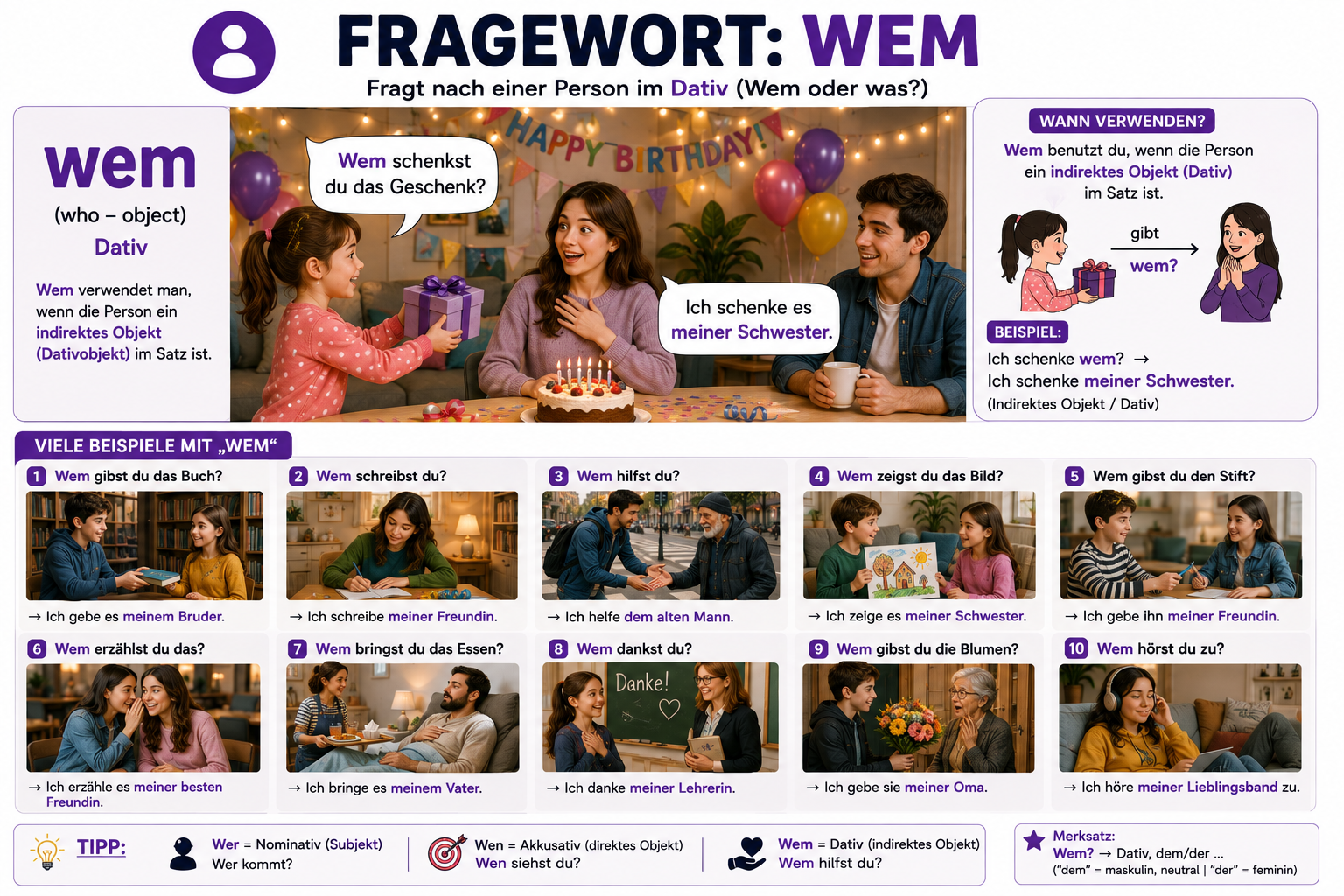
✅ Examples Wem:
| German | English |
|---|---|
| Wem gibst du das Buch? | To whom are you giving the book? |
| Wem schenkst du das Geschenk? | To whom are you giving the gift? |
| Wem hilfst du? | Whom are you helping? |
| Wem schreibst du? | To whom are you writing? |
| Wem erzählst du die Geschichte? | To whom are you telling the story? |
| Wem zeigst du das Foto? | To whom are you showing the photo? |
| Wem schickst du die E-Mail? | To whom are you sending the email? |
| Wem gehörte das Auto? | To whom did the car belong? |
| Wem vertraust du? | Whom do you trust? |
| Wem glaubst du? | Whom do you believe? |
| Wem dankst du? | Whom are you thanking? |
| Wem gratulierst du? | Whom are you congratulating? |
| Wem antwortest du? | To whom are you replying? |
| Wem folgst du auf Instagram? | Whom do you follow on Instagram? |
| Wem bringst du den Kaffee? | To whom are you bringing the coffee? |
| Wem leihst du dein Fahrrad? | To whom are you lending your bicycle? |
| Wem gibst du den Schlüssel? | To whom are you giving the key? |
| Wem gehört dieses Handy? | To whom does this phone belong? |
| Wem kaufst du Blumen? | For whom are you buying flowers? |
| Wem erzählst du das Geheimnis? | To whom are you telling the secret? |
4. Wessen --> Whose
flowchart LR
A["👨 Owner (Genitive)<br/><b>der Mann</b>"]
B["🚗 Possession<br/><b>das Auto</b>"]

    D["❓ Wessen Auto ist das?"]
    E["✅ Das Auto des Mannes."]

    A -->|"owns"| B

    A -. Answers .-> D
    D --> E
    B -.-> E

    classDef owner fill:#ddd6fe,stroke:#7c3aed,color:#000;
    classDef item fill:#fde68a,stroke:#ca8a04,color:#000;
    classDef question fill:#dbeafe,stroke:#2563eb,color:#000;

    class A owner;
    class B item;
    class D,E question;
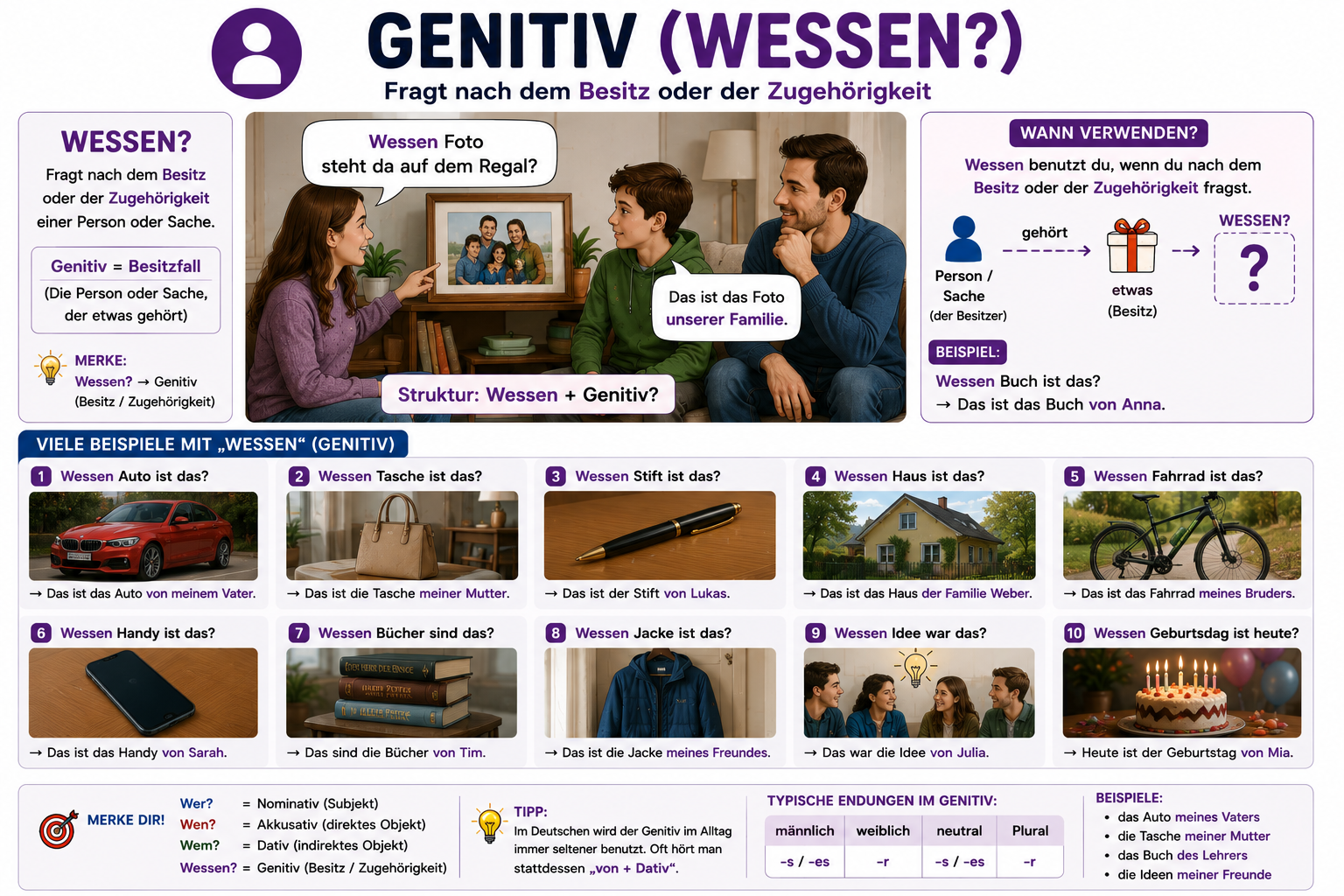
✅ Examples Wem:
| German | English |
|---|---|
| Wessen Auto ist das? | Whose car is that? |
| Wessen Buch ist das? | Whose book is that? |
| Wessen Handy klingelt? | Whose phone is ringing? |
| Wessen Tasche ist das? | Whose bag is that? |
| Wessen Fahrrad ist das? | Whose bicycle is that? |
| Wessen Schlüssel sind das? | Whose keys are those? |
| Wessen Hund ist das? | Whose dog is that? |
| Wessen Jacke hängt dort? | Whose jacket is hanging there? |
| Wessen Laptop benutzt du? | Whose laptop are you using? |
| Wessen Haus ist das? | Whose house is that? |
| Wessen Stift hast du? | Whose pen do you have? |
| Wessen Foto ist das? | Whose photo is that? |
| Wessen Idee war das? | Whose idea was that? |
| Wessen Geburtstag ist heute? | Whose birthday is today? |
| Wessen Katze schläft dort? | Whose cat is sleeping there? |
| Wessen Rucksack ist das? | Whose backpack is that? |
| Wessen Uhr trägst du? | Whose watch are you wearing? |
| Wessen Computer ist kaputt? | Whose computer is broken? |
| Wessen Zimmer ist das? | Whose room is that? |
| Wessen Notizen liest du? | Whose notes are you reading? |
Place 📍
| # | Question | 🇬🇧 English | 💬 Example | 🧭 Notes |
|---|---|---|---|---|
| 📍 | wo | where | Wo wohnst du? → Where do you live? | Static location (no movement) |
| 🗺️ | woher | where from | Woher kommst du? → Where do you come from? | Origin / source |
| ✈️ | wohin | where to | Wohin gehst du? → Where are you going? | Destination / direction |
1. 📍 WO = Where
👤 is at 📍 Place
flowchart LR
    A["👩 Anna"]
    B["🏠 House"]

    D["❓ Wo wohnt Anna?"]
    E["✅ In München."]

    A -->|"wohnt in"| B

    A -. Answers .-> D
    D --> E
    B -.-> E

    classDef person fill:#d1fae5,stroke:#16a34a,color:#000;
    classDef place fill:#fde68a,stroke:#ca8a04,color:#000;
    classDef question fill:#dbeafe,stroke:#2563eb,color:#000;

    class A person;
    class B place;
    class D,E question;
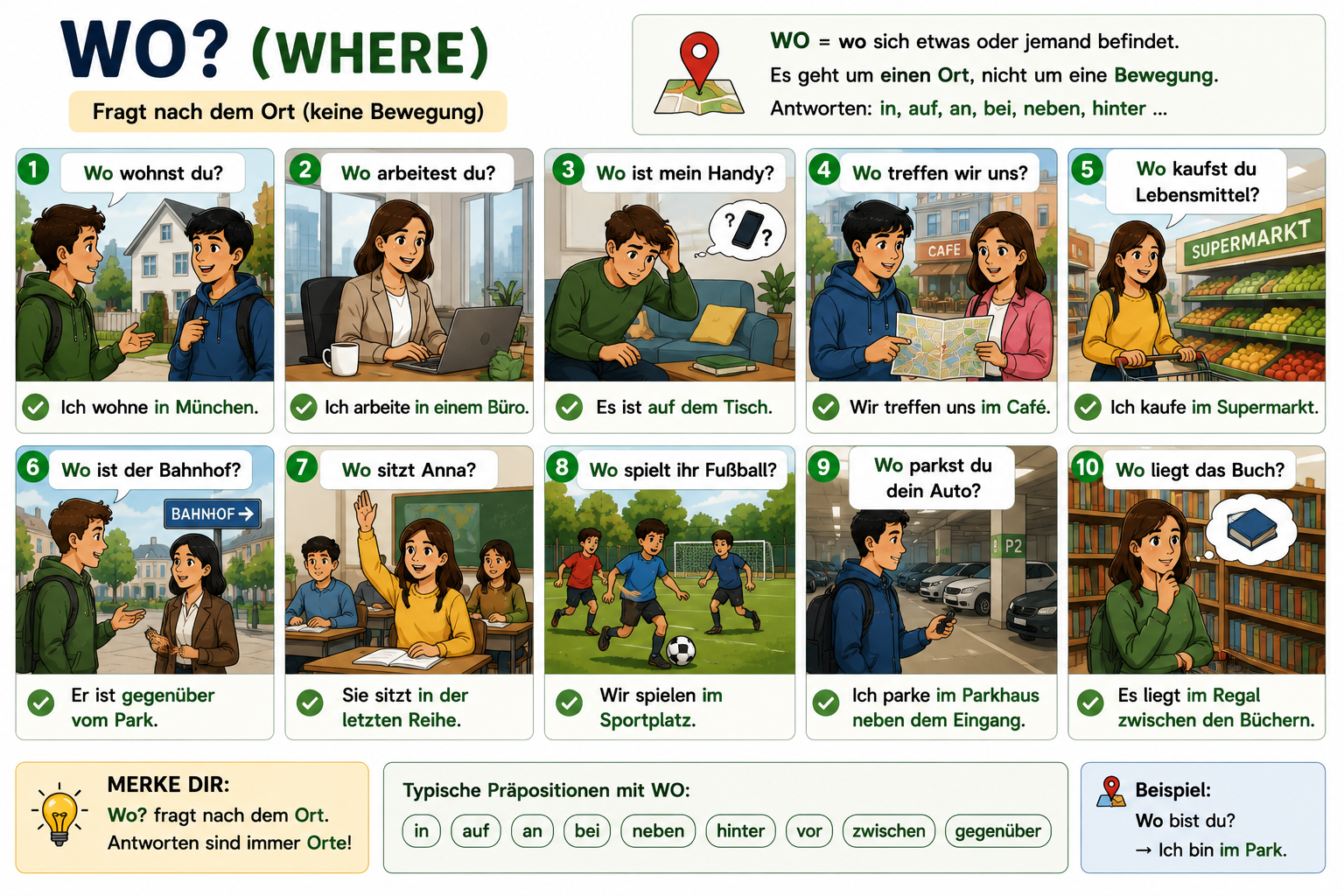
✅ Examples Wem:
| German | English |
|---|---|
| Wo wohnst du? | Where do you live? |
| Wo arbeitest du? | Where do you work? |
| Wo bist du? | Where are you? |
| Wo ist das Hotel? | Where is the hotel? |
| Wo ist mein Handy? | Where is my phone? |
| Wo liegt München? | Where is Munich located? |
| Wo steht mein Auto? | Where is my car parked? |
| Wo sitzt Anna? | Where is Anna sitting? |
| Wo schläfst du? | Where do you sleep? |
| Wo lernst du Deutsch? | Where do you learn German? |
| Wo kaufst du Lebensmittel? | Where do you buy groceries? |
| Wo trinkst du Kaffee? | Where do you drink coffee? |
| Wo treffen wir uns? | Where shall we meet? |
| Wo spielt ihr Fußball? | Where do you play football? |
| Wo feierst du deinen Geburtstag? | Where are you celebrating your birthday? |
| Wo parkst du dein Auto? | Where do you park your car? |
| Wo wartet der Bus? | Where is the bus waiting? |
| Wo ist der Bahnhof? | Where is the train station? |
| Wo liegt das Buch? | Where is the book? |
| Wo wohnt deine Familie? | Where does your family live? |
2. 🗺️ Woher = From Where
👤 comes from → Place 📍
flowchart LR

    A["👩 Anna"]
    B["🌍 Origin<br/><b>Deutschland</b>"]

    D["❓ Woher kommt Anna?"]
    E["✅ Aus Deutschland."]

    A -->|"kommt aus"| B

    A -.-> D
    D -->E
    B --> |"Answers"| E

    classDef place fill:#fde68a,stroke:#ca8a04,color:#000;
    classDef person fill:#d1fae5,stroke:#16a34a,color:#000;
    classDef question fill:#dbeafe,stroke:#2563eb,color:#000;

    class A place;
    class B person;
    class D,E question;
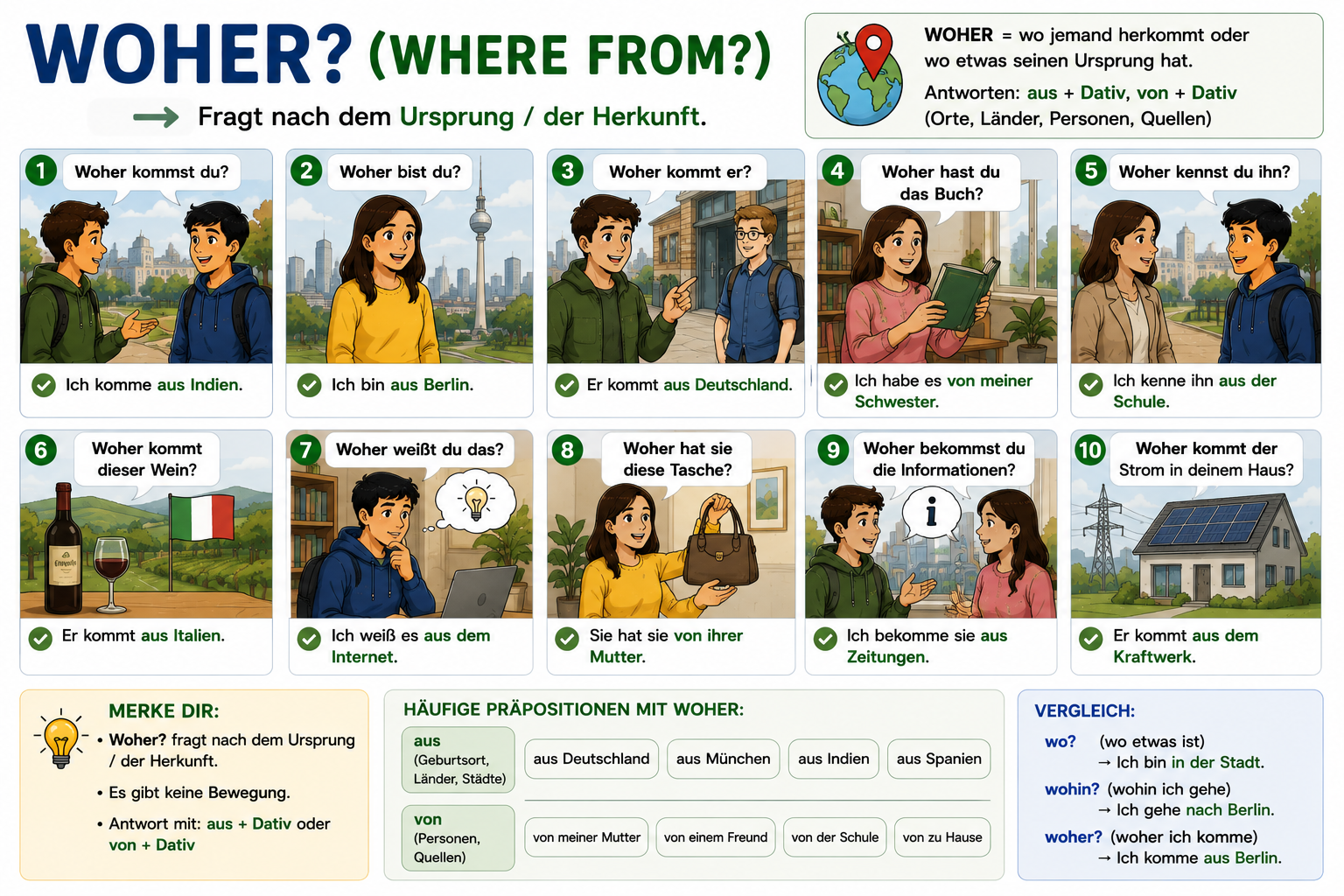
Common Patterns
| Origin | Preposition | Example |
|---|---|---|
| 🏙️ Cities | aus | aus Paris, aus Berlin |
| 🌍 Countries | aus | aus Deutschland, aus Indien |
| 🏠 Home | von zu Hause | Ich komme von zu Hause. |
| 👤 People | von | von meiner Oma, von meinem Freund |
| 🏢 Buildings / Institutions | von | vom Arzt, von der Schule, vom Bahnhof |
| 🌳 Enclosed places | aus + Dativ | aus dem Park, aus dem Kino, aus der Stadt |
| 🏖️ Open places | von + Dativ | vom Strand, vom Markt |
✅ Examples Woher:
| Origin Type | Question | Answer |
|---|---|---|
| 🏙️ City | Woher kommst du? | Ich komme aus Paris. |
| 🇩🇪 Country | Woher kommst du? | Ich komme aus Deutschland. |
| 🇮🇳 Country | Woher kommst du? | Ich komme aus Indien. |
| 🏫 School | Woher kommst du? | Ich komme von der Schule. |
| 🏢 Office | Woher kommst du? | Ich komme vom Büro. |
| 🏡 Home | Woher kommst du? | Ich komme von zu Hause. |
| 🏥 Doctor | Woher kommst du? | Ich komme vom Arzt. |
| 🏪 Supermarket | Woher kommst du? | Ich komme vom Supermarkt. |
| ☕ Café | Woher kommst du? | Ich komme vom Café. |
| 🎬 Cinema | Woher kommt ihr? | Wir kommen aus dem Kino. |
| 🌳 Park | Woher kommst du? | Ich komme aus dem Park. |
| 🏖️ Beach | Woher kommt ihr? | Wir kommen vom Strand. |
| 🚉 Train Station | Woher kommst du? | Ich komme vom Bahnhof. |
| ✈️ Airport | Woher kommst du? | Ich komme vom Flughafen. |
| 👵 Grandmother | Woher kommst du? | Ich komme von meiner Oma. |
3. ✈️ Wohin = Where to
👤 goes ✈️ to --> 📍 Place
flowchart LR

  A["👩 Anna"]
  B["🗼 Destination<br/><b>Paris</b>"]

  D["❓ Wohin fährt Anna?"]
  E["✅ Nach Paris."]

  A -->|"fährt 🚄 ➜"| B

  A -. Answers .-> D
  D --> E
  B -.-> E

  classDef person fill:#d1fae5,stroke:#16a34a,color:#000;
  classDef place fill:#fde68a,stroke:#ca8a04,color:#000;
  classDef question fill:#dbeafe,stroke:#2563eb,color:#000;

  class A person;
  class B place;
  class D,E question;
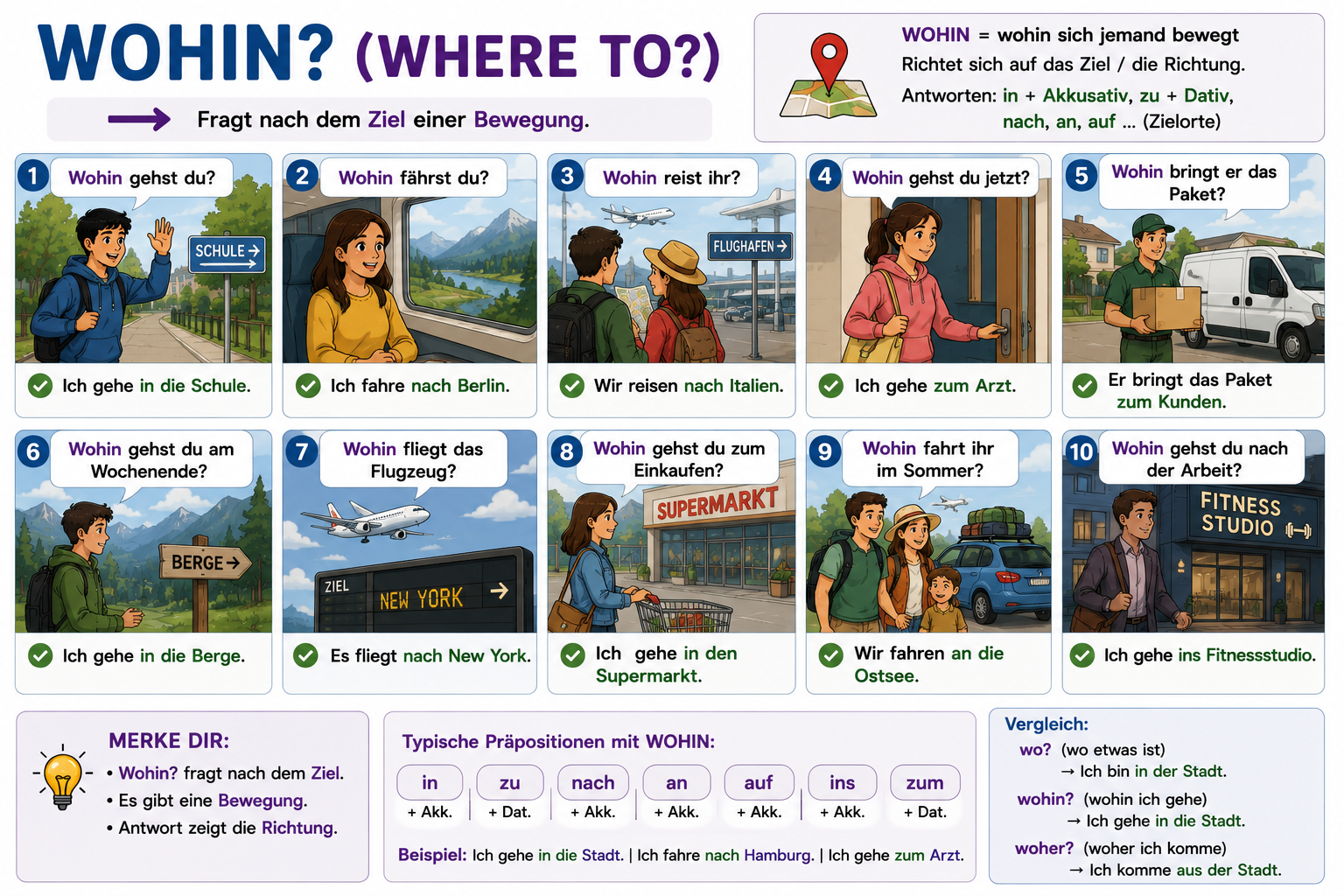
Common Patterns
| Destination | Preposition | Example |
|---|---|---|
| 🏙️ City | nach | Nach Paris |
| 🇩🇪 Country (no article) | nach | Nach Deutschland |
| 🏫 Building / person | zu | Zur Schule, zum Arzt |
| 🏠 Home | (no preposition) | Nach Hause |
| 🌳 Place with article | in + Akk. | In die Stadt, in den Park |
| 🏝️ Country with article | in + Akk. | In die Schweiz, in die USA |
✅ Examples Wohin:
| Destination Type | Question | Answer |
|---|---|---|
| 🏙️ City | Wohin fährst du? | Ich fahre nach Paris. |
| 🇩🇪 Country (no article) | Wohin reist ihr? | Wir reisen nach Deutschland. |
| 🇨🇭 Country (with article) | Wohin fährst du? | Ich fahre in die Schweiz. |
| 🏫 School | Wohin gehst du? | Ich gehe zur Schule. |
| 🏥 Doctor | Wohin gehst du? | Ich gehe zum Arzt. |
| 🏢 Office | Wohin gehst du? | Ich gehe ins Büro. |
| 🏡 Home | Wohin gehst du? | Ich gehe nach Hause. |
| 🌳 Park | Wohin gehst du? | Ich gehe in den Park. |
| 🏪 Supermarket | Wohin gehst du? | Ich gehe in den Supermarkt. |
| ☕ Café | Wohin gehst du? | Ich gehe ins Café. |
| 🎬 Cinema | Wohin geht ihr? | Wir gehen ins Kino. |
| 🏖️ Beach | Wohin fahrt ihr? | Wir fahren an den Strand. |
| 🏔️ Mountains | Wohin fahrt ihr? | Wir fahren in die Berge. |
| ✈️ Airport | Wohin fährst du? | Ich fahre zum Flughafen. |
| 🚉 Train Station | Wohin gehst du? | Ich gehe zum Bahnhof. |
Manner & Quantity 🤔
| # | Question | 🇬🇧 English | 💬 Example | 🧭 Notes |
|---|---|---|---|---|
| 🤔 | wie | how | Wie geht es dir? → How are you? | Manner / condition |
| 💰 | wie viel | how much | Wie viel kostet das? → How much does it cost? | Uncountable nouns |
| 🔢 | wie viele | how many | Wie viele Geschwister hast du? → How many siblings do you have? | Countable nouns |
| 🔄 | wie oft | how often | Wie oft gehst du ins Fitnessstudio? → How often do you go to the gym? | Frequency |
| ⏳ | wie lange | how long | Wie lange lernst du Deutsch? → How long have you been learning German? | Duration |
1. 🤔 Wie (How?)
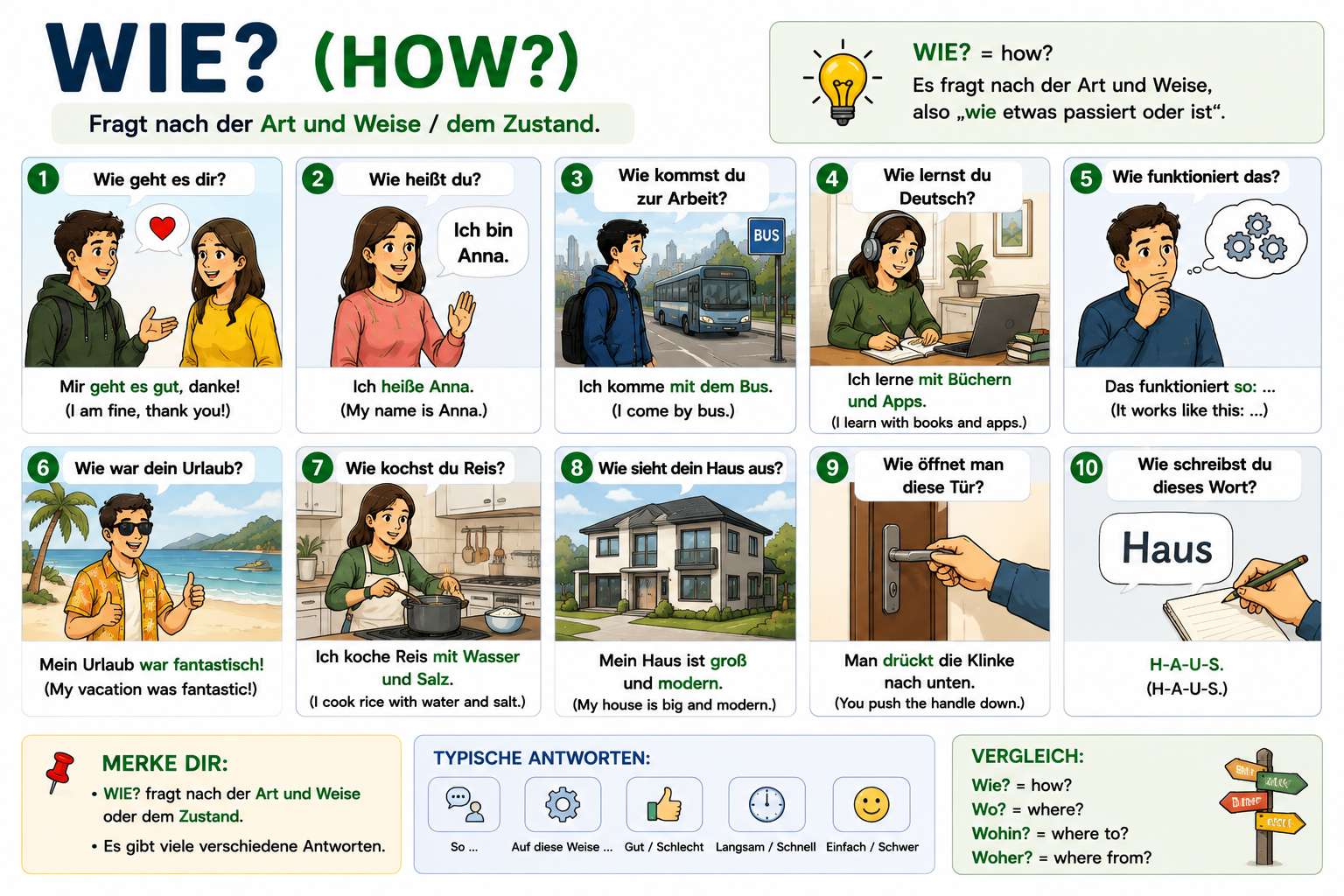
✅ Examples Wie:
| German | English |
|---|---|
| Wie geht es dir? | How are you? |
| Wie heißt du? | What is your name? (Literally: How are you called?) |
| Wie kommst du zur Arbeit? | How do you get to work? |
| Wie lernst du Deutsch? | How do you learn German? |
| Wie funktioniert das? | How does that work? |
| Wie kochst du Reis? | How do you cook rice? |
| Wie sieht dein Haus aus? | What does your house look like? |
| Wie war dein Urlaub? | How was your vacation? |
| Wie öffnet man diese Tür? | How do you open this door? |
| Wie schreibst du dieses Wort? | How do you spell this word? |
2. 💰 Wie viel (How much?)
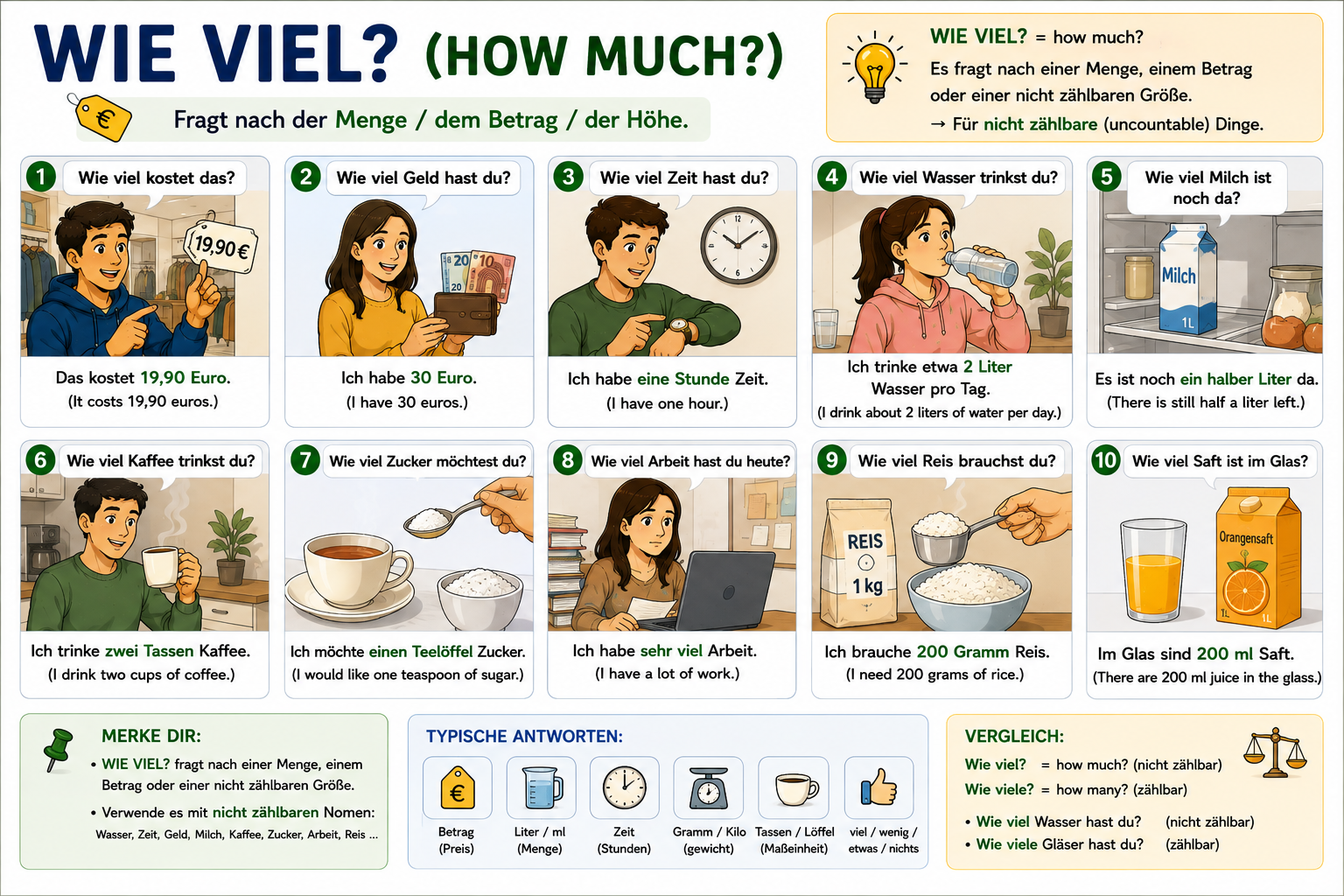
✅ Examples Wie viel:
| German | English |
|---|---|
| Wie viel kostet das? | How much does it cost? |
| Wie viel Wasser trinkst du? | How much water do you drink? |
| Wie viel Zeit hast du? | How much time do you have? |
| Wie viel Geld brauchst du? | How much money do you need? |
| Wie viel Zucker möchtest du? | How much sugar would you like? |
| Wie viel Milch ist noch da? | How much milk is left? |
| Wie viel Kaffee trinkst du? | How much coffee do you drink? |
| Wie viel Arbeit hast du heute? | How much work do you have today? |
| Wie viel Brot kaufst du? | How much bread are you buying? |
| Wie viel Reis brauchst du? | How much rice do you need? |
🔢 wie viele (How many?)
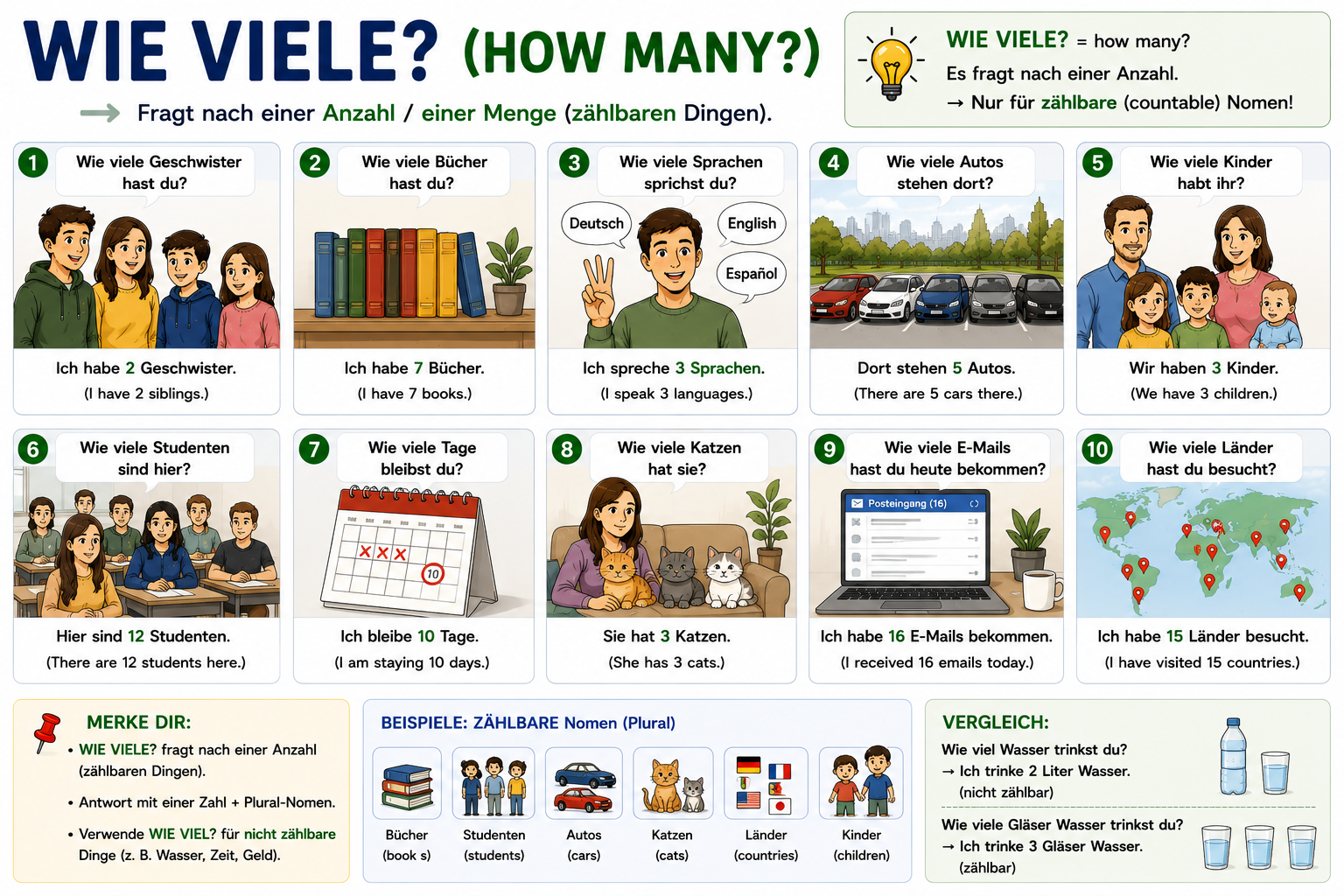
✅ Examples Wie viele:
| German | English |
|---|---|
| Wie viele Geschwister hast du? | How many siblings do you have? |
| Wie viele Bücher hast du? | How many books do you have? |
| Wie viele Sprachen sprichst du? | How many languages do you speak? |
| Wie viele Kinder habt ihr? | How many children do you have? |
| Wie viele Autos stehen dort? | How many cars are parked there? |
| Wie viele Studenten sind hier? | How many students are here? |
| Wie viele Tage bleibst du? | How many days are you staying? |
| Wie viele E-Mails hast du heute bekommen? | How many emails did you receive today? |
| Wie viele Katzen hat sie? | How many cats does she have? |
| Wie viele Länder hast du besucht? | How many countries have you visited? |
3. 🔄 Wie oft (How often?)
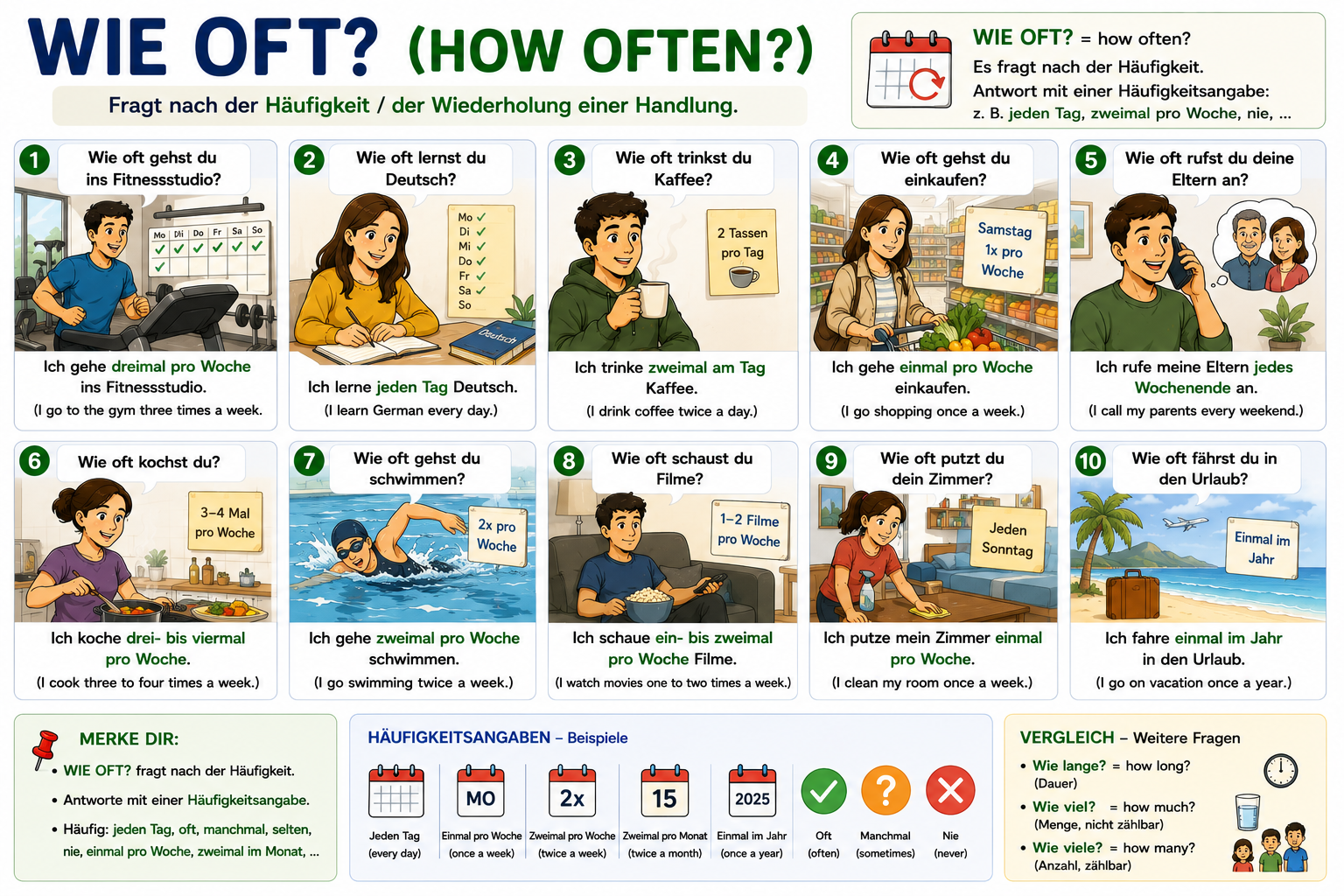
✅ Examples Wie oft:
| German | English |
|---|---|
| Wie oft gehst du ins Fitnessstudio? | How often do you go to the gym? |
| Wie oft lernst du Deutsch? | How often do you study German? |
| Wie oft reist du? | How often do you travel? |
| Wie oft rufst du deine Eltern an? | How often do you call your parents? |
| Wie oft kochst du? | How often do you cook? |
| Wie oft gehst du einkaufen? | How often do you go shopping? |
| Wie oft liest du Bücher? | How often do you read books? |
| Wie oft schaust du Filme? | How often do you watch movies? |
| Wie oft putzt du dein Auto? | How often do you clean your car? |
| Wie oft fährst du nach Berlin? | How often do you travel to Berlin? |
4. ⏳ wie lange (How long?)
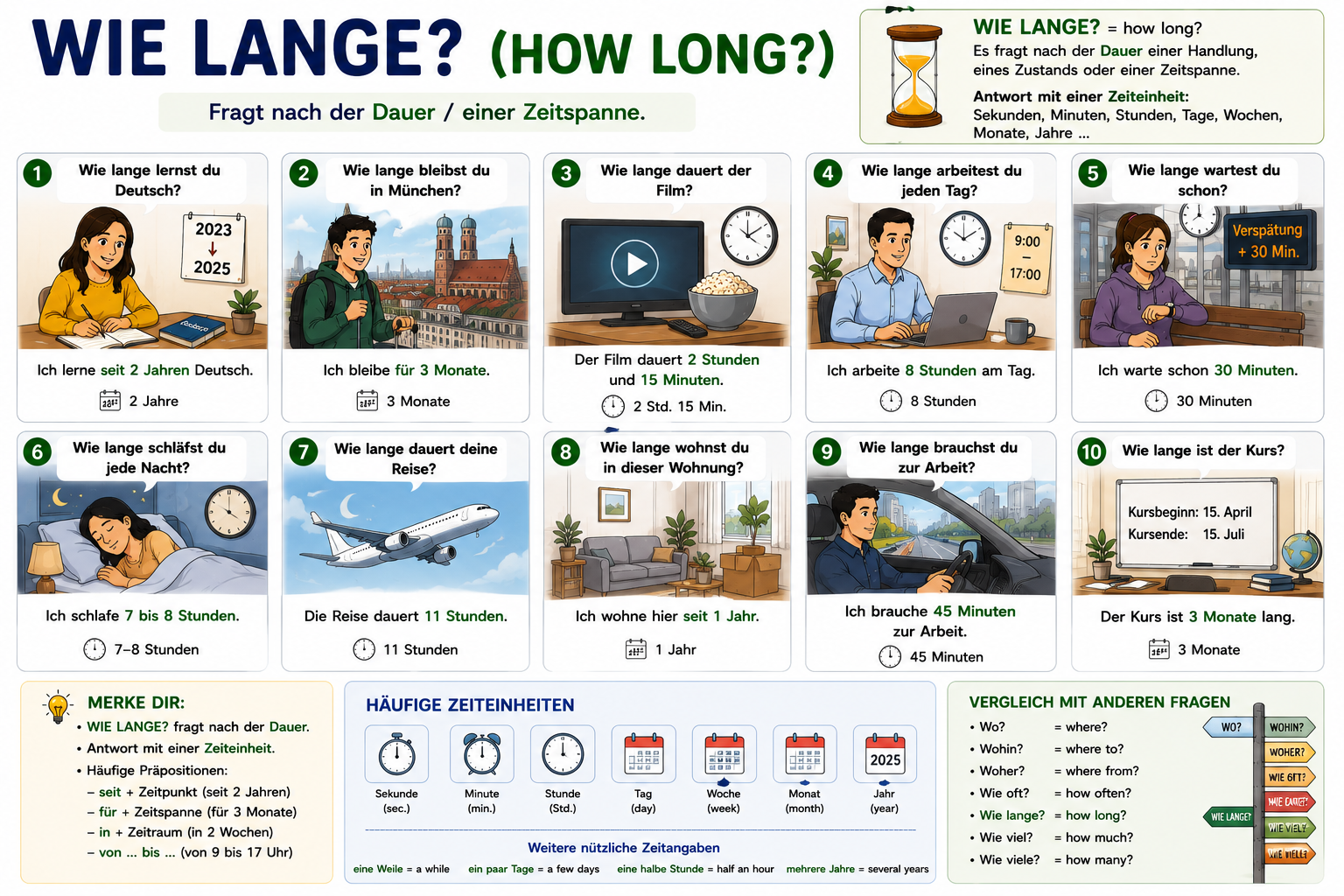
✅ Examples Wie lange:
| German | English |
|---|---|
| Wie lange lernst du Deutsch? | How long have you been learning German? |
| Wie lange bleibst du hier? | How long are you staying here? |
| Wie lange dauert der Film? | How long is the movie? |
| Wie lange arbeitest du heute? | How long are you working today? |
| Wie lange wohnst du in München? | How long have you lived in Munich? |
| Wie lange dauert die Reise? | How long does the trip take? |
| Wie lange wartest du schon? | How long have you been waiting? |
| Wie lange schläfst du? | How long do you sleep? |
| Wie lange kennst du ihn? | How long have you known him? |
| Wie lange brauchst du zur Arbeit? | How long does it take you to get to work? |
Reason 💭
| # | Question | 🇬🇧 English | 💬 Example | 🧭 Notes |
|---|---|---|---|---|
| 🤷 | warum | why | Warum lernst du Deutsch? → Why are you learning German? | Standard, everyday; asks for the reason |
| 💭 | wieso | why / how come | Wieso bist du spät? → Why are you late? | Casual, conversational |
| 📝 | weshalb | why | Weshalb ist der Laden geschlossen? → Why is the shop closed? | Formal; common in writing |
| 🎯 | wozu | what for / for what purpose | Wozu brauchst du das Messer? → What do you need the knife for? | Asks for the purpose |
| 📜 | aus welchem Grund | for what reason | Aus welchem Grund wurde das Meeting verschoben? → For what reason was the meeting postponed? | Very formal; common in official documents, reports, and legal language |
1. 🤷 Warum = Why
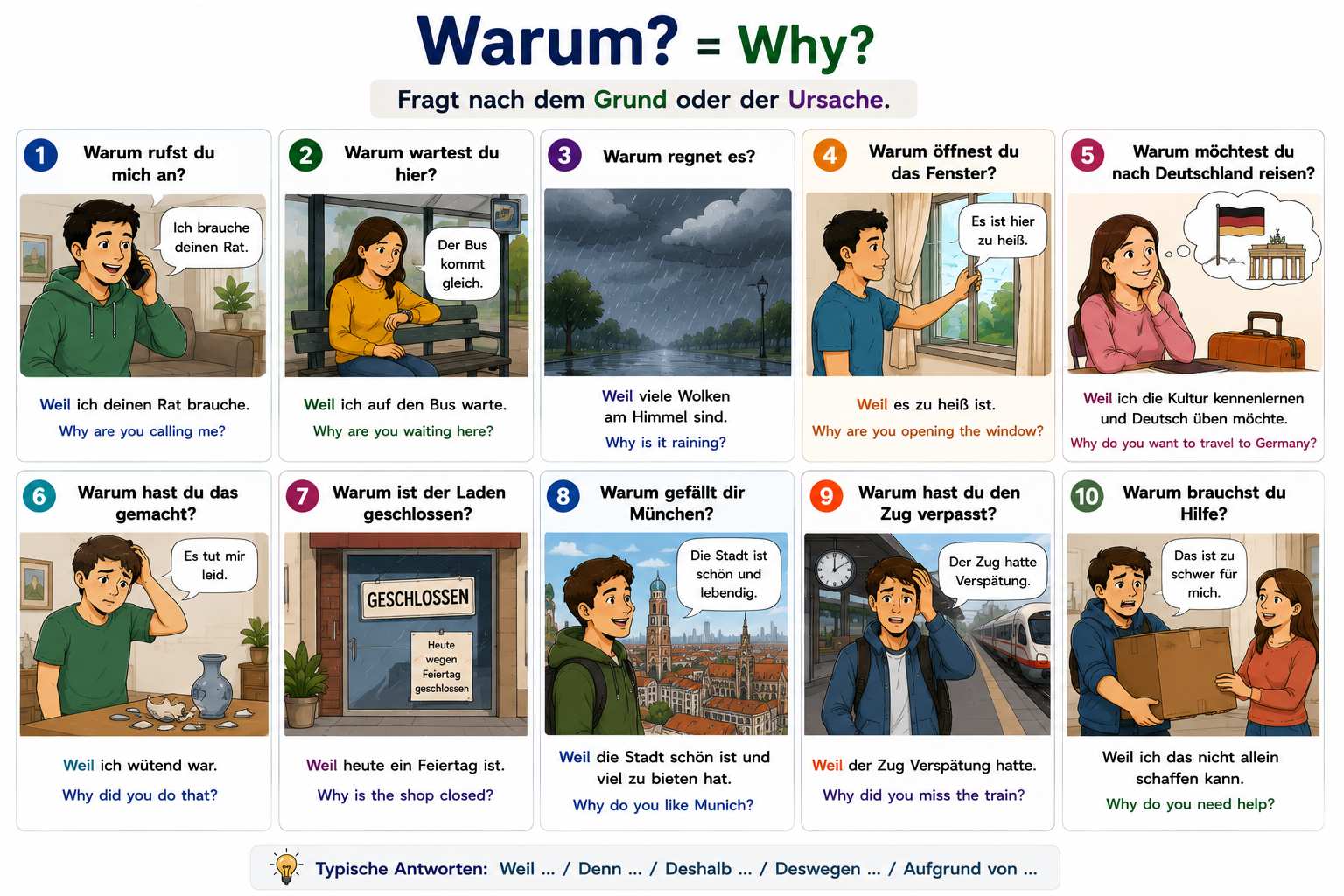
✅ Examples Warum:
| German | English |
|---|---|
| Warum lernst du Deutsch? | Why are you learning German? |
| Warum bist du müde? | Why are you tired? |
| Warum kommst du zu spät? | Why are you late? |
| Warum lachst du? | Why are you laughing? |
| Warum weinst du? | Why are you crying? |
| Warum gehst du nach Hause? | Why are you going home? |
| Warum arbeitest du heute? | Why are you working today? |
| Warum kaufst du das Buch? | Why are you buying the book? |
| Warum trinkst du so viel Kaffee? | Why do you drink so much coffee? |
| Warum kochst du heute? | Why are you cooking today? |
| Warum rufst du mich an? | Why are you calling me? |
| Warum wartest du hier? | Why are you waiting here? |
| Warum regnet es? | Why is it raining? |
| Warum öffnest du das Fenster? | Why are you opening the window? |
| Warum möchtest du nach Deutschland reisen? | Why do you want to travel to Germany? |
| Warum hast du das gemacht? | Why did you do that? |
| Warum ist der Laden geschlossen? | Why is the shop closed? |
| Warum gefällt dir München? | Why do you like Munich? |
| Warum hast du den Zug verpasst? | Why did you miss the train? |
| Warum brauchst du Hilfe? | Why do you need help? |
2. 💭 Wieso = Why (Causal)
It asks for the reason or cause of something, just like warum.
The difference is that wieso is slightly more casual and often expresses curiosity or surprise.
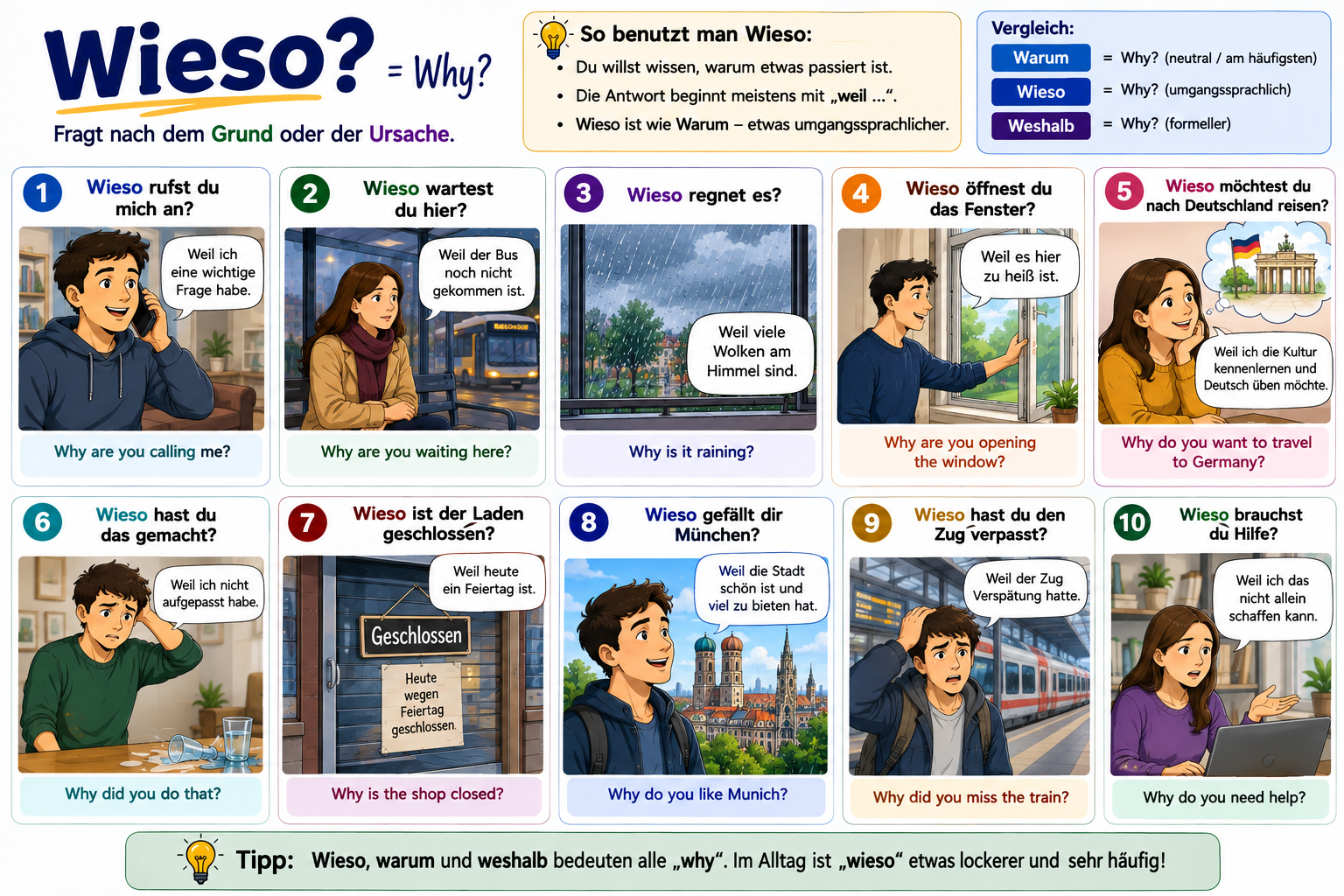
✅ Examples Wieso:
| German | English |
|---|---|
| Wieso bist du spät? | Why are you late? |
| Wieso lachst du? | Why are you laughing? |
| Wieso bist du heute zu Hause? | Why are you at home today? |
| Wieso lernst du Deutsch? | Why are you learning German? |
| Wieso regnet es heute? | Why is it raining today? |
| Wieso hast du angerufen? | Why did you call? |
| Wieso wartest du hier? | Why are you waiting here? |
| Wieso gefällt dir München? | Why do you like Munich? |
| Wieso hast du den Zug verpasst? | Why did you miss the train? |
| Wieso brauchst du Hilfe? | Why do you need help? |
3. 📝 Weshalb = Why? (formal)
Why format used in Formal writing
Usage
- 📰 Newspapers and articles
- 🏛️ Official letters and documents
- 🎓 Exams and formal writing
- 💼 Professional or formal conversations
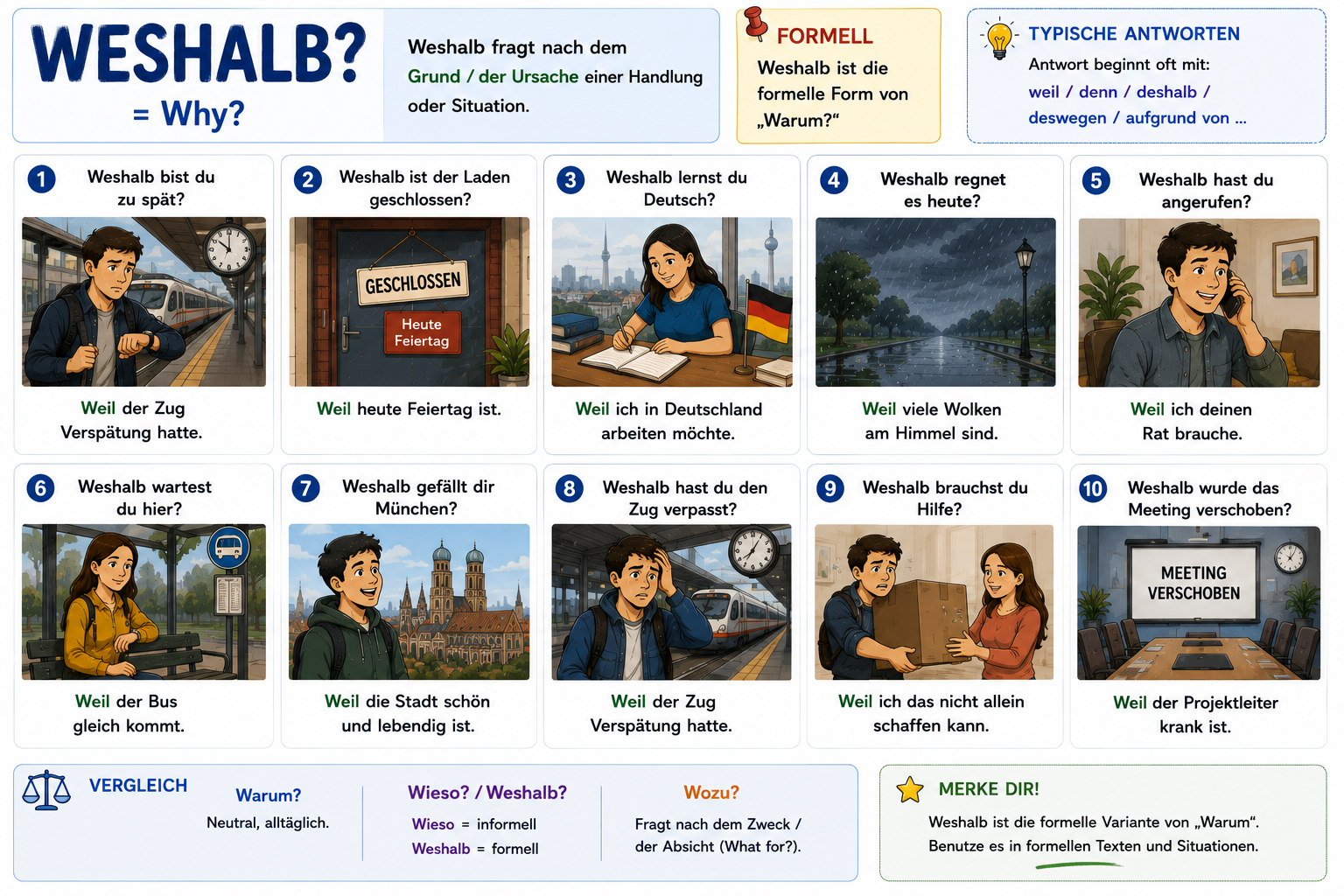
✅ Examples Weshalb:
| German | English |
|---|---|
| Weshalb bist du zu spät? | Why are you late? |
| Weshalb ist der Laden geschlossen? | Why is the shop closed? |
| Weshalb lernst du Deutsch? | Why are you learning German? |
| Weshalb regnet es heute? | Why is it raining today? |
| Weshalb hast du angerufen? | Why did you call? |
| Weshalb wartest du hier? | Why are you waiting here? |
| Weshalb gefällt dir München? | Why do you like Munich? |
| Weshalb hast du den Zug verpasst? | Why did you miss the train? |
| Weshalb brauchst du Hilfe? | Why do you need help? |
| Weshalb wurde das Meeting verschoben? | Why was the meeting postponed? |
4. 🎯 Wozu = for what Purpose
Asking for purpose
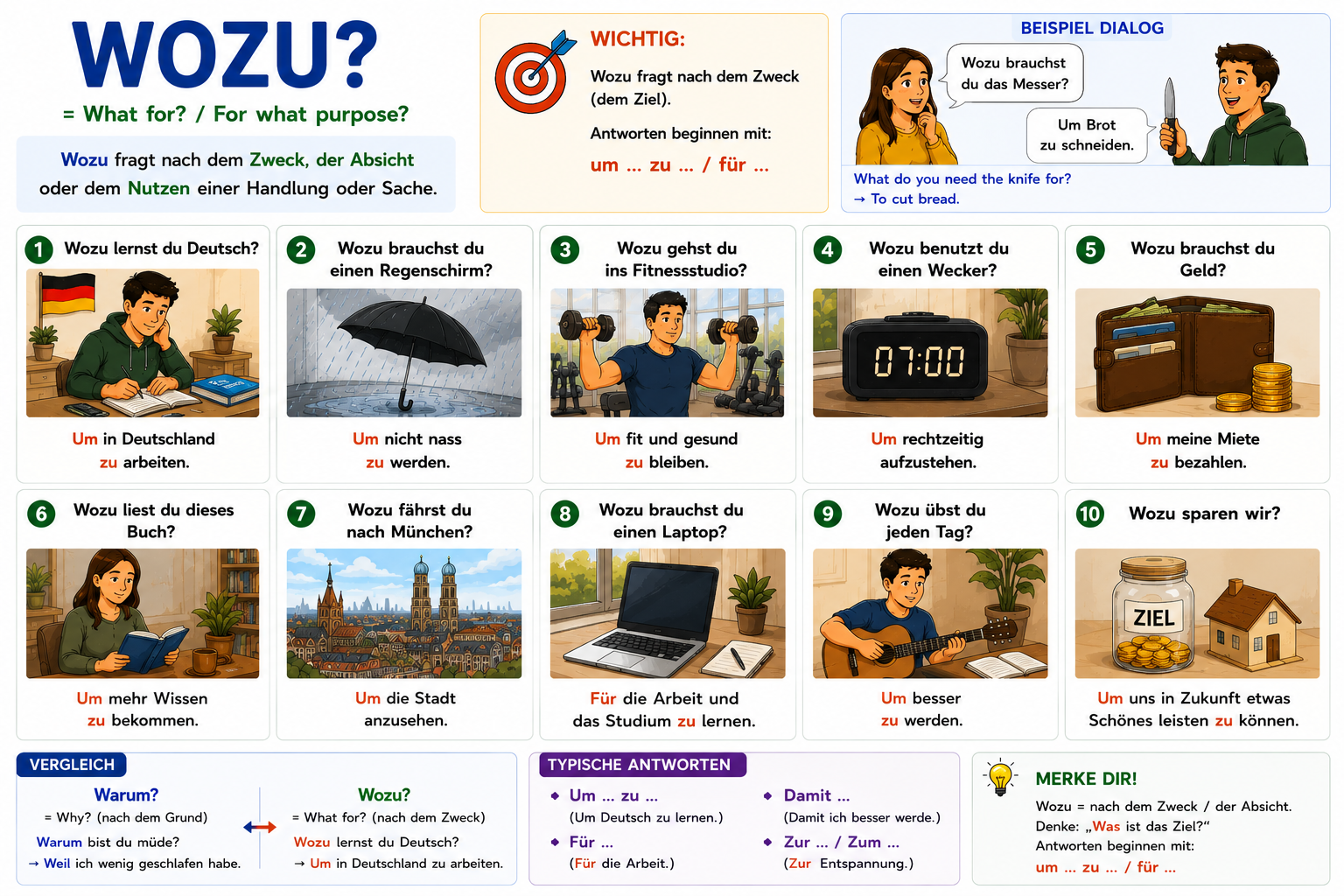
Common Answer Patterns
| Pattern | Example |
|---|---|
| Um ... zu + Infinitiv | Um Deutsch zu lernen. |
| Für + Akkusativ | Für die Arbeit. |
| Damit + Nebensatz | Damit ich die Prüfung bestehe. |
| Zum / Zur + Nomen | Zum Lernen, zur Entspannung. |
✅ Examples Weshalb:
| Question | Answer |
|---|---|
| Wozu lernst du Deutsch? | Um in Deutschland zu arbeiten. |
| Wozu brauchst du das Messer? | Um Brot zu schneiden. |
| Wozu brauchst du einen Regenschirm? | Um trocken zu bleiben. |
| Wozu gehst du ins Fitnessstudio? | Um fit zu bleiben. |
| Wozu benutzt du einen Wecker? | Um pünktlich aufzustehen. |
| Wozu brauchst du Geld? | Um meine Miete zu bezahlen. |
| Wozu liest du dieses Buch? | Um mehr zu lernen. |
| Wozu fährst du nach München? | Um Freunde zu besuchen. |
| Wozu brauchst du einen Laptop? | Für die Arbeit und das Studium. |
| Wozu übst du jeden Tag? | Um besser zu werden. |
| Wozu sparst du Geld? | Um ein Haus zu kaufen. |
| Wozu trägst du einen Helm? | Um meinen Kopf zu schützen. |
| Wozu benutzt man eine Brille? | Um besser sehen zu können. |
| Wozu dient dieser Knopf? | Um das Gerät einzuschalten. |
| Wozu braucht ihr ein Auto? | Für den Arbeitsweg. |
| Wozu kaufst du Blumen? | Für meine Mutter. |
| Wozu hast du das Werkzeug gekauft? | Um das Regal zu reparieren. |
| Wozu brauchst du einen Reisepass? | Um ins Ausland zu reisen. |
| Wozu möchtest du nach Deutschland reisen? | Um die Kultur kennenzulernen. |
| Wozu lernst du Programmieren? | Um Software zu entwickeln. |
5. 📜 Aus welchem Grund = "For what reason?"
On what ground = asking for reeason
Unlike wozu, which asks about purpose, aus welchem Grund always asks for the reason or cause behind something.
It asks for the reason or cause of an action or event, just like warum or weshalb, but it is very formal.
Usage
You'll often see it in official letters, legal documents, reports, contracts, surveys, and news articles.
- 🏛️ Government and legal documents
- 📄 Official letters and emails
- 📰 Formal reports and journalism
- 🎓 Academic writing
- 💼 Business communication
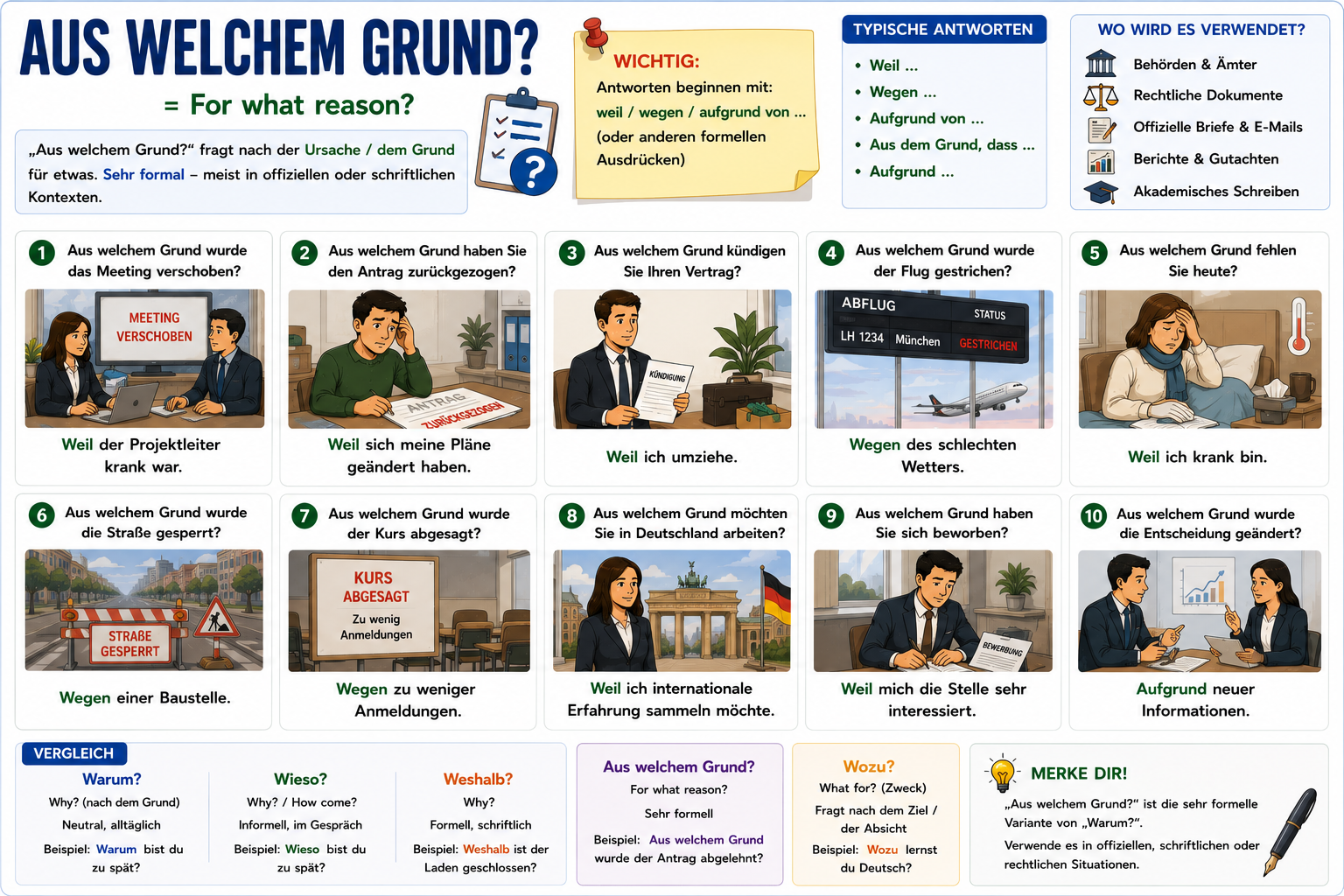
✅ Examples Aus welchem Grund:
Asking Aus welchem Grund Question
| German | English |
|---|---|
| Aus welchem Grund wurde das Meeting verschoben? | For what reason was the meeting postponed? |
| Aus welchem Grund haben Sie den Antrag zurückgezogen? | For what reason did you withdraw the application? |
| Aus welchem Grund kündigen Sie Ihren Vertrag? | For what reason are you terminating your contract? |
| Aus welchem Grund wurde der Flug gestrichen? | For what reason was the flight cancelled? |
| Aus welchem Grund fehlen Sie heute? | For what reason are you absent today? |
| Aus welchem Grund wurde die Straße gesperrt? | For what reason was the road closed? |
| Aus welchem Grund wurde der Kurs abgesagt? | For what reason was the course cancelled? |
| Aus welchem Grund möchten Sie in Deutschland arbeiten? | For what reason do you want to work in Germany? |
| Aus welchem Grund haben Sie sich beworben? | For what reason did you apply? |
| Aus welchem Grund wurde die Entscheidung geändert? | For what reason was the decision changed? |
Answering Aus welchem Grund
| Question | Answer |
|---|---|
| Aus welchem Grund wurde das Meeting verschoben? | Weil der Projektleiter krank war. |
| Aus welchem Grund haben Sie den Antrag zurückgezogen? | Weil sich meine Pläne geändert haben. |
| Aus welchem Grund kündigen Sie Ihren Vertrag? | Weil ich umziehe. |
| Aus welchem Grund wurde der Flug gestrichen? | Wegen des schlechten Wetters. |
| Aus welchem Grund fehlen Sie heute? | Weil ich krank bin. |
| Aus welchem Grund wurde die Straße gesperrt? | Wegen einer Baustelle. |
| Aus welchem Grund wurde der Kurs abgesagt? | Wegen zu weniger Anmeldungen. |
| Aus welchem Grund möchten Sie in Deutschland arbeiten? | Weil ich internationale Erfahrung sammeln möchte. |
| Aus welchem Grund haben Sie sich beworben? | Weil mich die Stelle sehr interessiert. |
| Aus welchem Grund wurde die Entscheidung geändert? | Aufgrund neuer Informationen. |
Time Interval 📅
| # | Question | 🇬🇧 English | 💬 Example | 🧭 Notes |
|---|---|---|---|---|
| 📅 | wann | when | Wann hast du Geburtstag? → When is your birthday? | Time reference |
| 🗓️ | seit wann | since when(Starting point) | Seit wann lernst du Deutsch? → Since when have you been learning German? | Starting point in time |
| 🕐 | ab wann | from when (Starting point) | Ab wann beginnt der Kurs? → From when does the course start? | Starting time |
| ⏱️ | bis wann | until when(Ending point) | Bis wann musst du die Aufgabe abgeben? → Until when do you have to submit the assignment? | Deadline |
| 🔄 | von wann bis wann | from when until when | Von wann bis wann dauert der Kurs? → From when until when does the course last? | Time range |
| ⏳ | wie lange | how long (Duration) | Wie lange lernst du schon Deutsch? → How long have you been learning German? | Duration |
flowchart LR


Start(("Start"))
End(("End "))

A["📅 Wann?<br/>When?"]
B["🗓️ Seit wann?<br/>Since when?"]
C["⏳ Wie lange?<br/>How long?"]
D["⏱️ Bis wann?<br/>Until when?"]
E["🕐 Ab wann?<br/>From when?"]
F["🔄 Von wann bis wann?<br/>Time range"]

  Start --> |begin| A -.-> C -.-> D--> |complete| End
  Start --> E -.-> C
  Start --> B -.-> C
  Start --> F --> D


classDef blue fill:#dbeafe,stroke:#2563eb,stroke-width:2px,color:#000;
classDef green fill:#d9f7be,stroke:#389e0d,stroke-width:2px,color:#000;
classDef yellow fill:#fff7b3,stroke:#d4b106,stroke-width:2px,color:#000;
classDef red fill:#ffd6d6,stroke:#cf1322,stroke-width:2px,color:#000;

class A,F blue;
class B,E green;
class C yellow;
class D red;
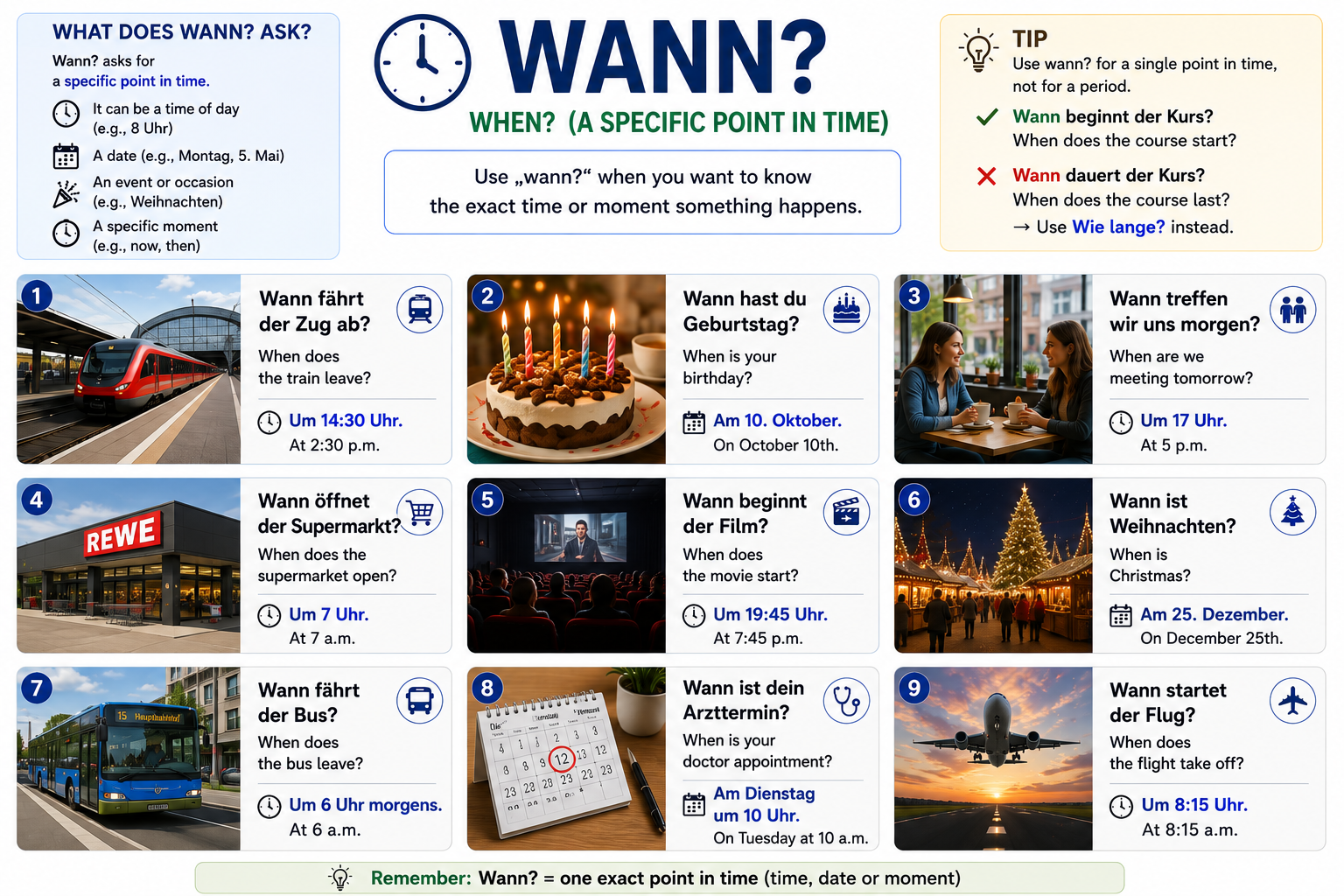
1. 📅 wann = When?
Wann = Wann Question about time
Wenn vs Wann
Wenn means "if" or "when" (for repeated events or future events).
| Feature | 📅 wann | 🌦️ wenn |
|---|---|---|
| Meaning | when? | if / when / whenever |
| Purpose | Asks or tells about a time | Introduces a condition or time clause |
| Type | Question word | Conjunction |
| Starts | Question or indirect question | Subordinate clause |
| Verb Position | Normal word order | Verb goes to the end |
| Example | Wann hast du Geburtstag? | Wenn es regnet, bleibe ich zu Hause. |
✅ Examples Wann:
| Question | Example (DE) | Example (EN) |
|---|---|---|
| 📅 Wann? | Wann beginnt der Kurs? | When does the course start? |
| Wann kommst du nach Hause? | When are you coming home? | |
| Wann hast du Geburtstag? | When is your birthday? | |
| Wann fährt der Zug ab? | When does the train leave? | |
| Wann treffen wir uns? | When are we meeting? | |
| Wann öffnet der Supermarkt? | When does the supermarket open? | |
| Wann ist Weihnachten? | When is Christmas? | |
| Wann hast du Zeit? | When do you have time? |
2. ️🗓️ Seit Wann?
Since When = Starting point
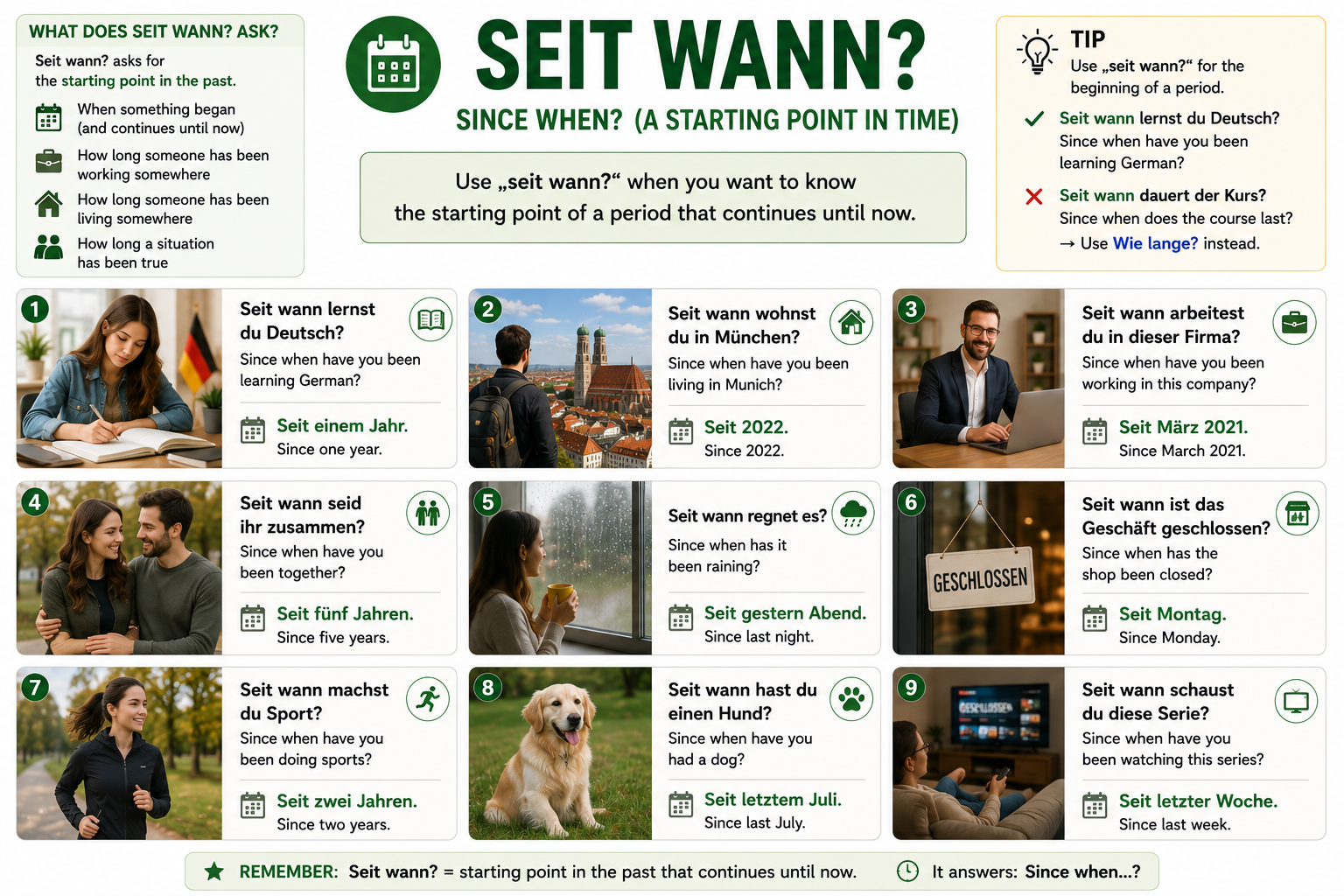
✅ Examples Seit wann:
| Question | Example (DE) | Example (EN) |
|---|---|---|
| 🗓️ Seit wann? | Seit wann lernst du Deutsch? | Since when have you been learning German? |
| Seit wann wohnst du in München? | Since when have you been living in Munich? | |
| Seit wann arbeitest du hier? | Since when have you been working here? | |
| Seit wann kennt ihr euch? | Since when have you known each other? | |
| Seit wann bist du verheiratet? | Since when have you been married? | |
| Seit wann wartest du? | Since when have you been waiting? | |
| Seit wann ist das Geschäft geschlossen? | Since when has the shop been closed? | |
| Seit wann regnet es? | Since when has it been raining? |
3. 🕐 Ab wann?
From when = Starting point
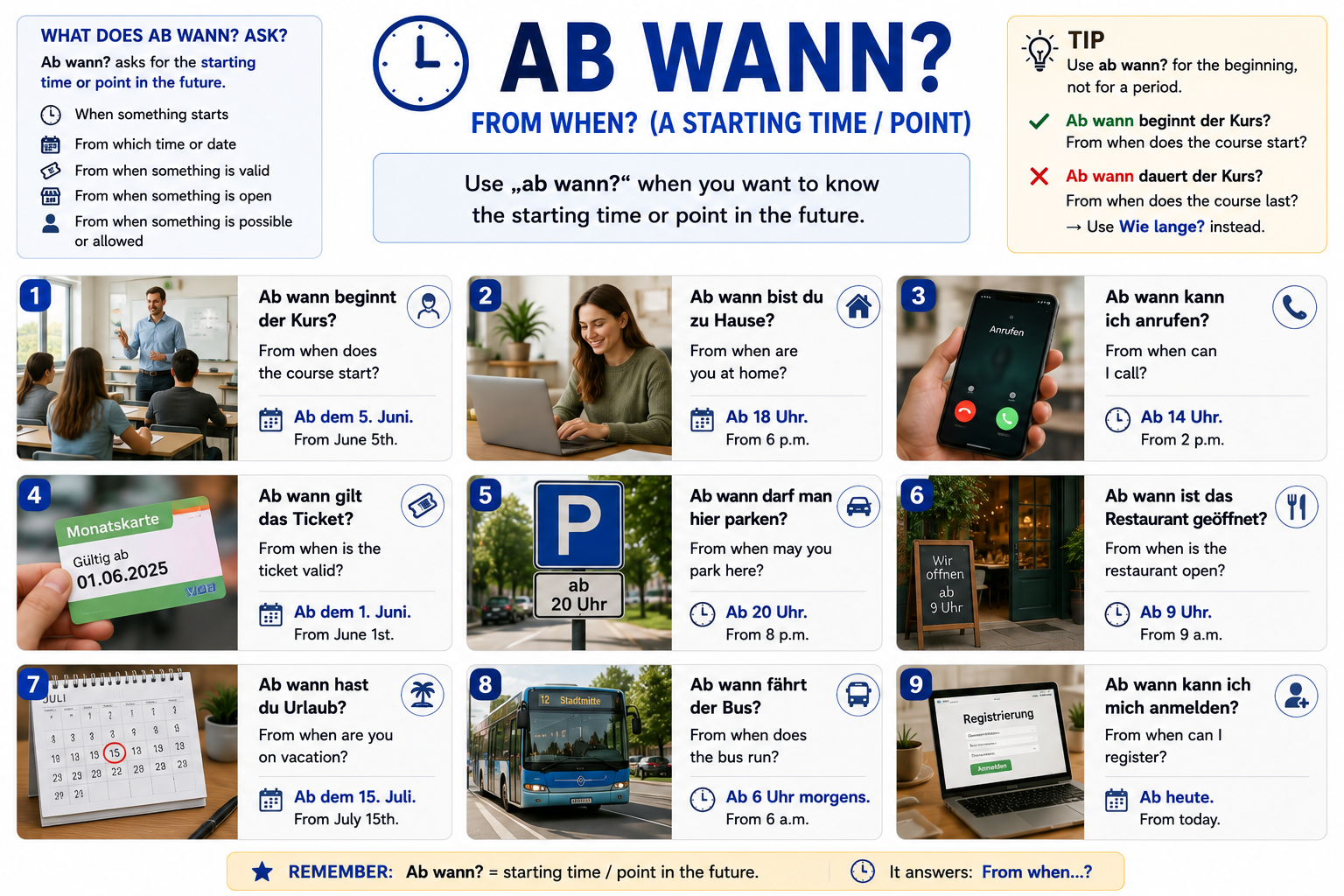
✅ Examples Ab Wann:
| Question | Example (DE) | Example (EN) |
|---|---|---|
| 🕐 Ab wann? | Ab wann beginnt der Kurs? | From when does the course start? |
| Ab wann bist du zu Hause? | From when are you at home? | |
| Ab wann kann ich anrufen? | From when can I call? | |
| Ab wann gilt das Ticket? | From when is the ticket valid? | |
| Ab wann darf man hier parken? | From when may you park here? | |
| Ab wann hast du Urlaub? | From when are you on vacation? | |
| Ab wann ist das Restaurant geöffnet? | From when is the restaurant open? | |
| Ab wann fährt der Bus? | From when does the bus run? |
4. ⏳ Wie lange?
How long = Interval
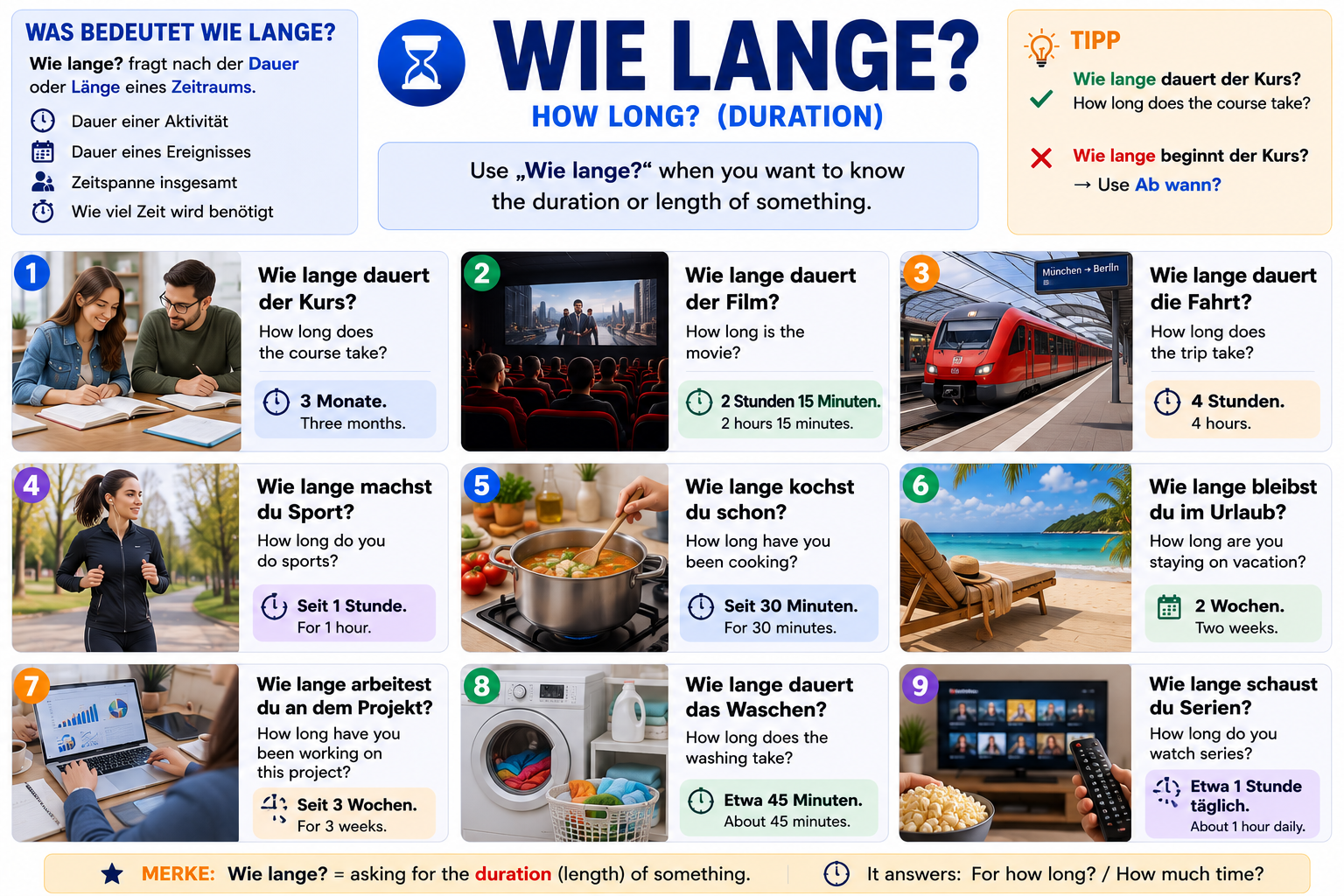
✅ Examples Wie lange:
| Question | Example (DE) | Example (EN) |
|---|---|---|
| ⏳ Wie lange? | Wie lange dauert der Kurs? | How long does the course last? |
| Wie lange lernst du Deutsch? | How long have you been learning German? | |
| Wie lange bleibst du hier? | How long are you staying here? | |
| Wie lange arbeitest du heute? | How long are you working today? | |
| Wie lange dauert die Reise? | How long does the trip take? | |
| Wie lange wartest du schon? | How long have you been waiting? | |
| Wie lange ist das Museum geöffnet? | How long is the museum open? | |
| Wie lange brauchst du zur Arbeit? | How long do you need to get to work? |
6. ⏱️ Bis wann?
End time = Deadline
von ---> bis
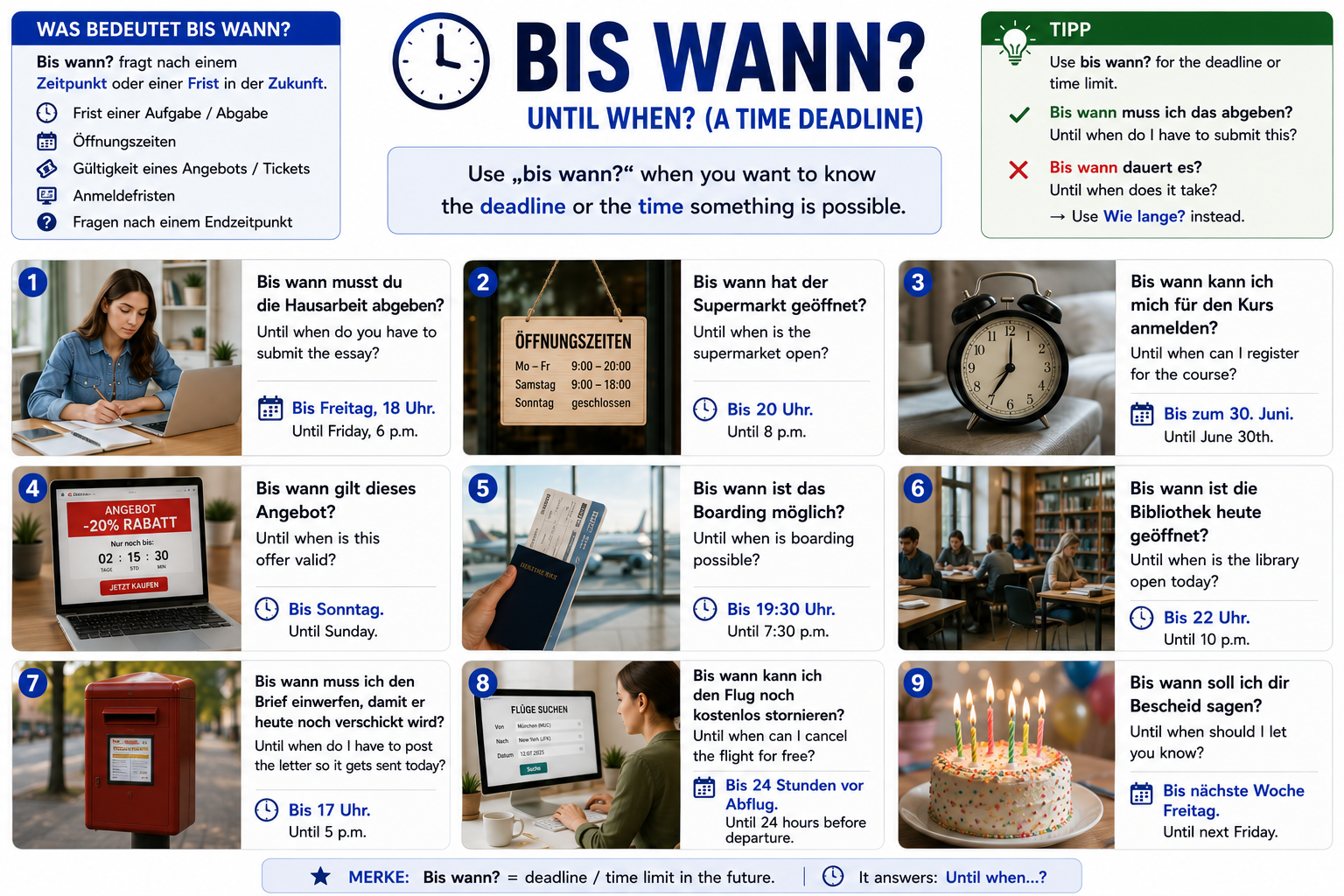
✅ Examples Bis wann:
| Question | Example (DE) | Example (EN) |
|---|---|---|
| ⏱️ Bis wann? | Bis wann musst du die Aufgabe abgeben? | Until when do you have to submit the assignment? |
| Bis wann arbeitest du heute? | Until when are you working today? | |
| Bis wann bleibt das Geschäft geöffnet? | Until when is the shop open? | |
| Bis wann gilt das Ticket? | Until when is the ticket valid? | |
| Bis wann bist du im Büro? | Until when are you at the office? | |
| Bis wann bleibst du in Berlin? | Until when are you staying in Berlin? | |
| Bis wann kann ich mich anmelden? | Until when can I register? | |
| Bis wann muss ich bezahlen? | Until when do I have to pay? |
7. 🔄 Von wann bis wann?
Interval
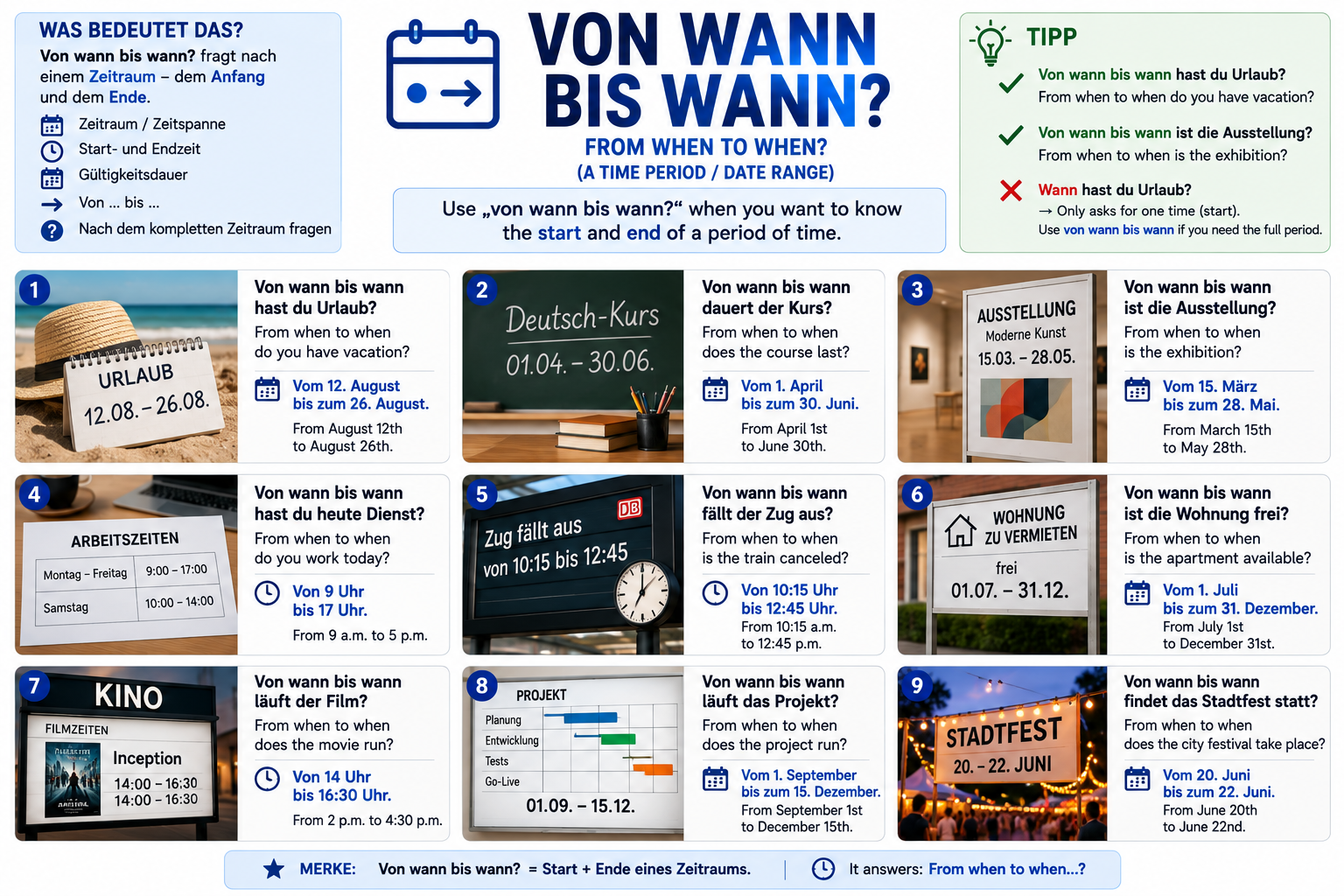
✅ Examples Von wann bis wann:
| Question | Example (DE) | Example (EN) |
|---|---|---|
| 🔄 Von wann bis wann? | Von wann bis wann dauert der Kurs? | From when until when does the course run? |
| Von wann bis wann arbeitest du? | From when until when do you work? | |
| Von wann bis wann ist das Museum geöffnet? | From when until when is the museum open? | |
| Von wann bis wann hast du Urlaub? | From when until when are you on vacation? | |
| Von wann bis wann gilt die Fahrkarte? | From when until when is the ticket valid? | |
| Von wann bis wann ist die Bibliothek geöffnet? | From when until when is the library open? | |
| Von wann bis wann findet das Festival statt? | From when until when does the festival take place? | |
| Von wann bis wann hast du Unterricht? | From when until when do you have classes? |
Things ❓
| # | Question | 🇬🇧 English | 💬 Example | 🧭 Notes |
|---|---|---|---|---|
| ❓ | was | what | Was machst du? → What are you doing? | Things, actions, or ideas |
| 🗂️ | was für ein(e) | what kind of | Was für ein Film ist das? → What kind of movie is that? | Type or category |
| 💁 | welcher / welche / welches | which | Welches Buch liest du? → Which book are you reading? | Selects from known choices; changes by gender, number & case |
1. Was = What ❓
Things, objects, actions, ideas
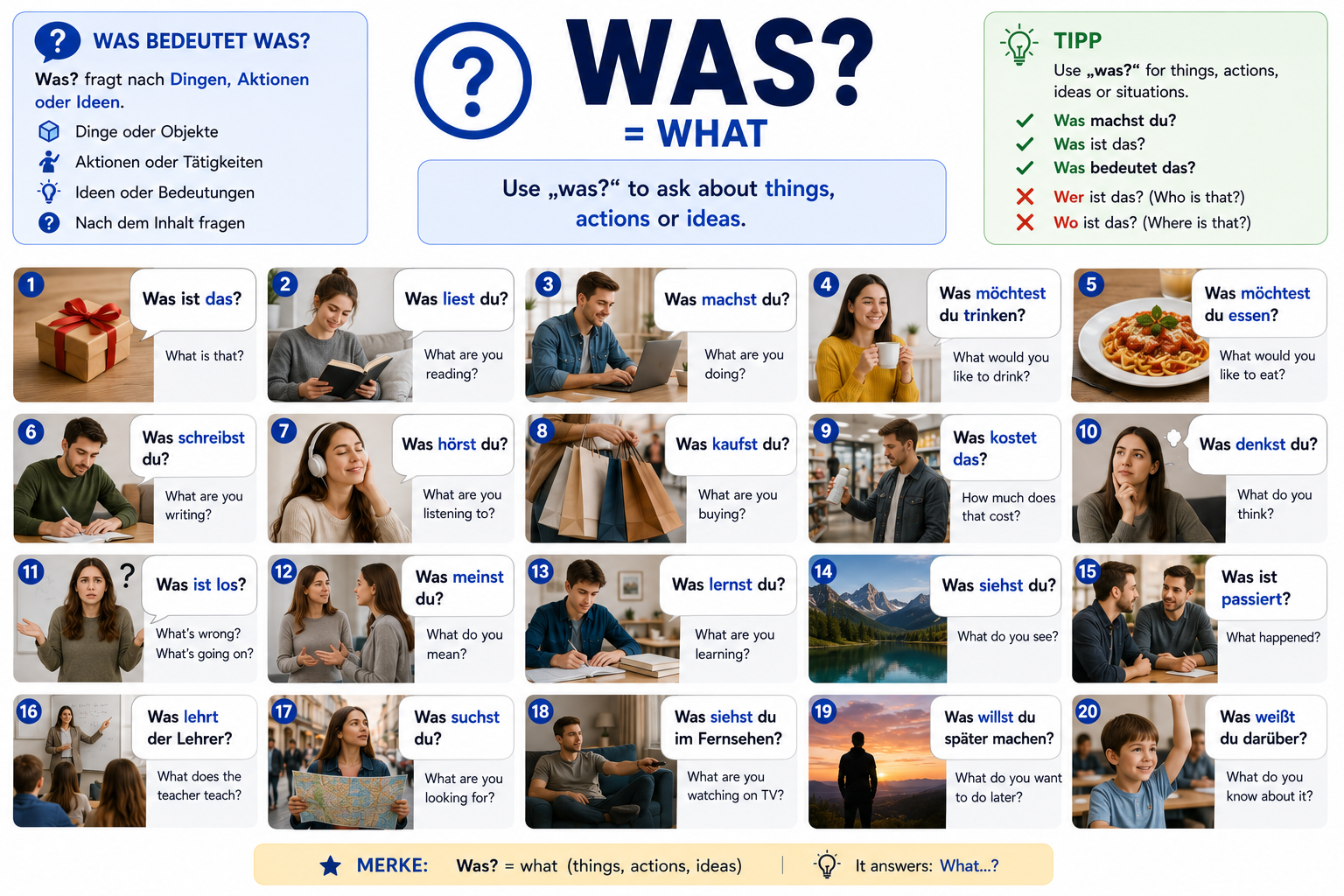
🧠 Note: “wie” instead of “was”
In some cases, “wie” (how) replaces “was” (what), especially when asking for descriptions, names, or opinions, not definitions.
| Expression | Meaning | Example | Explanation |
|---|---|---|---|
| Wie heißt du? | What’s your name? | 👉 Wie heißt du? → What’s your name? | In English we say “what’s your name”, but in German it’s “how are you called” |
| Wie alt bist du? | How old are you? | 👉 Wie alt bist du? → How old are you? | “How old” expresses degree/measurement |
| Wie ist das Wetter? | What’s the weather like? | 👉 Wie ist das Wetter heute? → What’s the weather like today? | Describes state/condition, not “what is” |
| Wie geht’s (dir)? | How are you? | 👉 Wie geht’s dir? → How are you doing? | Describes how someone feels |
| Wie viel Uhr ist es? | What time is it? | 👉 Wie viel Uhr ist es? → What time is it? | Literally “how much hour” |
💬 Persönliche Informationen (Personal Information)
In these cases, “wie” is used (not “was”) because you’re asking how something is expressed, not what it is.
| 🗣️ Frage (Question) | 💡 Bedeutung (Meaning) | 🧩 Beispielantwort (Example Answer) |
|---|---|---|
| Wie ist dein Name? | What’s your name? | 👉 Mein Name ist Hitesh. |
| Wie ist dein Vorname? | What’s your first name? | 👉 Mein Vorname ist Hitesh. |
| Wie ist dein Nachname? | What’s your last name? | 👉 Mein Nachname ist Sharma. |
| Wie ist dein Familienname? | What’s your family name? | 👉 Mein Familienname ist Sharma. |
| Wie ist deine Adresse? | What’s your address? | 👉 Meine Adresse ist Hauptstraße 12, Berlin. |
| Wie ist deine E-Mail-Adresse? | What’s your email address? | 👉 Meine E-Mail-Adresse ist hitesh@mail.com. |
| Wie ist deine Telefonnummer? | What’s your phone number? | 👉 Meine Telefonnummer ist 0176 1234567. |
| Was ist deine Muttersprache? | What’s your native language? | 👉 Meine Muttersprache ist Hindi. |
✅ Examples Was:
| 🇩🇪 German | 🇬🇧 English |
|---|---|
| Was ist das? | What is that? |
| Was machst du? | What are you doing? |
| Was arbeitest du? | What do you do for work? |
| Was lernst du? | What are you studying? |
| Was liest du? | What are you reading? |
| Was schreibst du? | What are you writing? |
| Was siehst du? | What do you see? |
| Was hörst du? | What are you listening to? |
| Was möchtest du essen? | What would you like to eat? |
| Was möchtest du trinken? | What would you like to drink? |
| Was kaufst du? | What are you buying? |
| Was brauchst du? | What do you need? |
| Was kostet das? | How much does that cost? |
| Was bedeutet dieses Wort? | What does this word mean? |
| Was ist passiert? | What happened? |
| Was ist los? | What's wrong? / What's going on? |
| Was denkst du? | What do you think? |
| Was möchtest du später machen? | What would you like to do later? |
| Was gibt es heute zum Mittagessen? | What's for lunch today? |
| Was hast du gestern gemacht? | What did you do yesterday? |
| Was wirst du morgen machen? | What will you do tomorrow? |
| Was gefällt dir? | What do you like? |
| Was gefällt dir an Deutschland? | What do you like about Germany? |
| Was suchst du? | What are you looking for? |
| Was willst du werden? | What do you want to become? |
2. 🗂️ Was für ein --> What kind of
Used to ask question about category/ collection
It follows the same pattern as Article for ein
| Case | 🟦 Masculine | 🟨 Neuter | 🟥 Feminine | 🟩 Plural |
|---|---|---|---|---|
| 👤 Nominativ | was für ein | was für ein | was für eine | was für |
| 🎯 Akkusativ | was für einen | was für ein | was für eine | was für |
| 🎁 Dativ | was für einem | was für einem | was für einer | was für |
| 🧩 Genitiv | was für eines | was für eines | was für einer | was für |
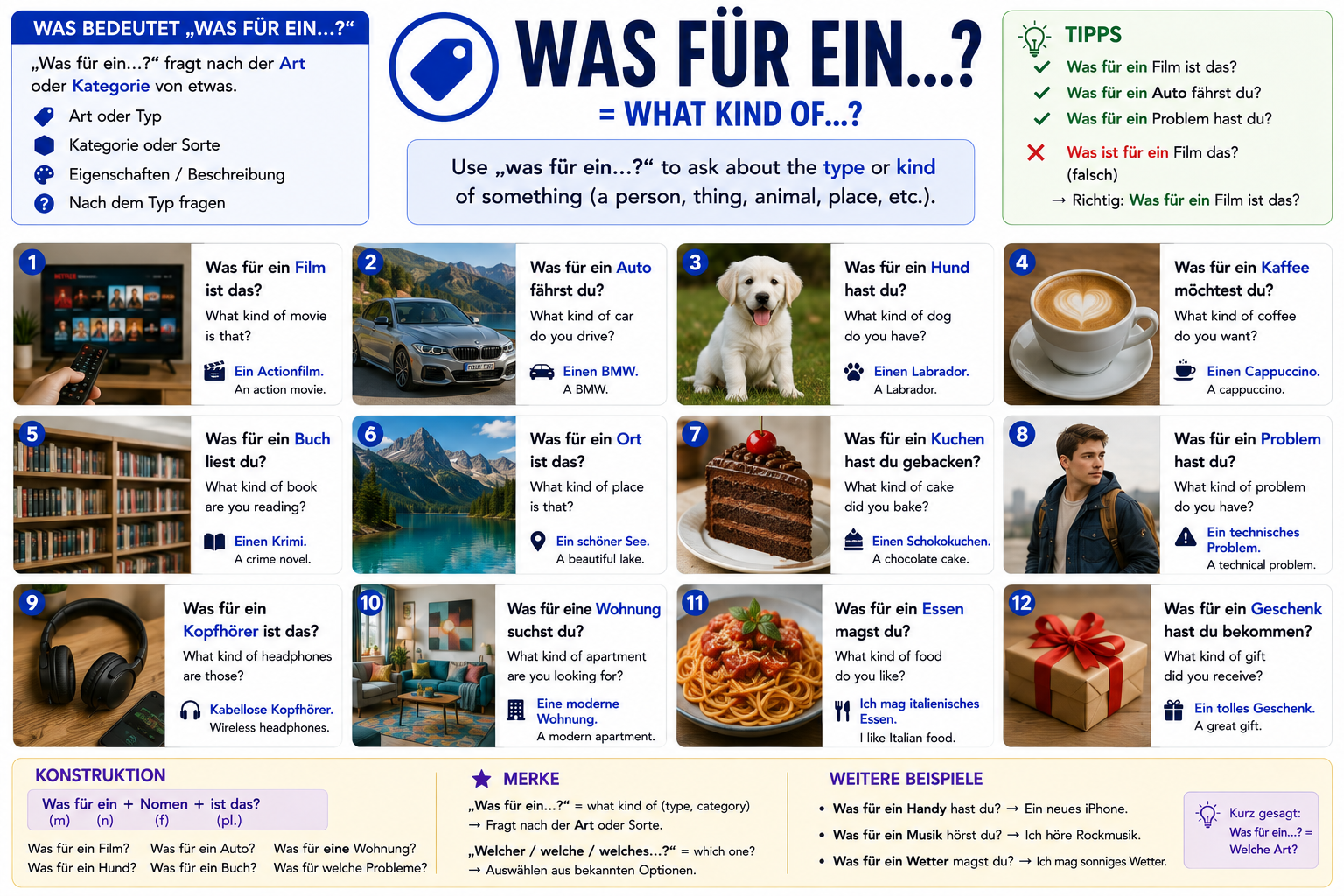
Memory Map
| Case | 🟦 Masculine | 🟨 Neuter | 🟥 Feminine | 🟩 Plural | Mnemonic / Tip |
|---|---|---|---|---|---|
| 👤 Nom | – | – | –e | – | Nom = base forms, fem/plural get –e |
| 🎯 Akk | –en | – | –e | – | Akk → masculine gets –en; others same as Nom |
| 🎁 Dat | –em | –em | –er | – | Dat = “m, m, r, n” pattern |
| 🧩 Gen | –es | –es | –er | – | Gen = “s, s, r, r” pattern |
Example:
| German | English |
|---|---|
| Was für ein Auto hast du? | What kind of car do you have? |
| Was für einen Film möchtest du sehen? | What kind of movie would you like to watch? |
| Was für eine Musik hörst du gern? | What kind of music do you like? |
| Was für ein Buch liest du? | What kind of book are you reading? |
| Was für einen Hund hast du? | What kind of dog do you have? |
| Was für eine Sprache lernst du? | What language are you learning? |
| Was für ein Restaurant suchst du? | What kind of restaurant are you looking for? |
| Was für eine Pizza möchtest du? | What kind of pizza would you like? |
| Was für einen Computer benutzt du? | What kind of computer do you use? |
| Was für Bücher liest du gern? | What kinds of books do you like to read? |
✅ Examples Was für ein:
👤 Nominative
| German | English |
|---|---|
| Was für ein Hund ist das? | What kind of dog is that? |
| Was für ein Auto steht dort? | What kind of car is parked there? |
| Was für eine Blume ist das? | What kind of flower is that? |
| Was für Bücher sind das? | What kind of books are those? |
🎯 Accusative
| German | English |
|---|---|
| Was für einen Film möchtest du sehen? | What kind of movie would you like to watch? |
| Was für ein Handy kaufst du? | What kind of phone are you buying? |
| Was für eine Pizza möchtest du? | What kind of pizza would you like? |
| Was für Bücher liest du gern? | What kinds of books do you like to read? |
🎁 Dative
| German | English |
|---|---|
| Mit was für einem Auto fährst du? | What kind of car are you driving? |
| Mit was für einem Computer arbeitest du? | What kind of computer do you work with? |
| Mit was für einer Kamera fotografierst du? | What kind of camera are you taking photos with? |
| Mit was für Leuten arbeitest du zusammen? | What kind of people do you work with? |
🧩 Genitive (less common in everyday speech)
| German | English |
|---|---|
| Wegen was für eines Problems bist du hier? | Because of what kind of problem are you here? |
| Trotz was für eines Wetters geht ihr spazieren? | Despite what kind of weather are you going for a walk? |
| Wegen was für einer Krankheit fehlt sie? | Because of what kind of illness is she absent? |
| Wegen was für Bücher bist du in der Bibliothek? | Because of what kinds of books are you in the library? |
3. 💁♂️ Welch
“Welch-” is used to ask “which” when choosing between options.
Welch- behaves like the definite article (der/die/das).
- It changes its ending like an article (der/die/das) depending on gender, number, and case.
- The ending depends on the gender of the noun and case in the sentence.
In spoken German, people sometimes shorten to “Was für ein ...” to sound more natural: Was für ein Kuli ist das? →
| Case | 🟦 Masculine | 🟨 Neuter | 🟥 Feminine | 🟩 Plural |
|---|---|---|---|---|
| 👤 Nom | welcher | welches | welche | welche |
| 🎯 Akk | welchen | welches | welche | welche |
| 🎁 Dat | welchem | welchem | welcher | welchen (+ -n on noun) |
| 🧩 Gen | welches | welches | welcher | welcher |
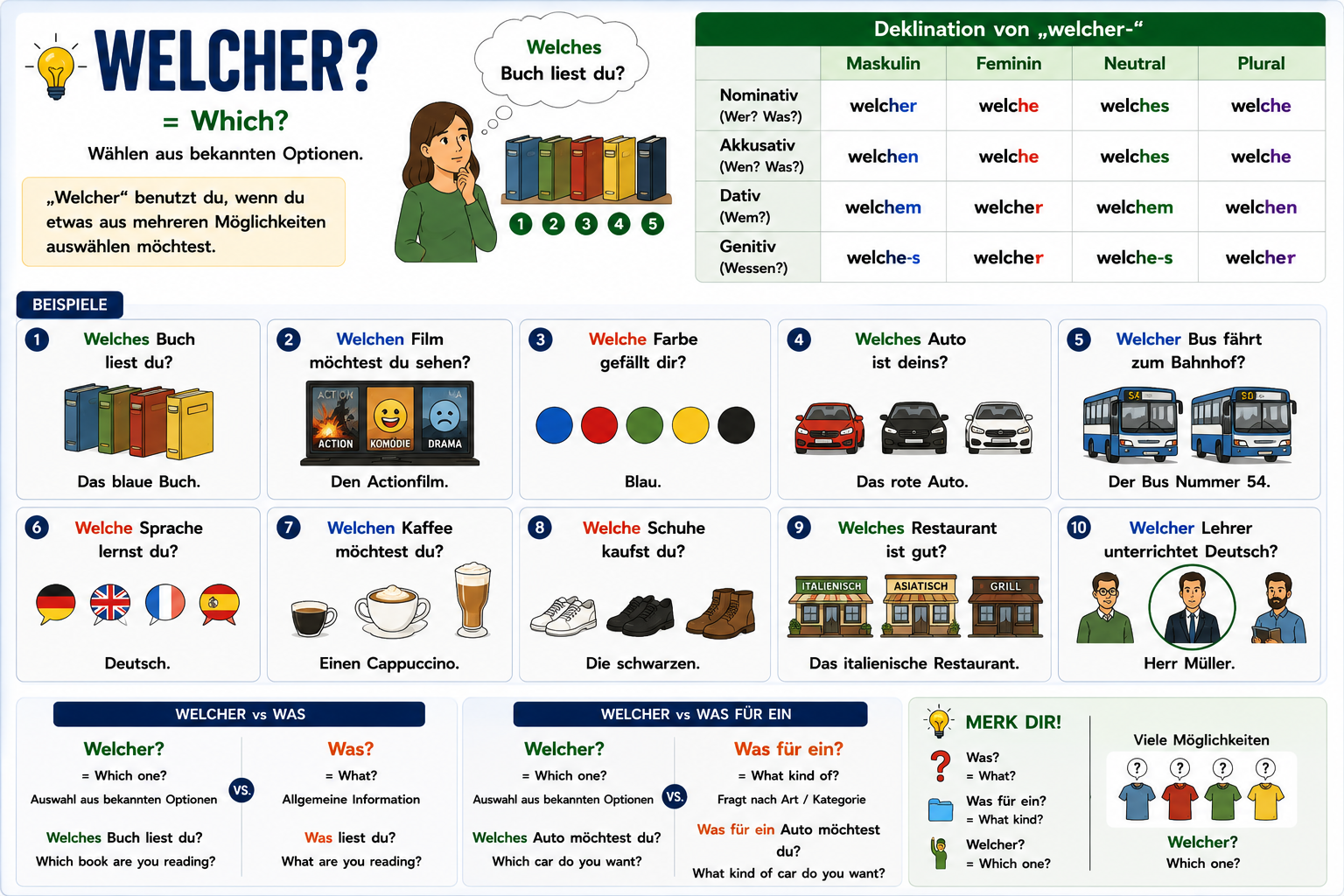
Usage
- 📚 Choose from several books
- 🚗 Choose a car
- 👕 Choose clothes
- 🍕 Choose food
- 🏨 Choose a hotel
- 🎬 Choose a movie
4. Welcher vs Was für ein
| 💁 Welcher? | 📂 Was für ein? |
|---|---|
| Which one? | What kind/type? |
| Choose from known options | Ask about category or type |
| Welches Auto möchtest du? | Was für ein Auto möchtest du? |
| Which car do you want? | What kind of car do you want? |
✅ Examples Welch:
👤 Nominative| Case | Example | English |
|---|---|---|
| 👤 Nom. Masc. | Welcher Mann spricht Deutsch? | Which man speaks German? |
| 👤 Nom. Neut. | Welches Buch ist interessant? | Which book is interesting? |
| 👤 Nom. Fem. | Welche Frau kommt heute? | Which woman is coming today? |
| 👤 Nom. Pl. | Welche Kinder spielen draußen? | Which children are playing outside? |
🎯 Accusative
| Case | Example | English |
|---|---|---|
| 🎯 Akk. Masc. | Welchen Film möchtest du sehen? | Which movie would you like to watch? |
| 🎯 Akk. Neut. | Welches Auto kaufst du? | Which car are you buying? |
| 🎯 Akk. Fem. | Welche Tasche nimmst du? | Which bag are you taking? |
| 🎯 Akk. Pl. | Welche Bücher liest du? | Which books are you reading? |
🎁 Dative
| Case | Example | English |
|---|---|---|
| 🎁 Dat. Masc. | Mit welchem Lehrer sprichst du? | Which teacher are you talking to? |
| 🎁 Dat. Neut. | Mit welchem Kind spielst du? | Which child are you playing with? |
| 🎁 Dat. Fem. | Mit welcher Freundin gehst du ins Kino? | Which friend are you going to the cinema with? |
| 🎁 Dat. Pl. | Mit welchen Kindern spielst du? | Which children are you playing with? |
🧩 Genitive (less common in everyday speech)
| Case | Example | English |
|---|---|---|
| 🧩 Gen. Masc. | Welches Mannes Auto ist das? | Which man's car is that? |
| 🧩 Gen. Neut. | Wegen welches Problems bist du hier? | Because of which problem are you here? |
| 🧩 Gen. Fem. | Wegen welcher Krankheit fehlt sie? | Because of which illness is she absent? |
| 🧩 Gen. Pl. | Wegen welcher Bücher bist du hier? | Because of which books are you here? |
🤔 Satzfrage (Yes/No question)
A Satzfrage is a question that can be answered with Ja (Yes) or Nein (No).
Formation
- All answers are in yes or no.
W-Frage vs Satzfrage
| W-Frage❓ | Satzfrage ✅/❌ |
|---|---|
| Asks for information | Asks for a Yes/No decision |
| Starts with a W-word | Starts with the verb |
| Wo wohnst du? Wann kommst du? Warum lernst du Deutsch? | Wohnst du in München? Kommst du morgen? Lernst du Deutsch? |
Example:
| German | English | Answer |
|---|---|---|
| Kommst du morgen? | Are you coming tomorrow? | Ja. / Nein. |
| Hast du Hunger? | Are you hungry? | Ja. / Nein. |
| Kannst du Deutsch sprechen? | Can you speak German? | Ja. / Nein. |
| Wohnst du in Berlin? | Do you live in Berlin? | Ja. / Nein. |
| Arbeitest du heute? | Are you working today? | Ja. / Nein. |
| Magst du Pizza? | Do you like pizza? | Ja. / Nein. |
| Ist das dein Auto? | Is that your car? | Ja. / Nein. |
| Fährst du mit dem Bus? | Are you going by bus? | Ja. / Nein. |
| Lernst du Deutsch? | Are you learning German? | Ja. / Nein. |
| Regnet es heute?** | Is it raining today? | Ja. / Nein. |