Prepositions 📍
Understand German Prepositions: Accusative, Dative, and Two-Way Usage. Learn how to use prepositions correctly with cases, examples, and common expression patterns.
PREPOSITION 📍
Always comes before Noun or Pronoun as a combination of word
Preposition has 2 roles
- Show position of the Subject
- Decide the CASE of object(
Prepositional Object) associated with it - Preposition take preference over verb when it comes to deciding the case of object
- There are 70 verbs with fixed preposition, and they always take the case of that preposition, not the verb
| Category | Members | Case |
|---|---|---|
| Always Akkusativ | für, um, durch, bis, ohne, gegen, entlang | Akkusativ |
| Always Dativ | aus, bei, mit, nach, von, zu, seit, ab, gegenüber | Dativ |
| Wechsel (two-way) | an, auf, in, hinter, neben, über, unter, vor, zwischen | Dativ (stationary) / Akkusativ (movement) — see SDMA below |
🎯 Focus per level:
- A1: Location/time prepositions (in, auf, bei, zu)
- A2-B1: Wechselpräpositionen
- B2: Abstract usage (wegen, trotz, laut, gemäß)
Preposition Types:
1. 🎯 Accusative Prepositions(7)
Accusative = Where something is going (movement / direction).
Historically, these prepositions expressed what Old German associated with the Accusative case.
- movement
- direction, or
- relationships
🎁 F U D B O G E Journey
Füra friend, walkUmthe tree, goDurchthe tunnel, continueBisthe bridge,Ohnestopping,Gegenthe wind,Entlangthe river.
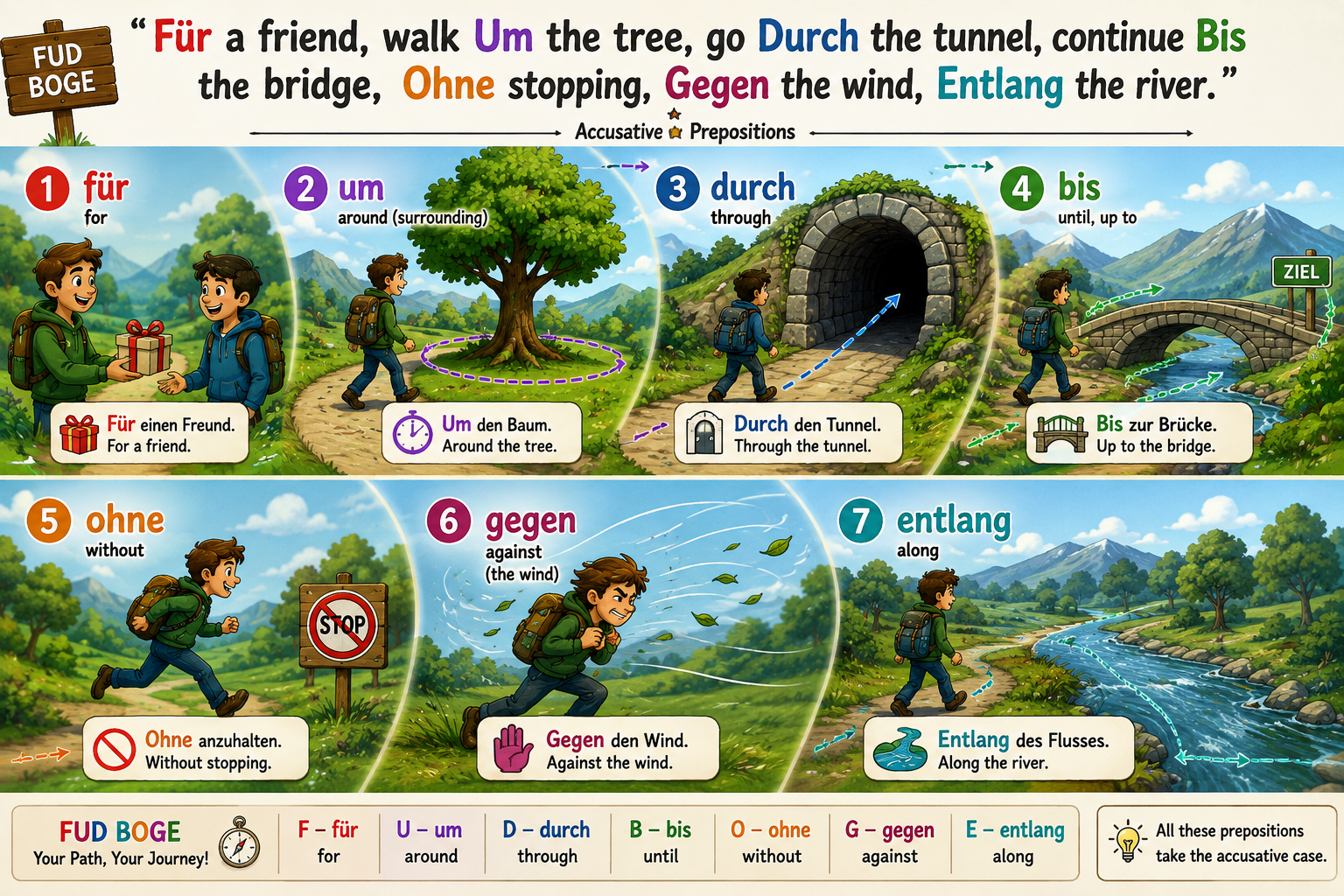
| # | 🆔 | Emoji | Preposition | Meaning |
|---|---|---|---|---|
| 1 | F | 🎁 | für | for |
| 2 | U | 🔄 | um | around(surronding something), at (time) |
| 3 | D | 🚪 | durch | through, by |
| 4 | B | ⏳ | bis | till, up to, by (time) |
| 5 | O | 🚫 | ohne | without |
| 6 | G | ✋ | gegen | against(something/ somebody), around(time) |
| 7 | E | 🛤️ | entlang | along (accusative follows the noun) |
--> entlang always comes at the end of sentence
✅ Examples:
🎯 Akkusativ (Wohin? / Fixed Accusative Prepositions)
| Satz | Präposition |
|---|---|
| Paul, hier ist ein Geschenk für dich. | für |
| Komm, wir gehen durch den Park. | durch |
| Bitte gehen Sie den Fluss entlang. | entlang |
| Wir fahren durch die Stadt. | durch |
| Sind diese Blumen für den Chef? | für |
| Ohne das Deutschheft darfst du nicht in die Schule. | ohne |
| Das Auto fährt gegen den Baum. | gegen |
| Die Familie sitzt um den Tisch und diskutiert. | um |
| Spielt ihr gegen oder für die Delhi-Mannschaft? | gegen / für |
| Ohne Thomas gehe ich nicht ins Kino. | ohne |
More examples
| Deutsch | English | Präposition |
|---|---|---|
| Das Geschenk ist für dich. | The gift is for you. | für |
| Wir gehen durch den Park. | We walk through the park. | durch |
| Er läuft die Straße entlang. | He walks along the street. | entlang |
| Ich gehe durch den Park. | I go through the park. | durch |
| Das Geschenk ist für das Kind. | The gift is for the child. | für |
| Der Unterricht beginnt um 8 Uhr. | The class begins at 8 o'clock. | um |
| Wir sitzen um den Tisch. | We sit around the table. | um |
| Er geht ohne seine Schwester. | He goes without his sister. | ohne |
2. 🎁 Dative Prepositions (9)
Dative = Where something is (position / no movement).
Dative = Location, source, accompaniment, recipient, or time.
Unlike the two-way prepositions, these always take the Dative case.
Mnemonic: V Z S N A M B A G
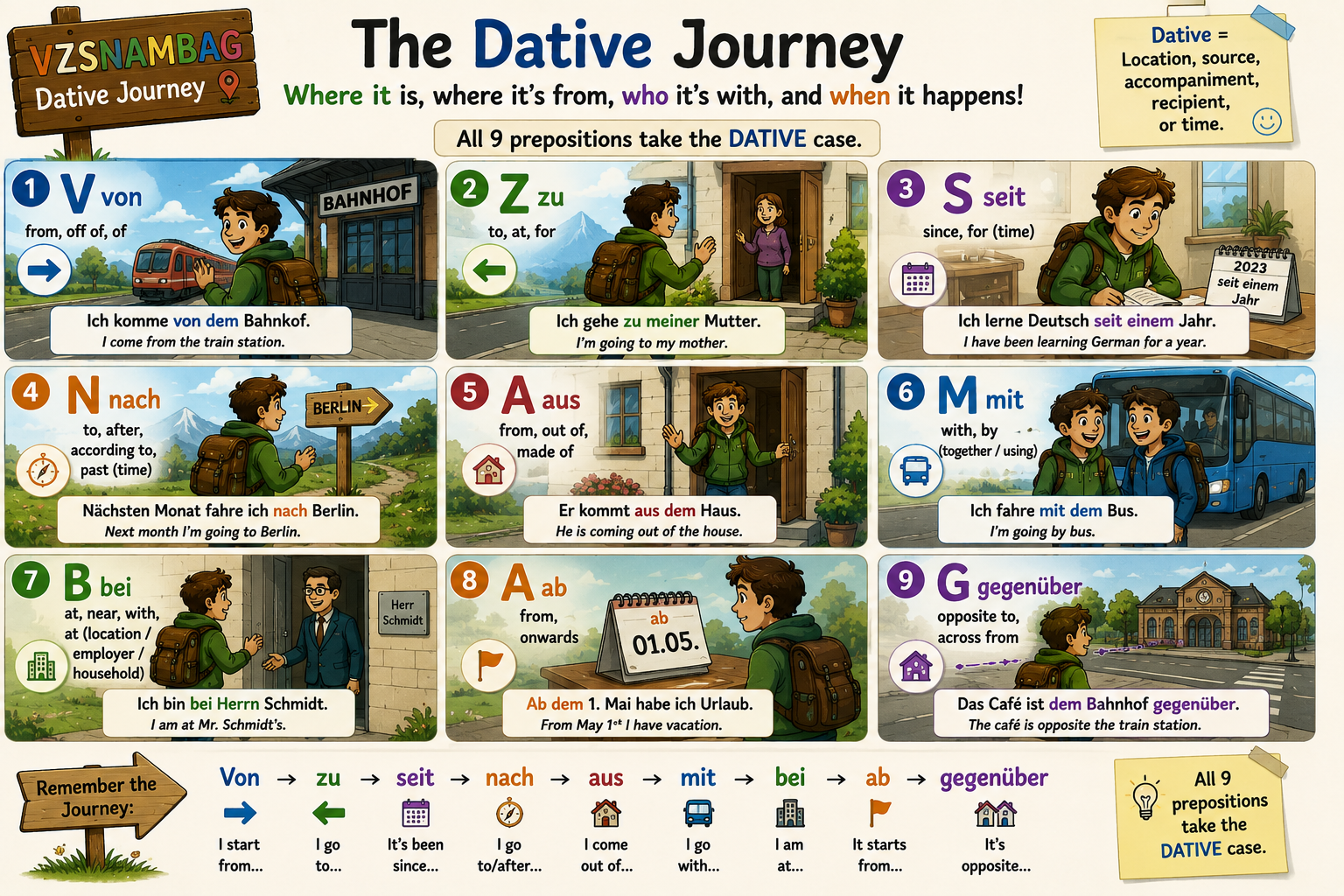
| # | 🆔 | Emoji | Preposition | Meaning |
|---|---|---|---|---|
| 1 | V | ➡️ | von | from, off of, of |
| 2 | Z | ⬅️ | zu | to, at, for |
| 3 | S | 📅 | seit | since, for (time) |
| 4 | N | 🗺️ | nach | to, after, according to, past (time) |
| 5 | A | 🏠 | aus | from, out of, made of |
| 6 | M | 🚌 | mit | with, by (together / using) |
| 7 | B | 🏢 | bei | at, near, with, at (location / employer / household) |
| 8 | A | 🏁 | ab | from, onwards |
| 9 | G | 🏘️ | gegenüber | opposite to, across from |
--> gegenüber always comes at the end of sentence
✅ Examples:
📍 Dativ (Wo? → Location)
| Satz | Präposition |
|---|---|
| Der Schalter ist in der Ecke. | in |
| Die Zeitung ist zwischen den Büchern. | zwischen |
| Der Garten ist hinter dem Haus. | hinter |
| Der Kühlschrank steht in der Küche. | in |
| Die Post ist am Bahnhof. | an |
| Die Fahrgäste sind schon im Zug. | in |
| Das Bier ist im Bauch. | in |
| Der Kuli ist in der Tasche. | in |
| Das Sofa ist zwischen dem Tisch und der Wand. | zwischen |
| Die Lampe hängt über dem Tisch. | über |
| Die Kleider hängen im Schrank. | in |
mit vs bei
mit= together with someone (companionship/accompaniment);bei= at someone's home or place (location)
- mit meinem Freund → with my friend (together, doing something with him)
- bei meinen Eltern → at my parents' place (location — I'm staying there)
in vs nach vs zu
| Preposition | Used for | Example |
|---|---|---|
| 🌍 nach | Countries, cities (no article), directions | Ich fliege nach Spanien → I’m flying to Spain |
| 🏢 in | Countries with article, rooms, buildings, enclosed places | Ich gehe in die Schule → I’m going into the school |
| 🧑⚕ zu | People, institutions, events, small destinations | Ich gehe zu meiner Oma → I’m going to my grandma’s |
🌍 1. nach
for countries, cities, and directions (no article)
Use nach when you’re going to a country or city that has no article, or when talking about a direction.
Examples:
- I’m going to Germany → Ich fahre nach Deutschland
- We’re flying to Berlin → Wir fliegen nach Berlin
- She’s going home → Sie fährt nach Hause
- Look to the right / left → Schau nach rechts / nach links
🏢 2. in
for countries with an article, buildings, rooms, or enclosed places
Use in when you’re going inside somewhere, or when you’re inside a place.
in is a Wechselpräposition (SDMA)
Movement (Akkusativ – going into):
- I’m going into the school → Ich gehe in die Schule
- We’re driving into the city → Wir fahren in die Stadt
- He’s going into the supermarket → Er geht in den Supermarkt
- I’m traveling to Switzerland → Ich reise in die Schweiz 🇨🇭
(Languages like German use “in” with countries that have an article.)
Location (Dativ – being in):
- I’m in the school → Ich bin in der Schule
- We’re in the city → Wir sind in der Stadt
🧑⚕️ 3. zu
for people, events, and smaller destinations Use zu when you go to someone, or to a place/event/institution, but not necessarily inside.
zu emphasizes the destination or person, not entering a place.
- Ich gehe zum Supermarkt → you go to the supermarket.
- Ich gehe in den Supermarkt → you go inside the supermarket.
Examples:
- I’m going to my friend’s house → Ich gehe zu meiner Freundin
- We’re going to the doctor → Wir fahren zum Arzt
- I’m going to work → Ich gehe zur Arbeit
- Are you coming to dinner? → Kommst du zum Essen?
- He’s going to the train station → Er geht zum Bahnhof
🌍 Special Rule for Countries – Articles in German
1️⃣ General Rule – No Article
Use no article with countries when using “nach” (to) for most country names.
Example:
- He goes to Germany. → Er geht nach Deutschland.
- He is in Germany. → Er ist in Deutschland.
| Country | To / Movement | In / Location |
|---|---|---|
| Deutschland | nach Deutschland | in Deutschland |
| Frankreich | nach Frankreich | in Frankreich |
| Italien | nach Italien | in Italien |
| Spanien | nach Spanien | in Spanien |
| Portugal | nach Portugal | in Portugal |
| Japan | nach Japan | in Japan |
| Kanada | nach Kanada | in Kanada |
| China | nach China | in China |
2️⃣ Special Rule – Article Needed
- Some countries require a definite article because they are feminine, plural, or use certain cases.
- Often occurs with “in” (to/in) when referring to a country.
- Use accusative if you go to the country, dative if you are in it.
| Country | Gender/Number | To / Movement | In / Location |
|---|---|---|---|
| Schweiz | die (fem.) | in die Schweiz | in der Schweiz |
| USA | die (plural) | in die USA | in den USA |
| Iran | der (masc.) | in den Iran | in dem Iran (im Iran) |
| Niederlande | die (plural) | in die Niederlande | in den Niederlanden |
| Ukraine | die (fem.) | in die Ukraine | in der Ukraine |
| Türkei | die (fem.) | in die Türkei | in der Türkei |
3. 🟨 Two-Way (Wechsel) Prepositions(9)
👉 Can take
- Dative = (location – wo?/ Whom/ for Whom/ to whom) or
- Accusative (movement – wohin?/ What)
🧠 SDMA (Static Dative, Moving Accusative)
When a sentence contains both a verb and a Wechsel preposition, the preposition's SDMA rule wins, regardless of what the verb alone might suggest.
🪑 Stationary --> Dative
Where is it?
- Das Bild hängt an der Wand.
- Das Buch liegt auf dem Tisch.
- Der Hund schläft unter dem Tisch.
🏃 Movement --> Akkusative Where is it going?
- Ich hänge das Bild an die Wand.
- Ich lege das Buch auf den Tisch.
- Der Hund läuft unter den Tisch.
🎁 A A H U Ü V I N Z Journey
Stand
Anthe window, climbAufthe table, hideHinterthe curtain, crawlUnterthe bridge, flyÜberthe river, stopVorthe castle, walkInthe house, sitNebenyour friend, and finishZwischentwo trees.
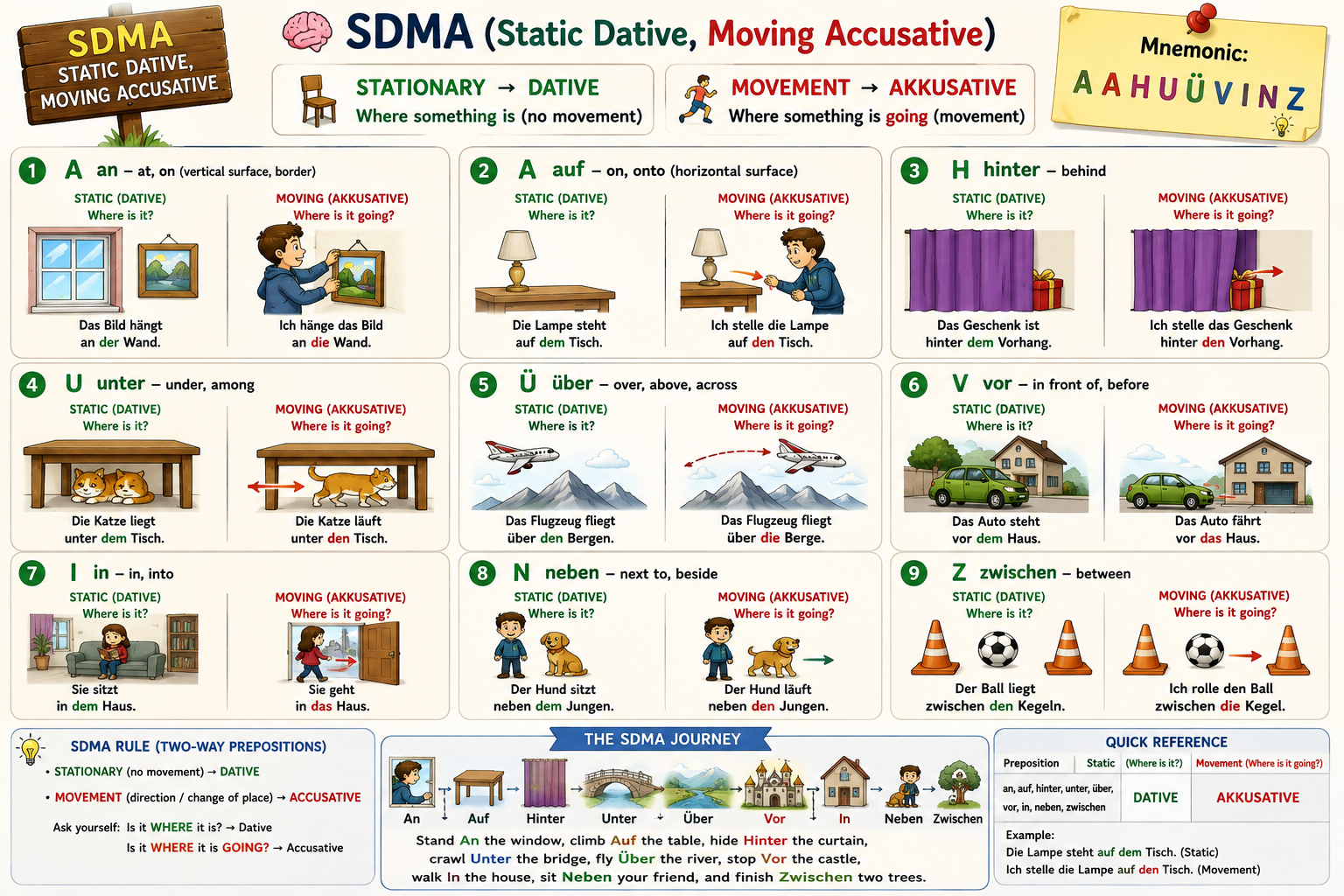
| # | 🆔 | Emoji | Preposition | Meaning |
|---|---|---|---|---|
| 1 | A | 🪟 | an | at, on (vertical surface, border) |
| 2 | A | 🛋️ | auf | on, onto (horizontal surface) |
| 3 | H | ⬅️ | hinter | behind |
| 4 | U | ⬇️ | unter | under, among |
| 5 | Ü | ⬆️ | über | over, above, across |
| 6 | V | ⬆️ | vor | vor - in front of, before, to (time) |
| 7 | I | 🏠 | in | in, into |
| 8 | N | ➡️ | neben | next to, beside |
| 9 | Z | ↔️ | zwischen | between |
✅ Examples:
- Dative (wo?) → Ich bin in der Schule. → I’m in the school.
- Accusative (wohin?) → Ich gehe in die Schule. → I’m going to the school.
✅ Examples:
🏠 Wechselpräpositionen (Wo? → Dativ)
| Satz | Richtige Form | Warum |
|---|---|---|
| Der Stuhl steht in der Küche. | der Küche | Wo? → Dativ |
| Die Brille ist in der Schublade. | der Schublade | Wo? → Dativ |
| Der Hund schläft unter dem Sofa. | dem Sofa | Wo? → Dativ |
| Das Foto hängt an der Wand. | der Wand | Wo? → Dativ |
| Die Weinflasche steht auf dem Tisch. | dem Tisch | Wo? → Dativ |
| Das Buch liegt zwischen den Heften. | den Heften | Wo? → Dativ Plural |
| Das Kind steht hinter der Mutter. | der Mutter | Wo? → Dativ |
| Nina steht vor dem Haus. | dem Haus | Wo? → Dativ |
| Es gibt Wolken über der Stadt. | der Stadt | Wo? → Dativ |
4. 🧩 Genitive Prepositions(6)
Genitive = Possession, reason, cause, or relation.
📚 Genitive Prepositions
These prepositions always take the Genitive case.
| # | 🆔 | Emoji | Preposition | Meaning |
|---|---|---|---|---|
| 1 | W | ⚠️ | wegen | because of |
| 2 | A | 🔄 | anstatt / statt | instead of |
| 3 | I | 🏠 | innerhalb | inside, within |
| 4 | T | 🌧️ | trotz | despite, in spite of |
Common Genitive Prepositions (B1–B2)
Mnemonic: S T W W A I
| # | 🆔 | Emoji | Preposition | Meaning |
|---|---|---|---|---|
| 1 | S | 🔄 | statt | instead of |
| 2 | T | 🌧️ | trotz | despite |
| 3 | Wg | ⚠️ | wegen | because of |
| 4 | Wr | ⏳ | während | during |
| 5 | A | 🌐 | außerhalb | outside of |
| 6 | I | 🏠 | innerhalb | inside of, within |
Advanced Genitive Prepositions (B2–C2)
| Emoji | Preposition | Meaning |
|---|---|---|
| 🌐 | außerhalb | outside of |
| 🏠 | innerhalb | inside of, within |
| ⬆️ | oberhalb | above |
| ⬇️ | unterhalb | below |
| ⬅️ | diesseits | on this side of |
| ➡️ | jenseits | on the other side of |
| 👑 | kraft | by virtue of |
| 🛡️ | aufgrund | due to |
| 📄 | hinsichtlich | regarding |
| 📌 | bezüglich | concerning |
| 🔝 | anstelle | in place of |
| 🧭 | entlang (literary) | along |
- Das Geschäft ist außerhalb der Stadt. → The shop is outside the city.
- Bitte antworten Sie innerhalb einer Woche. → Please reply within a week.
📌 Fixed Preposition :: Feste preposition
We have some verbs with that preposition are fixed
A large class of German verbs pair with one fixed preposition whose case is also fixed
- Neither the preposition nor its case can be derived from SDMA/PDTA logic, and the
- Preposition frequently does not match the literal English translation.
Misusing the preposition is marked wrong on the exam even if the rest of the sentence is correct.
Fixed Akkusative Preposition
| Preposition | Easy Memory |
|---|---|
| an | think about |
| auf | waiting / looking forward |
| über | emotions & talking |
| für | interest / support |
| gegen | opposition |
1. 🪟 an + Akkusativ
| Verb | Meaning | Example |
|---|---|---|
| denken an | to think of | Ich denke an dich. |
| sich erinnern an | to remember | Ich erinnere mich an den Urlaub. |
| sich gewöhnen an | to get used to | Er gewöhnt sich an das Wetter. |
| sich anpassen an | to adapt to | Wir passen uns an die Situation an. |
| schreiben an | to write to | Ich schreibe an meinen Freund. |
| sich heranwagen an | to tackle | Sie wagt sich an die Aufgabe heran. |
2. 🛋️ auf + Akkusativ
| Verb | Meaning | Example |
|---|---|---|
| warten auf | to wait for | Ich warte auf den Bus. |
| klicken auf | to click on | Klicke auf den Link. |
| sich freuen auf | to look forward to | Ich freue mich auf den Urlaub. |
| sich konzentrieren auf | to concentrate on | Er konzentriert sich auf die Prüfung. |
| beruhen auf | to be based on | Die Theorie beruht auf Fakten. |
| basieren auf | to be based on | Das Buch basiert auf einer Geschichte. |
| führen auf | to be attributed to | Der Erfolg ist auf harte Arbeit zurückzuführen. |
3. ⬆️ über + Akkusativ
| Verb | Meaning | Example |
|---|---|---|
| berichten über | to report on | Die Zeitung berichtet über den Unfall. |
| sich ärgern über | to be annoyed about | Ich ärgere mich über den Lärm. |
| sich aufregen über | to get upset about | Sie regt sich über den Verkehr auf. |
| nachdenken über | to think deeply about | Ich denke über das Problem nach. |
| sich freuen über | to be happy about | Er freut sich über das Geschenk. |
| sich beschweren über | to complain about | Wir beschweren uns über das Essen. |
| schreiben über | to write about | Er schreibt über Geschichte. |
4. 🎁 für + Akkusativ
| Verb | Meaning | Example |
|---|---|---|
| sich interessieren für | to be interested in | Ich interessiere mich für Musik. |
| sorgen für | to take care of | Sie sorgt für ihre Familie. |
| kämpfen für | to fight for | Wir kämpfen für Freiheit. |
| sich einsetzen für | to stand up for | Er setzt sich für Kinder ein. |
| sich entscheiden für | to decide on | Ich entscheide mich für Kaffee. |
| sich entschuldigen für | to apologize for | Er entschuldigt sich für den Fehler. |
| sich eignen für | to be suitable for | Das Buch eignet sich für Anfänger. |
5. ✋ gegen + Akkusativ
| Verb | Meaning | Example |
|---|---|---|
| kämpfen gegen | to fight against | Ärzte kämpfen gegen Krankheiten. |
Fixed Dativ Preposition
1. 🚌 mit + Dativ
| Verb | Meaning | Example |
|---|---|---|
| sich beschäftigen mit | to deal with | Ich beschäftige mich mit KI. |
| sich auskennen mit | to be familiar with | Sie kennt sich mit Computern aus. |
| sich einigen mit | to agree with | Ich habe mich mit ihm geeinigt. |
2. ➡️ von + Dativ
| Verb | Meaning | Example |
|---|---|---|
| abhängen von | to depend on | Alles hängt vom Wetter ab. |
| ausgehen von | to assume | Wir gehen von einem Fehler aus. |
| erzählen von | to tell about | Er erzählt von seiner Reise. |
| träumen von | to dream of | Ich träume von Italien. |
| sich erholen von | to recover from | Sie erholt sich von der Krankheit. |
3. 🌍 nach + Dativ
| Verb | Meaning | Example |
|---|---|---|
| suchen nach | to search for | Ich suche nach meinem Schlüssel. |
| sich erkundigen nach | to inquire about | Er erkundigt sich nach dem Zug. |
4. 🏠 aus + Dativ
| Verb | Meaning | Example |
|---|---|---|
| bestehen aus | to consist of | Wasser besteht aus Wasserstoff und Sauerstoff. |
5. 🏢 bei + Dativ
| Verb | Meaning | Example |
|---|---|---|
| sich bedanken bei | to thank | Ich bedanke mich bei dir. |
| sich entschuldigen bei | to apologize to | Sie entschuldigt sich beim Lehrer. |
6. 🧑⚕ zu + Dativ
| Verb | Meaning | Example |
|---|---|---|
| gehören zu | to belong to | Das gehört zu meiner Arbeit. |
| teilnehmen an | to participate in | Er nimmt am Wettbewerb teil. |
Most used Fixed Prepositions
| # | Verb + Präposition | Case | English | Example |
|---|---|---|---|---|
| 1 | abhängen von | Dativ | to depend on | Das hängt vom Wetter ab. |
| 2 | sich amüsieren über | Akkusativ | to be amused by / about | Wir amüsieren uns über den Film. |
| 3 | ankommen auf | Akkusativ | to matter / to depend on / to come down to | Es kommt auf die Situation an. |
| 4 | sich anpassen an | Akkusativ | to adapt / adjust to | Ich passe mich an die neue Arbeit an. |
| 5 | anregen zu | Dativ | to encourage / inspire | Der Artikel regt zum Nachdenken an. |
| 6 | sich ärgern über | Akkusativ | to be angry / annoyed about | Ich ärgere mich über den Fehler. |
| 7 | sich aufregen über | Akkusativ | to get upset about | Sie regt sich über den Lärm auf. |
| 8 | ausgehen von | Dativ | to proceed from / to assume | Wir gehen von dieser Annahme aus. |
| 9 | sich auskennen mit | Dativ | to be familiar with / to be well versed in | Er kennt sich mit Computern gut aus. |
| 10 | basieren auf | Dativ | to be based on | Der Film basiert auf einer wahren Geschichte. |
✅ Examples:
🌍 Dativ (Fixed Dative Prepositions)
| Satz | Präposition |
|---|---|
| Herr Braun arbeitet bei Schmitt & Co. | bei |
| Ich fahre mit dem Zug nach Delhi. | mit / nach |
| Heute fliegt Herr Graf nach Berlin. | nach |
| Kommen Sie nach Japan, Frau Kansaki? | nach |
| Mein Büro ist dem Rathaus gegenüber. | gegenüber |
| Gestern habe ich von Eva einen Brief erhalten. | von |
| Seit einem Jahr lerne ich Deutsch. | seit |
| Iris geht in den Ferien zu ihrer Großmutter. | zu |
| Peter wohnt bei seinen Eltern. | bei |
| Ich fahre mit meiner Schwester nach Stuttgart. | mit / nach |
Complete List of fixed prepositions
| German verb + preposition | Case | English meaning |
|---|---|---|
| abhängen von | Dativ | to depend on |
| ausgehen von | Dativ | to proceed from / to assume |
| (sich) basieren auf | Dativ | to be based on |
| sich heranwagen an | Akkusativ | to dare to approach/tackle |
| sich amüsieren über | Akkusativ | to be amused about |
| sich anpassen an | Akkusativ | to adapt/adjust to |
| sich ärgern über | Akkusativ | to be annoyed about |
| sich aufregen über | Akkusativ | to get upset/worked up about (works for people or things) |
| sich auskennen mit | Dativ | to be familiar/well versed with |
| sich basieren auf | Dativ | to be based on |
| sich bedanken bei | Dativ | to thank someone |
| berichten über | Akkusativ | to report on/about |
| beruhen auf | Dativ | to be based on / rest on |
| sich beschäftigen mit | Dativ | to occupy/busy oneself with |
| sich beschweren über | Akkusativ | to complain about |
| bestehen aus | Dativ | to consist of |
| bestehen auf | Dativ | to insist on |
| sich beteiligen an | Dativ | to take part in |
| denken an | Akkusativ | to think of/about (brief, passing thought) |
| nachdenken über | Akkusativ | to ponder/deliberate about (always über, never an) |
| deuten auf | Akkusativ | to point to / indicate |
| sich eignen für | Akkusativ | to be suitable for |
| sich einigen mit ... auf | Akkusativ | to agree with someone on something |
| sich einsetzen für | Akkusativ | to take a stand for / advocate for |
| sich entscheiden für | Akkusativ | to decide for/on |
| sich entschuldigen für | Akkusativ | to apologize for (something) |
| sich entschuldigen bei | Dativ | to apologize to (someone) |
| sich erholen von | Dativ | to recover from |
| sich erinnern an | Akkusativ | to remember (something/someone) |
| sich erkundigen nach | Dativ | to inquire about |
| erzählen von | Dativ | to tell/narrate about (standard choice) |
| erzählen über | Akkusativ | to tell/narrate about (also possible) |
| führen auf | Akkusativ | to lead to / attribute to |
| sich freuen auf | Akkusativ | to look forward to (future event) |
| sich freuen über | Akkusativ | to be happy about (already happened) |
| sich gewöhnen an | Akkusativ | to get used to |
| gehören zu | Dativ | to belong to |
| sich handeln um | Akkusativ | to be a matter of / concern |
| sich interessieren für | Akkusativ | to be interested in |
| kämpfen für / gegen | Akkusativ | to fight for / against |
| klicken auf | Akkusativ | to click on |
| sich konzentrieren auf | Akkusativ | to concentrate on |
| sich irren in | Dativ | to be mistaken about |
| leiden an | Dativ | to suffer from (a disease) |
| leiden unter | Dativ | to suffer under/because of (e.g. stress) |
| mitmachen an | Dativ | to participate in |
| schreiben an | Akkusativ | to write to (a person) |
| schreiben über | Akkusativ | to write about (a topic) |
| sich merken | — (reflexive Dativ pronoun) | to memorize / commit to memory |
| sorgen für | Akkusativ | to ensure / take care of |
| suchen nach | Dativ | to search for |
| teilnehmen an | Dativ | to participate in |
| träumen von | Dativ | to dream about/of |
| vertrauen | Dativ | to trust |
| sich vorbereiten auf | Akkusativ | to prepare for |
| warten auf | Akkusativ | to wait for |
| zukommen auf/zu | Dativ | to approach / come up to someone |
Präposition + Artikel (Contractions)
These are shortened forms that combine a preposition and a definite article.
- 🚶♂️ = Movement → Akkusativ
- 📍 = Location → Dativ
Common fusion
| Preposition + Article | Contraction | 🧠 Memory Tip | Example | Meaning | Case |
|---|---|---|---|---|---|
in + das | ins | 🚶 Going inside | Ich gehe ins Kino. | I'm going into the cinema. | 🚶 Movement → Akkusativ |
in + dem | im | 📍 Already inside | Ich bin im Kino. | I'm in the cinema. | 📍 Location → Dativ |
an + das | ans | 🚶 Going to the edge | Ich gehe ans Meer. | I'm going to the sea. | 🚶 Movement → Akkusativ |
an + dem | am | 📍 Already at the edge | Ich bin am Meer. | I'm at the sea. | 📍 Location → Dativ |
zu + dem | zum | 🎯 Going to a person/place | Ich gehe zum Arzt. | I'm going to the doctor. | 🎯 Destination → Dativ |
zu + der | zur | 🎯 Going to a feminine place | Ich gehe zur Schule. | I'm going to school. | 🎯 Destination → Dativ |
von + dem | vom | ⬅️ Coming from | Ich komme vom Bahnhof. | I'm coming from the station. | ⬅️ Origin → Dativ |
bei + dem | beim | 🏠 At / Near | Er arbeitet beim Bäcker. | He works at the bakery. | 📍 Location → Dativ |
Less Common (Obsolete or Bookish Today)
| Preposition + Article | Contraction | Example | Meaning | Case |
|---|---|---|---|---|
| für + das | fürs | Das ist gut fürs Herz. | That’s good for the heart. | 🚶♂️ Akkusativ |
| um + das | ums | Es geht ums Leben. | It’s a matter of life and death. | 🚶♂️ Akkusativ |
| durch + das | durchs | Wir gehen durchs Museum. | We’re walking through the museum. | 🚶♂️ Akkusativ |
| auf + das | aufs | Ich gehe aufs Land. | I’m going to the countryside. | 🚶♂️ Akkusativ |
| auf + dem | — | Ich bin auf dem Land. | I’m in the countryside. | 📍 Dativ |
| über + das | übers | Wir sprechen übers Wetter. | We’re talking about the weather. | 🚶♂️ Akkusativ |
| über + dem | — | Die Lampe hängt über dem Tisch. | The lamp hangs above the table. | 📍 Dativ |
⚙️ Tip:
“fürs,” “ums,” “durchs,” “aufs,” and “übers” are grammatically correct and still understood, but in everyday speech people often just say
für das,um das, etc.
Commonly used Preposition with Places
| German Place | English + Emoji | Preposition | Position: Where? + Dative | Direction: Where to? + Accusative | Meaning |
|---|---|---|---|---|---|
| der Strand | beach 🏖️ | an | am Strand | an den Strand | at the beach / to the beach |
| das Meer | sea 🌊 | an | am Meer | ans Meer | at the sea / to the sea |
| die See | sea / seaside 🌊 | an | an der See | an die See | at the seaside / to the seaside |
| der See | lake 🏞️ | an | am See | an den See | at the lake / to the lake |
| der Fluss | river 🏞️ | an | am Fluss | an den Fluss | at the river / to the river |
| der Wald | forest 🌲 | in | im Wald | in den Wald | in the forest / into the forest |
| der Berg | mountain ⛰️ | auf | auf dem Berg | auf den Berg | on the mountain / onto/up the mountain |
| das Gebirge | mountain range 🏔️ | in | im Gebirge | ins Gebirge | in the mountains / into the mountains |
| die Wand | wall 🧱 | an | an der Wand | an die Wand | on/against the wall / onto the wall |
| die Insel | island 🏝️ | auf | auf der Insel | auf die Insel | on the island / to the island |
| die Straße | street 🛣️ | auf | auf der Straße | auf die Straße | on the street / onto the street |
| die Brücke | bridge 🌉 | auf | auf der Brücke | auf die Brücke | on the bridge / onto the bridge |
| der Platz | square 🏙️ | auf | auf dem Platz | auf den Platz | on the square / onto the square |
| die Terrasse | terrace 🌅 | auf | auf der Terrasse | auf die Terrasse | on the terrace / onto the terrace |
| die Wiese | meadow 🌾 | auf | auf der Wiese | auf die Wiese | on the meadow / onto the meadow |
| die Brücke | bridge 🌉 | über | über der Brücke | über die Brücke | over the bridge / across the bridge |
| die Kreuzung | intersection 🚦 | an | an der Kreuzung | an die Kreuzung | at the intersection / to the intersection |
| die Ampel | traffic light 🚥 | an | an der Ampel | an die Ampel | at the traffic light / to the traffic light |
| die Bushaltestelle | bus stop 🚌 | an | an der Bushaltestelle | an die Bushaltestelle | at the bus stop / to the bus stop |
| die Tankstelle | gas station ⛽ | an | an der Tankstelle | an die Tankstelle | at the gas station / to the gas station |
| die Post | post office 📮 | an | an der Post | an die Post | at the post office / to the post office |
| die Bank | bank 🏦 | an | an der Bank | an die Bank | at the bank / to the bank |
| die Schule | school 🏫 | zu | zur Schule | zur Schule | to school / at school |
| die Universität | university 🎓 | zu | zur Universität | zur Universität | to university / at university |
| die Arbeit | work 🏢 | zu | zur Arbeit | zur Arbeit | to work / at work |
| die Kirche | church ⛪ | zu | zur Kirche | zur Kirche | to church / at church |
| die Apotheke | pharmacy 💊 | zu | zur Apotheke | zur Apotheke | to the pharmacy / at the pharmacy |
wo(r)- / da(r)- Words
The -r- insertion rule
For people
Präposition + wen (Akkusativ) or Präposition + wem (Dativ)
preposition stays separate from the question word.
- Auf wen freust du dich? → Who are you looking forward to?
- Mit was für einer Person sprichst du? (separate "was für" pattern, not part of wo(r)-/da(r)-)
For things:
Insert -r- between wo/da and the preposition only if the preposition begins with a
vowel (including umlaut vowels a/e/i/o/u) — purely for pronunciation.
Vowel-initial preposition (+ r) | Consonant-initial preposition (no r) | |
|---|---|---|
| Question word | worauf, woran, worüber | wovon, womit, wofür |
| Reference word | darauf, daran, darüber | dafür, damit, davon |
wo(r) + Präposition — never was + Präposition.
- Worauf freust du dich? → What are you looking forward to?
- Wovon träumst du? → What are you dreaming about?
- Worüber sprecht ihr? → What are you talking about?
da(r)- refers back to a non-living/abstract antecedent already mentioned. When the
antecedent is a person, use a normal preposition + personal pronoun instead.
Important caveat: a da(r)- construction only makes sense with prior context — it cannot
open a sentence/exam answer with nothing for "it" to refer back to.
1. Da-Wörter
Used to replace things, ideas, situations, or whole clauses, not people.
Instead of repeating the noun, German often uses a da-word.
Rules
- When the preposition starts with a
vowel, we add anrfor easier pronunciationda + (r) Präposition = preposition + it / that
Da-Wörter List:
| German | Parts | English |
|---|---|---|
| darüber | da + r + über | about it / about that |
| darauf | da + r+ auf | on it / about it |
| daran | da + r+ an | on it / about it |
| damit | da + mit | with it / with that |
| dafür | da + für | for it / for that |
| davon | da + von | from it / about it |
| dabei | da + bei | with it / during it |
| dazu | da + zu | to it / for it |
2. Use da-Wörter for non-living things
Thing / idea / situation → da-word
Use only for
- things, objects
- ideas
- situations
- entire clauses
3. Do not use them for people.
For people, use the appropriate preposition + pronoun (e.g., mit ihm, für sie).
- Person → preposition + pronoun (e.g., mit ihm, für sie)
Example:
| Full Sentence | Replace with Da-Word |
|---|---|
| Ich warte auf den Bus. | Ich warte darauf. |
| Ich freue mich auf den Urlaub. | Ich freue mich darauf. |
| Ich interessiere mich für das Thema. | Ich interessiere mich dafür. |
| Ich denke an die Prüfung. | Ich denke daran. |
| Ich spreche über das Problem. | Ich spreche darüber. |
| Ich träume von einem Haus. | Ich träume davon. |
| Ich helfe bei der Arbeit. | Ich helfe dabei. |
| Ich rechne mit schlechtem Wetter. | Ich rechne damit. |
dar + Präposition
| Preposition | Da-word | English |
|---|---|---|
| an | daran | on it / about it |
| auf | darauf | on it / about it |
| in | darin | in it |
| über | darüber | about it / over it |
| unter | darunter | under it |
| aus | daraus | from it / out of it |
da+ Präposition + Verb
| Preposition | Da-word | English |
|---|---|---|
| mit | damit | with it |
| für | dafür | for it |
| von | davon | from it / about it |
| zu | dazu | to it / for it |
| bei | dabei | with it / during it |
| nach | danach | after it |
Examples:
| Full sentence | With da-word | English |
|---|---|---|
| Ich warte auf den Bus. | Ich warte darauf. | I am waiting for it. |
| Ich freue mich auf den Urlaub. | Ich freue mich darauf. | I am looking forward to it. |
| Ich interessiere mich für das Thema. | Ich interessiere mich dafür. | I am interested in it. |
| Ich denke an die Prüfung. | Ich denke daran. | I am thinking about it. |
| Ich spreche über das Problem. | Ich spreche darüber. | I am talking about it. |
| Ich träume von einem Haus. | Ich träume davon. | I dream about it. |
| Ich helfe bei der Arbeit. | Ich helfe dabei. | I help with it. |
| Ich rechne mit schlechtem Wetter. | Ich rechne damit. | I expect it / I count on it. |
2. Wo-Wörter ↔ Da-Words
Pronominaladverbien for Questions & Things
Wo-words ask the question.
Da-words answer the question.
Exampels
| Question | Answer |
|---|---|
| Woran denkst du? | Ich denke daran. |
| Worauf wartest du? | Ich warte darauf. |
| Wofür interessierst du dich? | Ich interessiere mich dafür. |
| Worüber sprichst du? | Ich spreche darüber. |
| Womit schreibst du? | Ich schreibe damit. |
| Wovon träumst du? | Ich träume davon. |
| Wonach suchst du? | Ich suche danach. |
Rules
-
Same
r-insertion rule as da-Wörter,wo+ Präposition = wofür, womit, wovon...wo+r+ Präposition (if it starts with a vowel) = worüber, worauf, worin... -
Used to ask a question about a thing/idea (never a person)
Question about a thing ( wo-)Question about a person (preposition + wen/wem) Worauf wartest du? → Ich warte auf den Bus. Auf wen wartest du? → Ich warte auf meinen Freund. Worüber sprichst du? → Ich spreche über das Problem. Über wen sprichst du? → Ich spreche über meinen Chef. Wofür interessierst du dich? → Für das Thema. Für wen interessierst du dich? → Für die Lehrerin. -
Build a relative clause referring to an abstract antecedent (see
2-5-Relative-Clauses-Advanced.md).
Common Wo-Wörter
| Preposition | Wo-Word | English | Da-Word | English |
|---|---|---|---|---|
| an | woran | on/about what | daran | on/about it |
| auf | worauf | on/for what | darauf | on/for it |
| in | worin | in what | darin | in it |
| über | worüber | about/over what | darüber | about/over it |
| unter | worunter | under what | darunter | under it |
| aus | woraus | out of/from what | daraus | out of/from it |
| mit | womit | with what | damit | with it |
| für | wofür | for what | dafür | for it |
| von | wovon | from/about what | davon | from/about it |
| zu | wozu | for what / what for | dazu | to it / for it |
| bei | wobei | during what / with what | dabei | during it / with it |
| nach | wonach | after what | danach | after it |
⚠️ Don't say für was? / mit was? — that's colloquial. The correct B1 form is wofür? / womit?.