German Word Order (Satzstellung) 📐
A visual guide to German sentence structure: Position 1/2, the verb bracket (Satzklammer), inversion, main vs. subordinate clause word order, and W- vs. yes/no question formulas — with mermaid diagrams and formulas for each rule.
German Word Order :: Satzstellung
    Sentence Structure
        │
        ├── How do I build ONE clause?
        │      ↓
        │   Word Order
        │
        ├── What kinds of clauses exist?
        │      ↓
        │   Main Clause
        │   Subordinate Clause
        │   Infinitive Clause
        │
        └── How do I connect clauses?
                ↓
            Conjunctions
            Sentence Connectors
| Structure | Formula |
|---|---|
| Main Clause | |
| Inversion | |
| Subordinate Clause | |
| Relative Clause | |
| Indirect Question | |
| Infinitive Clause | |
| Verb Bracket |
Word Order
Unlike English, German follows a position-based word order.
The finite (conjugated) verb is usually in Position 2 in a main clause.
English:
Subject + Subject + More VERBS + More Nouns
German:
Subject + Subject + More Nouns + More VERBS
Sentence Formula
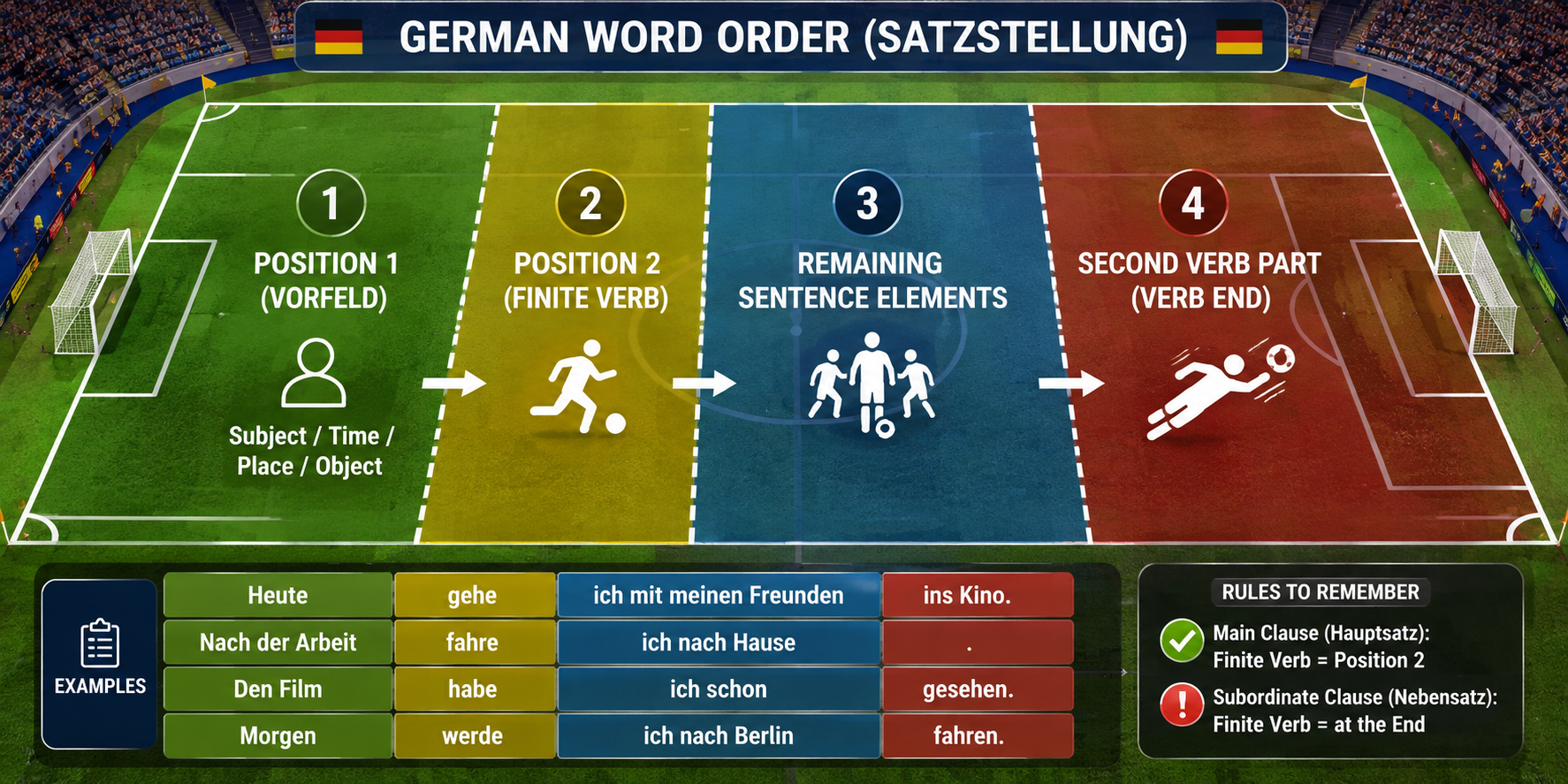
flowchart LR
    P1["Position 1 (Vorfeld)<br/><br/>Subject / Time / Place / Object"]
    P1-->P2["Position 2 <br/><br/> Finite Verb"]
    P2-->Mid["Remaining Sentence Elements"]
    Mid-->VerbEnd["Second Verb Part<br/><br/>(Verb End)"]
Example:
Positions
1. Position 1 () :: Vorfeld
Position 1 (Vorfeld) is the first position in a German main clause.
Only one sentence element occupies Position 1 from below elements:
General formula
Possible elements include:
- 👤 Subject
- 🎯 Object
- 📝 Adverbial Phrase
An adverbial phrase provides additional information about the action (verb).
| Type | Question | Example | Meaning |
|---|---|---|---|
| 🕒 Time | When? | heute | today |
| 📍 Place | Where? | in Berlin | in Berlin |
| 🚗 Manner | How? | mit dem Bus | by bus |
| 🎯 Reason | Why? | wegen des Regens | because of the rain |
| 🤝 Accompaniment | With whom? | mit meinen Freunden | with my friends |
- 🕒 Time
- 📍 Place
An adverbial phrase, even if it contains several words (e.g. mit meinen Freunden or nach der Arbeit), counts as one sentence element.
Possible elements for
mindmap
  root((Position 1))
    Subject
    Time
    Place
    Object
    Adverb
2. Position 2 () :: Finite Verb
The finite (conjugated) verb always occupies Position 2 in a main clause (Hauptsatz).
Golden Rule: In a main clause, the finite verb never leaves Position 2, regardless of what comes first (subject, time, place, object, or an adverbial phrase).
flowchart LR
    P1["Position 1 (Vorfeld)"]
    -->V["Finite Verb<br/>(Position 2)"]
    -->M["Remaining Sentence Elements<br/>(Mittelfeld)"]
    -->E["Second Verb Part (if any)<br/>(Verb End)"]
Formula
Examples
3. Inversion (Inversion)
Inversion happens when something other than the subject occupies Position 1.
Normal
Inversion
When Position 1 is not the subject, the subject moves behind the finite verb.
Examples
🕒 Time First
📍 Place First
🎯 Object First
📝 Adverbial Phrase First
4. Verb Bracket :: Satzklammer
Many German verb forms consist of two parts.
The finite verb stays in Position 2, while the second verb part moves to the end of the sentence.
This creates a Verb Bracket (Satzklammer) that encloses the rest of the sentence.
Formula
The finite verb opens the sentence, and the second verb part closes it. Everything else fits between these two parts, forming the Verb Bracket (Satzklammer).
flowchart LR
    A["Finite Verb"] --> B["Middle Field"]
    B --> C["Second Verb Part"]
Examples
Separable Verb
Modal Verb
Perfect Tense
Future Tense
Sentence Structure (Satzbau)
    Sentence Structure(Satzbau)
        │
        ├── 0. Word Order
        ├── 1. Main Clauses
        ├── 2. Subordinate Clauses
        ├── 3. Relative Clauses
        ├── 4. Indirect Questions
        ├── 5. Infinitive Clauses
        └── 6. Advanced Constructions
1. Main Clause (Hauptsatz)
A main clause (Hauptsatz) is an independent clause that expresses a complete thought and can stand alone.
- Can stand alone
- Expresses a complete idea
- Finite verb is in Position 2
- Can contain a Verb Bracket
Every German sentence contains at least one main clause.
Structure
where
- = Finite Verb
- = Second Verb Part (if any)
Rule
flowchart LR
    A["Main Clause"] --> B["Verb in Position 2"]
Examples
Subject First
Time First
Place First
Object First
With Verb Bracket
Separable Verb
Modal Verb
Perfect
Future
2. Subordinate Clause :: Nebensatz
A subordinate clause (Nebensatz) is a dependent clause that cannot stand alone. It depends on a main clause (Hauptsatz) to form a complete sentence.
The defining feature of a subordinate clause is:
The finite (conjugated) verb moves to the end of the clause.
A Nebensatz has the following properties:
- ❌ Cannot stand alone
- ❌ Does not express a complete thought
- ✅ Depends on a main clause
- ✅ Finite verb moves to the end
- ✅ Usually begins with a subordinating conjunction Rule
where
- = Subject
- = Remaining sentence elements
- = Finite (conjugated) verb
flowchart LR
    A["Conjunction"]
    -->B["Subject"]
    -->C["Object"]
    -->D["Finite Verb"]
Formula
Main Clause vs Subordinate Clause
| Feature | Main Clause | Subordinate Clause |
|---|---|---|
| Can stand alone | ✅ | ❌ |
| Complete thought | ✅ | ❌ |
| Finite verb | Position 2 | Sentence End |
| Begins with conjunction | Optional | Usually Yes |
| Structure |
Examples
Reason
Statement
Time
Contrast
Main Clause
Example
Subordinate Clause
Example
Position of the Subordinate Clause
A subordinate clause can appear after or before the main clause.
Main Clause First
flowchart LR

A["Main Clause"]-->B["Subordinate Clause"]
Subordinate Clause First
flowchart LR

A["Subordinate Clause"]
-->B["Main Clause"]
Rule
When the subordinate clause comes first,
- it occupies Position 1
- the finite verb of the main clause still remains in Position 2
Formula
Common Subordinating Conjunctions
mindmap
  root((Nebensätze))
    Reason
      weil
      da
    Statement
      dass
    Condition
      wenn
      falls
    Question
      ob
    Time
      als
      bevor
      nachdem
      bis
      seit
      während
      sobald
      solange
    Contrast
      obwohl
    Purpose
      damit
    Result
      sodass
3. Relative Clauses (Relativsätze)
A relative clause (Relativsatz) is a subordinate clause that gives more information about a noun.
It always begins with a relative pronoun.
Characteristics
- ✅ Describes a noun
- ✅ Begins with a relative pronoun
- ✅ Is a subordinate clause
- ✅ Finite verb moves to the end
Structure
flowchart LR
    A["Main Clause"]
    A["Main Clause"]-->B["Noun"]
    B-->C["Relative Pronoun"]
    C-->D["Relative Clause"]
    D-->E["Finite Verb<br/>Sentence End"]
Formula
Relative Pronouns
| Gender | Nominative | Accusative | Dative | Genitive |
|---|---|---|---|---|
| Masculine | der | den | dem | dessen |
| Feminine | die | die | der | deren |
| Neuter | das | das | dem | dessen |
| Plural | die | die | denen | deren |
Examples
Subject
The man who lives next door.
Object
Dative
Plural
Word Order
Main Clause
Relative Clause
Examples
flowchart LR
    A["Das ist der Mann"]
    A -->B["der"]
    B-->C["in Berlin"]
    C-->D["wohnt"]
flowchart LR

A["Ich kenne die Frau"]
A-->B["die"]
B-->C["Deutsch"]
C-->D["spricht"]
Relative Clause vs Conjunction Clause
| Relative Clause | Conjunction Clause |
|---|---|
| Describes a noun | Expresses a reason, time, condition, etc. |
| Starts with a relative pronoun | Starts with a conjunction |
| Verb at the end | Verb at the end |
Relative Clause
Conjunction Clause
Summary
mindmap
  root((Relative Clauses))
    Describe a noun
    Relative Pronoun
      der
      die
      das
      den
      dem
      dessen
      deren
      denen
    Verb at End
    Subordinate Clause
🧠 Remember
4. Questions
1. W-Questions
Formula
Examples
2. Yes / No Questions
Formula
Examples
flowchart LR

A["W-Question"] -->B["W-Word"]
B-->C["Verb"]
C-->D["Subject"]

E["Yes / No"]
E-->F["Verb"]
F-->G["Subject"]
Summary
| Topic | Formula |
|---|---|
| Normal Sentence | |
| Inversion | |
| Subordinate Clause | |
| W-Question | |
| Yes / No Question | |
| Verb Bracket |
4. Indirect Questions (Indirekte Fragesätze)
An indirect question reports or embeds a question inside another sentence.
Unlike direct questions, an indirect question is always a subordinate clause, so the finite verb moves to the end.
Characteristics
- ✅ Is a subordinate clause
- ✅ Depends on a main clause
- ✅ Verb moves to the end
- ✅ Starts with a W-word or ob
Structure
flowchart LR

A["Main Clause"]
A-->B["Question Word / ob"]
B-->C["Subject"]
C-->D["Remaining Sentence Elements"]
D-->E["Finite Verb<br/>Sentence End"]
Formula
W-Question
Yes / No Question
Direct vs Indirect Questions
W-Question
| Direct Question | Indirect Question |
|---|---|
| Wo wohnst du? | Ich weiß nicht, wo du wohnst. |
Yes / No Question
| Direct Question | Indirect Question |
|---|---|
| Kommst du morgen? | Ich weiß nicht, ob du morgen kommst. |
W-Words
mindmap
  root((W-Words))
    wer
    was
    wann
    wo
    wohin
    woher
    warum
    wie
    welcher
Using ob
Use ob when the direct question can be answered with yes or no.
flowchart TD

A["Is it a Yes/No Question?"]

A -->|Yes| B["Use ob"]

A -->|No| C["Use a W-word"]
Examples
W-Question
Yes / No
Common Reporting Verbs
mindmap
  root((Reporting Verbs))
    wissen
    fragen
    sagen
    erklären
    erzählen
    verstehen
Examples
- Ich weiß nicht, ...
- Kannst du mir sagen, ...
- Sie fragt, ...
- Er erklärt, ...
Word Order
Direct Question
Example
Indirect Question
Example
Yes / No
Example
Direct vs Indirect
flowchart LR

A["Direct Question"]
-->B["Verb = Position 1 or 2"]

C["Indirect Question"]
-->D["Verb = Sentence End"]
| Direct | Indirect |
|---|---|
| Wo wohnst du? | Ich weiß nicht, wo du wohnst. |
| Kommst du? | Ich weiß nicht, ob du kommst. |
Summary
mindmap
  root((Indirect Questions))
    W-word
    ob
    Verb at End
    Reporting Verb
    Subordinate Clause
🧠 Remember
6. Infinitive Clauses (Infinitivsätze)
An Infinitive Clause (Infinitivsatz) is a dependent sentence construction that uses
zu + Infinitivinstead of a finite (conjugated) verb.
Unlike subordinate clauses, an infinitive clause does not contain a finite verb.
Structure
flowchart LR

A["Main Clause"]
-->B["zu + Infinitive"]
-->C["Remaining Elements"]
Formula
Example
Characteristics
- ✅ Dependent sentence construction
- ✅ Uses zu + infinitive
- ❌ No finite verb
- ✅ Usually the subject is the same as in the main clause
Same Subject Rule
Use an infinitive clause when both clauses have the same subject.
flowchart TD

A["Same Subject?"]

A -->|Yes| B["Use zu + Infinitiv"]

A -->|No| C["Use dass-Clause"]
Same Subject
Both actions are performed by ich.
Different Subject
Different subject (du), so use a dass-clause.
dass vs zu
| Same Subject | Different Subject |
|---|---|
zu + Infinitiv | dass Clause |
| Ich hoffe, zu gewinnen. | Ich hoffe, dass du gewinnst. |
| Er versucht, Deutsch zu lernen. | Er glaubt, dass sie Deutsch lernt. |
Common Verbs
mindmap
  root((Verbs))
    hoffen
    versuchen
    vergessen
    beginnen
    planen
    beschließen
    versprechen
Examples
Purpose
um ... zu
Expresses purpose.
Meaning
in order to pass the exam
Without
ohne ... zu
Meaning
without saying anything
Instead of
anstatt ... zu
Meaning
instead of studying
Separable Verbs
With separable verbs, zu is inserted between the prefix and the verb.
| Infinitive | zu + Infinitive |
|---|---|
| einkaufen | einzukaufen |
| anrufen | anzurufen |
| aufstehen | aufzustehen |
Example
Exceptions
Modal Verbs
Modal verbs do not use zu.
❌
✅
brauchen + zu
Special case
Meaning
You don't need to come.
Summary
mindmap
  root((Infinitive Clauses))
    Same Subject
    zu + Infinitive
    um ... zu
    ohne ... zu
    anstatt ... zu
    No Finite Verb
    Separable Verbs
    Modal Verbs
🧠 Remember
flowchart TD

A["Same Subject?"]

A -->|Yes| B["zu + Infinitiv"]

A -->|No| C["dass-Satz"]
Final Words
Comparison
| Construction | Finite Verb | Example |
|---|---|---|
| Main Clause | ✅ Position 2 | Ich lerne Deutsch. |
| Subordinate Clause | ✅ Sentence End | ..., weil ich Deutsch lerne. |
| Relative Clause | ✅ Sentence End | ..., der Deutsch spricht. |
| Indirect Question | ✅ Sentence End | ..., wo du wohnst. |
| Infinitive Clause | ❌ | ..., Deutsch zu lernen. |
Memory Map
mindmap
  root((German Word Order))
    Position 1
      Subject
      Time
      Place
      Object
    Position 2
      Finite Verb
    Inversion
    Verb Bracket
      Separable Verbs
      Modal Verbs
      Perfect
      Future
    Main Clause
      Verb Position 2
    Subordinate Clause
      Verb at End
    Questions
      W-Questions
      Yes/No Questions