Konjunktiv: Mood & Konjunktiv I (Indirekte Rede) 🎭
Learn what Konjunktiv is as a grammatical mood, then Konjunktiv I for indirect/reported speech (sie sei, er habe, sie müsse) — including when Konjunktiv I collapses into the indicative and German falls back to Konjunktiv II instead. Core B1 grammar for telc.
Konjunktiv 🎭
Konjunktiv is the German mood used to express things that are not direct facts.
Der Konjunktiv is the German verb mood used to express things that are not presented as straightforward facts:
- wishes
- hypothetical situations
- politeness
- possibilities, and
- reported speech.
Unlike tenses (Präsens, Perfekt, Futur), which tell when something happens,
Konjunktiv tells how the speaker views the statement.
What is a Mood?
A mood (Modus) expresses the speaker's attitude.
| Mood | German | Purpose |
|---|---|---|
| 😊 Indicative | Indikativ | Facts |
| 👉 Imperative | Imperativ | Commands |
| 💭 Subjunctive | Konjunktiv | Wishes, possibilities, reported speech, politeness |
Konjunktiv Forms
Konjunktiv have 2 forms
| Konjunktiv I | Konjunktiv II |
|---|---|
| K I | K II |
| Reported speech | Wishes, hypotheticals, unreal situations, politeness |
| Someone says/thinks that... | would / could / might |
| Er sagt, er sei krank. | Wenn ich Zeit hätte, würde ich kommen. |
                 KONJUNKTIV
                     │
          ┌──────────┴──────────┐
          │                     │
     KONJUNKTIV I         KONJUNKTIV II
          │                     │
   🗣️ Reported speech     💭 Unreal / hypothetical
          │                     │
   Er sagt, er sei...     Wenn ich wäre...
                            │
                       ┌────┼────┐
                       │    │    │
                     🙏     💭    🙇
                   wishes  unreal polite
🗣️ Konjunktiv I: Indirekte Rede
Konjunktiv I is mainly used to quote what someone else said without presenting it as your own statement.
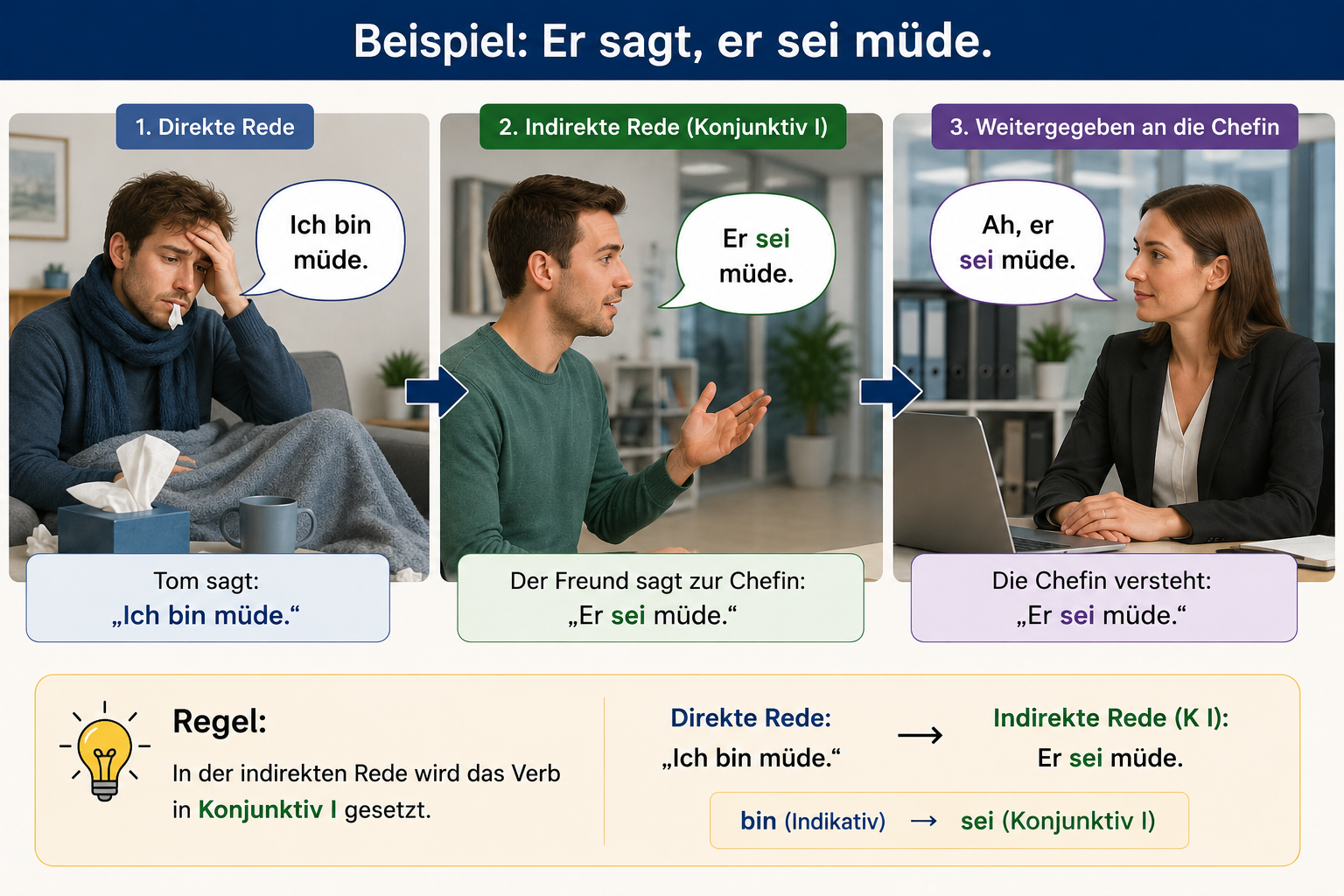
Rule
When quoting use K-I Verb Forms
- Word order remains SVO.
- Remove quotation marks from direct speech
- The verb in the reported statement is changed to Konjunktiv I.
Konjunktiv I forms
| Infinitive | Konjunktiv I | Example |
|---|---|---|
| sein | sei | Er sagt, er sei müde. |
| haben | habe | Er sagt, er habe keine Zeit. |
| werden | werde | Er sagt, er werde morgen kommen. |
| kommen | komme | Er sagt, er komme später. |
| gehen | gehe | Er sagt, er gehe nach Hause. |
| machen | mache | Er sagt, er mache das morgen. |
Example
- Direct: Er sagt: "Ich
binkrank." - Indirect: Er sagt, er
seikrank.
with dass
Move KII form to end
Direct
Er sagt: "Ich
habekeine Zeit."
Indirect
Er sagt, er
habekeine Zeit.
Dass
Er sagt, dass er keine Zeit
habe.
Examples
| # | 🗣️ Direct Speech | → | 📝 Indirect Speech |
|---|---|---|---|
| 1 | Er sagt: "Ich bin müde." | → | Er sagt, er sei müde. |
| 2 | Sie sagt: "Ich habe keine Zeit." | → | Sie sagt, sie habe keine Zeit. |
| 3 | Peter sagt: "Ich komme morgen." | → | Peter sagt, er komme morgen. |
| 4 | Anna sagt: "Ich gehe nach Hause." | → | Anna sagt, sie gehe nach Hause. |
| 5 | Tom sagt: "Ich kaufe ein neues Auto." | → | Tom sagt, er kaufe ein neues Auto. |
| 6 | Maria sagt: "Ich arbeite heute." | → | Maria sagt, sie arbeite heute. |
| 7 | Er sagt: "Ich kann dir helfen." | → | Er sagt, er könne mir helfen. |
| 8 | Sie sagt: "Ich muss morgen arbeiten." | → | Sie sagt, sie müsse morgen arbeiten. |
| 9 | Paul sagt: "Ich werde später kommen." | → | Paul sagt, er werde später kommen. |
| 10 | Lisa sagt: "Ich möchte ein neues Handy." | → | Lisa sagt, sie möchte ein neues Handy. |
| 11 | Die Kinder sagen: "Wir sind müde." | → | Die Kinder sagen, sie seien müde. |
| 12 | Die Mitarbeiter sagen: "Wir haben ein Problem." | → | Die Mitarbeiter sagen, sie hätten ein Problem. |
⚠️ When Konjunktiv I is not enough
Sometimes the Konjunktiv I form is identical to the normal Indicative form.
So German often uses Konjunktiv II to make it clear that this is reported speech:
| Direct speech | Konjunktiv I | Problem | Common alternative |
|---|---|---|---|
| "Wir kommen morgen." | sie kommen morgen | identical | sie kämen morgen |
| "Sie haben Zeit." | sie haben Zeit | identical | sie hätten Zeit |
| "Sie gehen nach Hause." | sie gehen nach Hause | identical | sie gingen nach Hause |
| "Wir machen das." | sie machen das | identical | sie machten das |
🧠 Key Points
- sein → wäre, haben → hätte — one-word forms, never with würde.
- Modals use their own one-word forms (könnte, müsste, sollte…) → see Modal Verbs.
- All other verbs → just würde + Infinitiv. Don't overthink it.
- Unreal "if": both the wenn-clause and the result use Konjunktiv II.
- Past: hätte / wäre + Partizip II; with a modal → double infinitive (hätte kommen können).
Related: Modal Verbs · Tenses · Partizip II · Coordinating Conjunctions