Grammar
Auxiliary Verbs: sein, haben, werden 💠
Learn the three German auxiliary (helping) verbs — sein, haben, and werden — their full conjugation, how werden forms Futur I, and the rule against using ein/eine with an unqualified profession or nationality.
German
Grammar
Hilfsverben
Auxiliary Verbs
Verbs
Language
💠 Auxiliary Verbs/ Helping Verbs
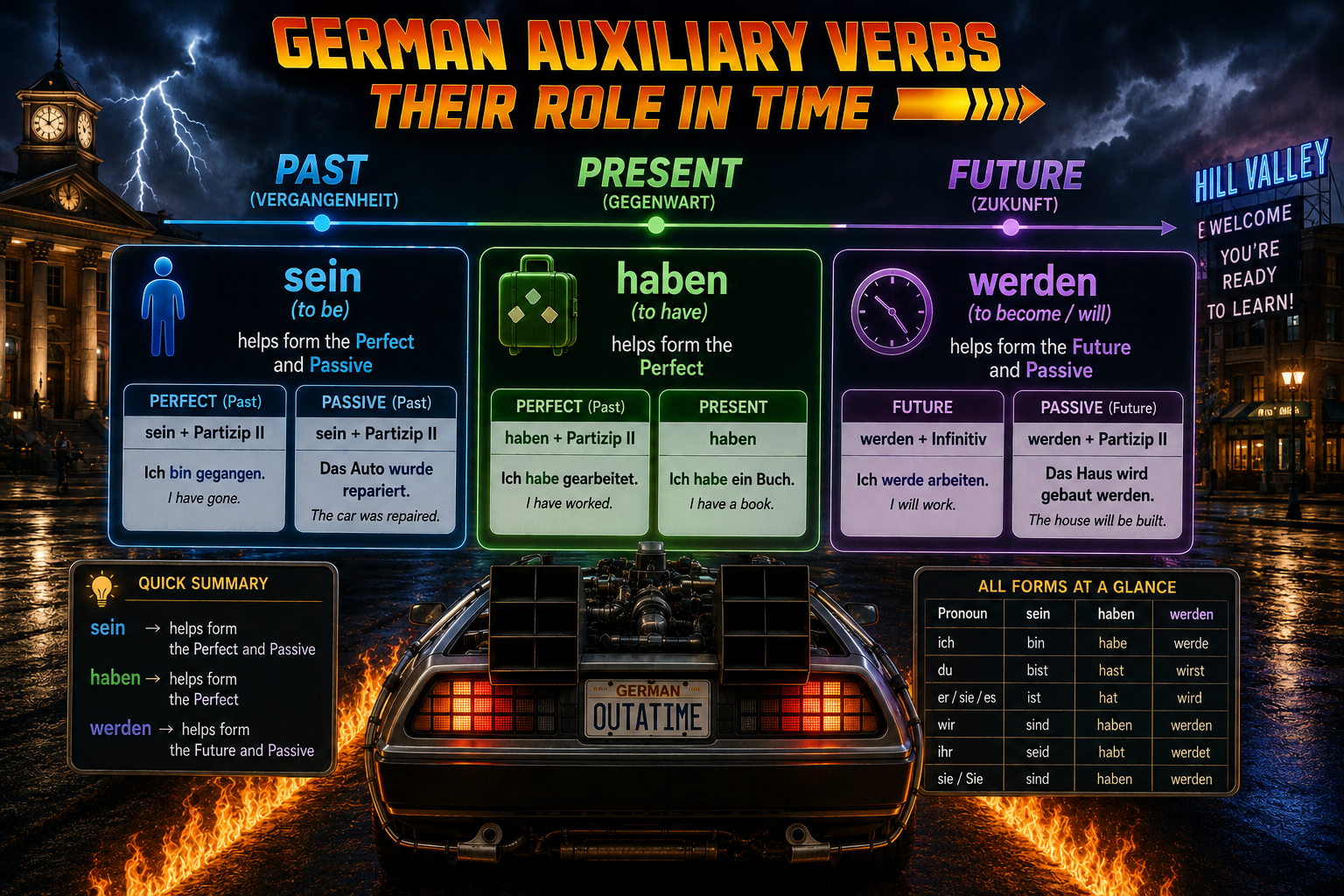
Auxiliary verbs are verbs that help another verb form a tense, voice, or grammatical structure. They usually do not carry the main action themselves.
In German, the three main auxiliary verbs are:
| Verb | Emoji | English | Main Use |
|---|---|---|---|
sein | 🧍 | to be | Perfect tense, passive, movement/change of state |
haben | 🧳 | to have | Perfect tense, possession, most verbs |
werden | 🌱 | to become / will | Future tense, passive voice, change of state |
Conjugation of Auxiliary Verbs
| Pronoun | sein 🧍 | haben 🧳 | werden 🌱 |
|---|---|---|---|
English | to be | to have | to become / will |
ich | bin | habe | werde |
du | bist | hast | wirst |
er / sie / es | ist | hat | wird |
wir | sind | haben | werden |
ihr | seid | habt | werdet |
sie / Sie | sind | haben | werden |
Konjunktiv II Conjugation of Auxiliary Verb
| # | Emoji | Modal Verb | ich (-) | du (s/st) | er/sie/es (-) | wir (en) | ihr (t) | sie/Sie (en) | English Meaning |
|---|---|---|---|---|---|---|---|---|---|
| 1️⃣ | 💪 | Haben | hätte | hättest | hätte | hätten | hättet | hätten | would have / should have |
| 2️⃣ | 💖 | Sein | wäre | wärest | wäre | wären | wärt | wären | would be |
| 3️⃣ | 💭 | Werden | würde | würdest | würde | würden | würdet | würden | would / would become |
- Ich hätte mehr Zeit, wenn ich nicht so viel arbeiten müsste. → I would have more time if I didn’t have to work so much.
- Er wäre glücklich, wenn er ein neues Auto hätte. → He would be happy if he had a new car.
- Wir würden gerne ins Kino gehen, aber wir haben keine Zeit. → We would like to go to the cinema, but we don’t have time.
- Sie würde gerne reisen, aber sie hat Angst vor dem Fliegen. → She would like to travel, but she is afraid of flying.
- Wenn ich reich wäre, würde ich eine Weltreise machen. → If I were rich, I would go on a world tour.
English → German Auxiliary Verbs
It is common misconception that English helping verbs translate as German helping verb.
German: SEIN + HABEN + WERDEN
English: BE + HAVE + DO
| Auxiliary | Forms | Main Function | Example |
|---|---|---|---|
be | am, is, are, was, were | Continuous + Passive | She is working. / The car was repaired. |
do | do, does, did | Questions + Negatives + Emphasis | Do you work? / He doesn't work. / I did call. |
have | have, has, had | Perfect tenses | I have finished. / She had left. |
They do not translate one-to-one into German helping verbs.
English helping verbs are always translated as main verbs
English Auxiliary Verbs Mapping
| English | German | Example |
|---|---|---|
am | bin | Iam tired. → Ichbin müde. |
is | ist | Heis tired. → Erist müde. |
are | sind / bist / seid | Weare tired. → Wirsind müde. |
was | war | Iwas tired. → Ichwar müde. |
were | waren / warst / wart | Wewere tired. → Wirwaren müde. |
do | no direct equivalent | Do you work? →Arbeitest du? |
does | no direct equivalent | Does he work? →Arbeitet er? |
did | no direct equivalent | Did you work? →Hast du gearbeitet? /Arbeitetest du? |
have | habe / haben | Ihave a car. → Ichhabe ein Auto. |
has | hat | Shehas a car. → Siehat ein Auto. |
had | hatte / hatten | Ihad a car. → Ichhatte ein Auto. |
🇬🇧 Do/Does/Did → 🇩🇪 usually nothing
The big difference: do / does / did
English uses do as a grammatical helper:
- Do you speak German?
- Does he work here?
- Did you see him?
German simply conjugates the main verb:
- Sprichst du Deutsch?
- Arbeitet er hier?
- Hast du ihn gesehen?
Useful mapping
| English Auxiliary | German Equivalent | Function |
|---|---|---|
be → am/is/are/was/were | sein | to be |
have → have/has/had | haben | to have |
do → do/does/did | no equivalent | questions/negatives/emphasis |
werden | will / become | Future + Passive |
Examples
- Ich habe ein Auto - I have a car
- Sie hat eine Tochter - she has a daughter
- Wir haben ein Handy - We have a Mobile
- Sie haben ein Haus - They have a house
- Das Kind hat ein Buch - The child has a book
Wird
- Main verb comes at end
- Conjugation of werden at IInd position
Example
- Er kommt morgen - He will come tomorrow
- Er wird morgen kommen
- Er wird heute kommen - He will come today
- Sie wird ein Auto kaufen - She will buy a car
- Sie werden nach Berlin gehen - They will go to Berlin
- Wir werden ein Buch lesen- We will read the book
- Das kind wird Milch trinken - The child will drink milk
- Sie wird Deutsch lernen
- Sie werden ein Haus kaufen
- Das Kind wird eine Banane essen
- Er wird heute kommen
- Ich werde das Buch lesen
With profession (including student ) we should not us ein/eine because as per German system it mean one which make no
sense to speak. but wehn we talk about quality of the profession we have to use ein/eine
- Ich bin Student - I am a student
- Sie sind Student - You are a student
- Er ist mein Freund - He is my friend
- Sie ist meine Tochter- She is my daughter
- Heute ist Mittwoch - Today is Wednesday
- Wir sind in Delhi - We are in Delhi
- Das Kind ist frech - The child is naughty
- Der Mann ist Arzt- The man is a doctor
- Er ist ein guter Artz - He is a good doctor
Related: Verbs Overview · Tenses · Passive Voice