title: "Reflexive Verbs (Reflexive Verben) 🪞" excerpt: >- Learn German reflexive verbs — sich freuen, sich beeilen, sich erinnern, and more — with their matching reflexive pronouns, plus the closely related double-infinitive verb pattern (spazieren gehen, kennen lernen). coverImage: /_notes/Grammar/cover/verbs.jpeg date: '2026-08-10T00:00:00.000Z' tags:
- German
- Grammar
- Reflexive Verben
- Reflexive Verbs
- Verbs
- Language
- Learning ogImage: url: /_notes/Grammar/cover/verbs.jpeg
Reflexive Verben :: Reflexive verbs 🪞️
Reflexive verbs (Reflexive Verben) are verbs where the subject and the object refer to the same person.
- In Perfekt, reflexive verbs use haben: Ich habe mich gewaschen. → I washed myself.
Reflexive Pronouns
💡 Reflexive verbs always take a reflexive pronoun that matches the subject.
Ich wasche mich.
flowchart LR

A["👤 Subject<br/>Ich"]-->B["🧼 wasche"]-->C["<b>mich</b> <br/> 🎯 Akkusativ"]
C -. 🪞 refers back .-> A
Ich wasche mir die Hände.
flowchart LR

A["👤 Subject<br/>Ich"]-->B["🧼 wasche"]-->C["<b>mir</b> <br/> 🎯 Akkusativ"] --> D["Hand <br/> 🎁 Dative"]
D -. 🪞 refers back .-> A
Reflexive pronouns have no genitive form in modern German
| Person | Emoji | 👤 Nominativ | 🎯 Akkusativ | 🎁 Dativ | 🇬🇧 Meaning |
|---|---|---|---|---|---|
| 1st singular | 👤 ich | — | mich | mir | myself |
| 2nd singular | 🫵 du | — | dich | dir | yourself (informal) |
| 3rd singular | 🟦️/🟨/🟥 er/es/sie | — | sich | sich | himself/ herself/ itself |
| 1st plural | 👥 wir | — | uns | uns | ourselves |
| 2nd plural | 👨👩👧👦ihr | — | euch | euch | yourselves |
| 3rd plural | 🧑🤝🧑 sie (they)** | — | sich | sich | themselves |
| 2nd formal | 🎩 Sie* | — | sich | sich | yourself (formal) |
- For er / sie / es / sie / Sie, AKK and DAT are always
sich
Reflexive Verbs
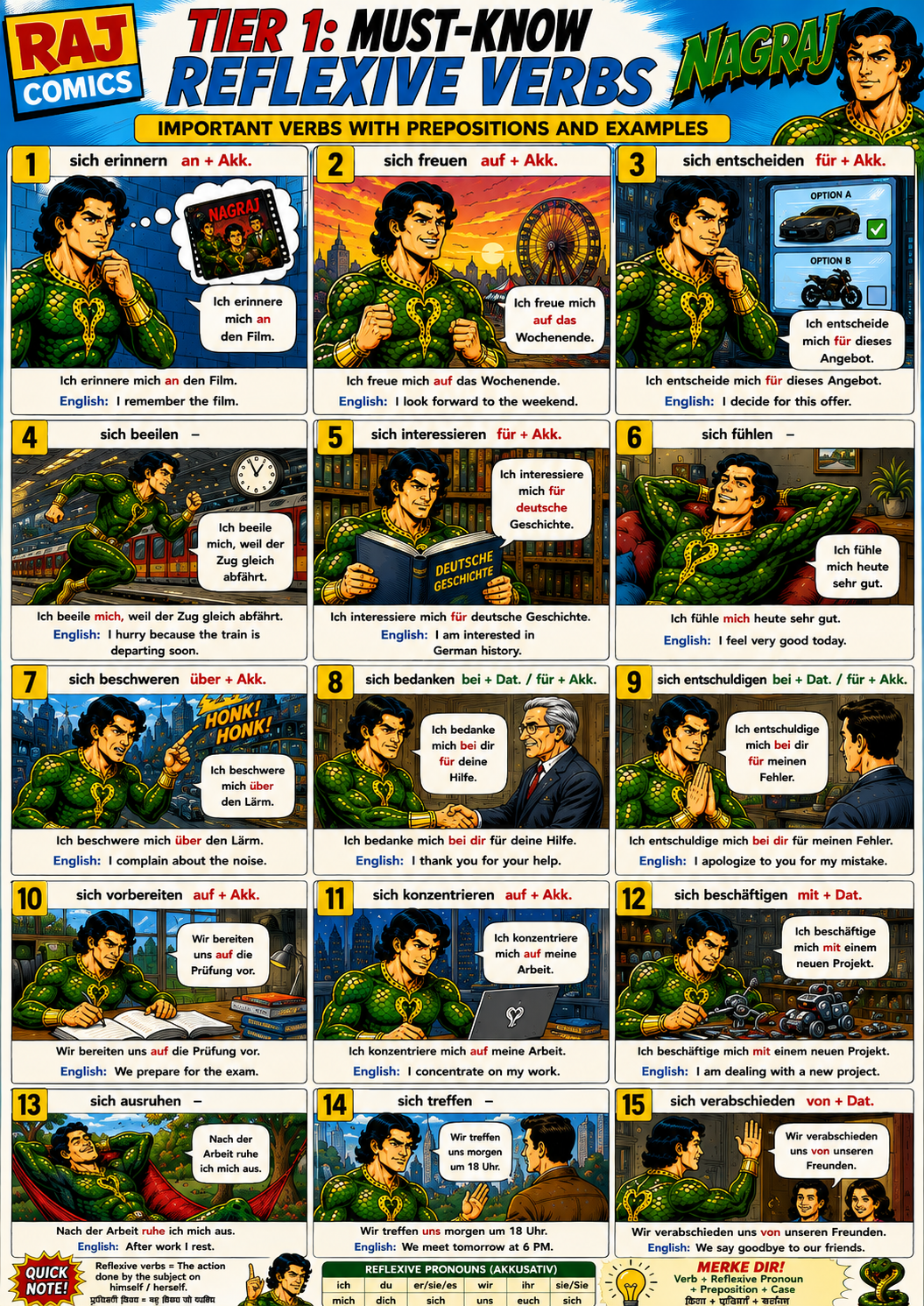
🔥 Tier 1: Must-Know Reflexive Verbs
- Some verbs are always reflexive (e.g., sich freuen),
- while others can be reflexive or non-reflexive depending on context (e.g., waschen → Ich wasche das Auto vs Ich wasche mich).
| # | Emoji | Reflexive Verb | Case / Preposition | English | Example | Meaning |
|---|---|---|---|---|---|---|
| 1 | 🧠 | sich erinnern | an + Akk. | to remember | Ich erinnere mich an den Film. | I remember the movie. |
| 2 | 😊 | sich freuen | auf + Akk. | to look forward to | Ich freue mich auf das Wochenende. | I'm looking forward to the weekend. |
| 3 | 🪞 | sich entscheiden | für + Akk. | to decide | Ich entscheide mich für dieses Angebot. | I decide on this offer. |
| 4 | 🏃 | sich beeilen | — | to hurry | Ich beeile mich, weil der Zug gleich abfährt. | I hurry because the train is leaving soon. |
| 5 | ❤️ | sich interessieren | für + Akk. | to be interested | Ich interessiere mich für deutsche Geschichte. | I am interested in German history. |
| 6 | 😌 | sich fühlen | — | to feel | Ich fühle mich heute sehr gut. | I feel very good today. |
| 7 | 🗣️ | sich beschweren | über + Akk. | to complain | Er beschwert sich über den Lärm. | He complains about the noise. |
| 8 | 🙏 | sich bedanken | bei + Dat. / für + Akk. | to thank | Ich bedanke mich bei dir für deine Hilfe. | I thank you for your help. |
| 9 | ❤️ | sich entschuldigen | bei + Dat. / für + Akk. | to apologize | Ich entschuldige mich bei dir für meinen Fehler. | I apologize to you for my mistake. |
| 10 | 🏋️ | sich vorbereiten | auf + Akk. | to prepare | Wir bereiten uns auf die Prüfung vor. | We are preparing for the exam. |
| 11 | 📚 | sich konzentrieren | auf + Akk. | to concentrate | Ich konzentriere mich auf meine Arbeit. | I concentrate on my work. |
| 12 | 🧩 | sich beschäftigen | mit + Dat. | to deal with | Ich beschäftige mich mit einem neuen Projekt. | I am working on a new project. |
| 13 | 😴 | sich ausruhen | — | to rest | Nach der Arbeit ruhe ich mich aus. | I rest after work. |
| 14 | 🤝 | sich treffen | — | to meet | Wir treffen uns morgen um 18 Uhr. | We are meeting tomorrow at 6 PM. |
| 15 | 🚪 | sich verabschieden | von + Dat. | to say goodbye | Wir verabschieden uns von unseren Freunden. | We say goodbye to our friends. |
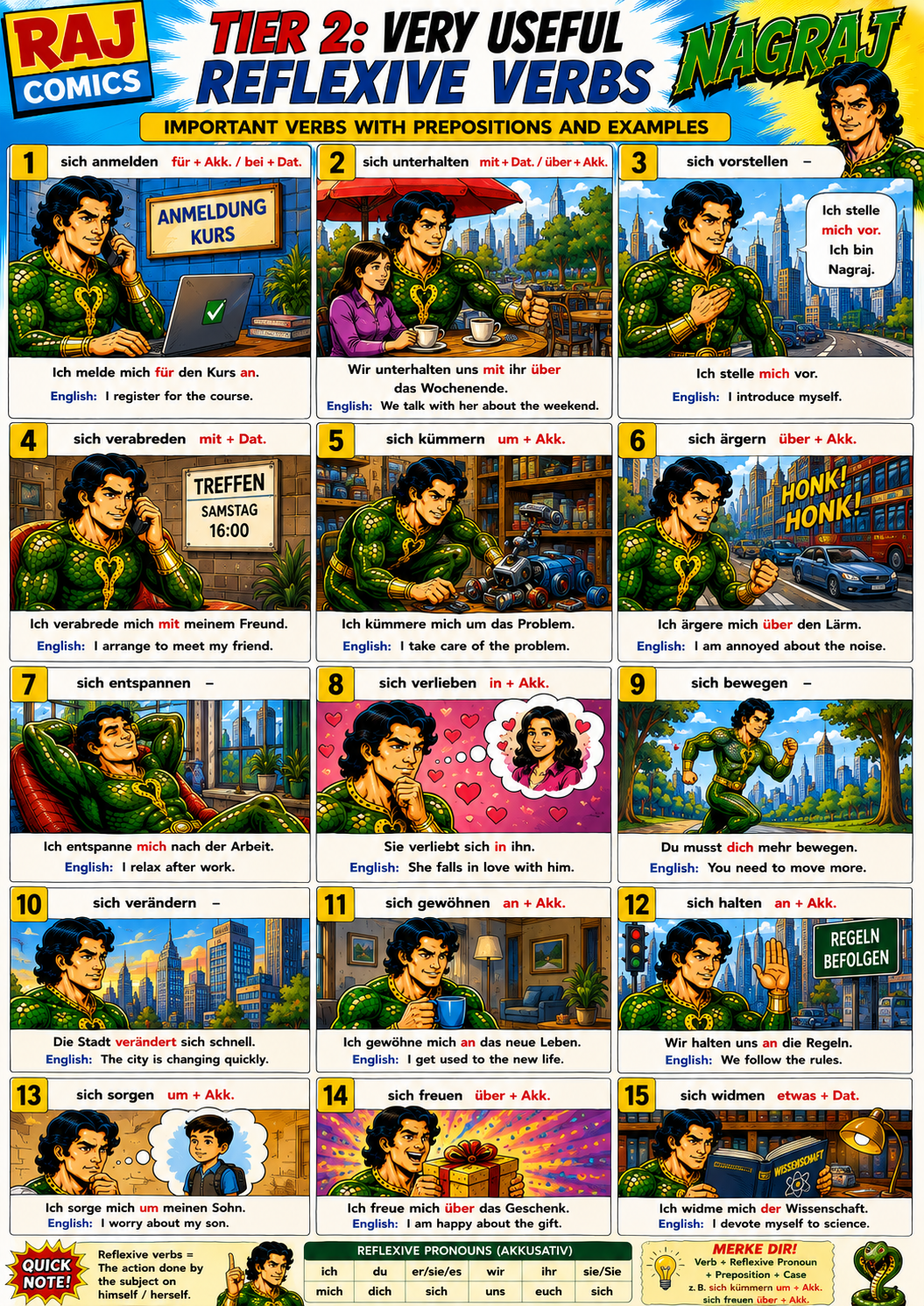
🟡 Tier 2: Very Useful Reflexive Verbs
| # | Emoji | Reflexive Verb | Case / Preposition | English | Example | Meaning |
|---|---|---|---|---|---|---|
| 1 | 📝 | sich anmelden | für + Akk. / bei + Dat. | to register / sign up | Ich melde mich für den Kurs an. | I register for the course. |
| 2 | 💬 | sich unterhalten | mit + Dat. / über + Akk. | to have a conversation | Wir unterhalten uns mit unseren Freunden über das Wochenende. | We talk with our friends about the weekend. |
| 3 | 💭 | sich vorstellen | — | to introduce oneself / imagine | Ich stelle mich vor. | I introduce myself. |
| 4 | 🤝 | sich verabreden | mit + Dat. | to arrange to meet | Ich verabrede mich mit meinem Freund. | I arrange to meet my friend. |
| 5 | 🛠️ | sich kümmern | um + Akk. | to take care of | Ich kümmere mich um das Problem. | I will take care of the problem. |
| 6 | 😡 | sich ärgern | über + Akk. | to get annoyed | Ich ärgere mich über den Lärm. | I am annoyed about the noise. |
| 7 | 🧘 | sich entspannen | — | to relax | Ich entspanne mich nach der Arbeit. | I relax after work. |
| 8 | 🥰 | sich verlieben | in + Akk. | to fall in love | Sie verliebt sich in ihn. | She falls in love with him. |
| 9 | 🚶 | sich bewegen | — | to move | Du musst dich mehr bewegen. | You need to move more. |
| 10 | 🌱 | sich verändern | — | to change | Die Stadt verändert sich schnell. | The city is changing quickly. |
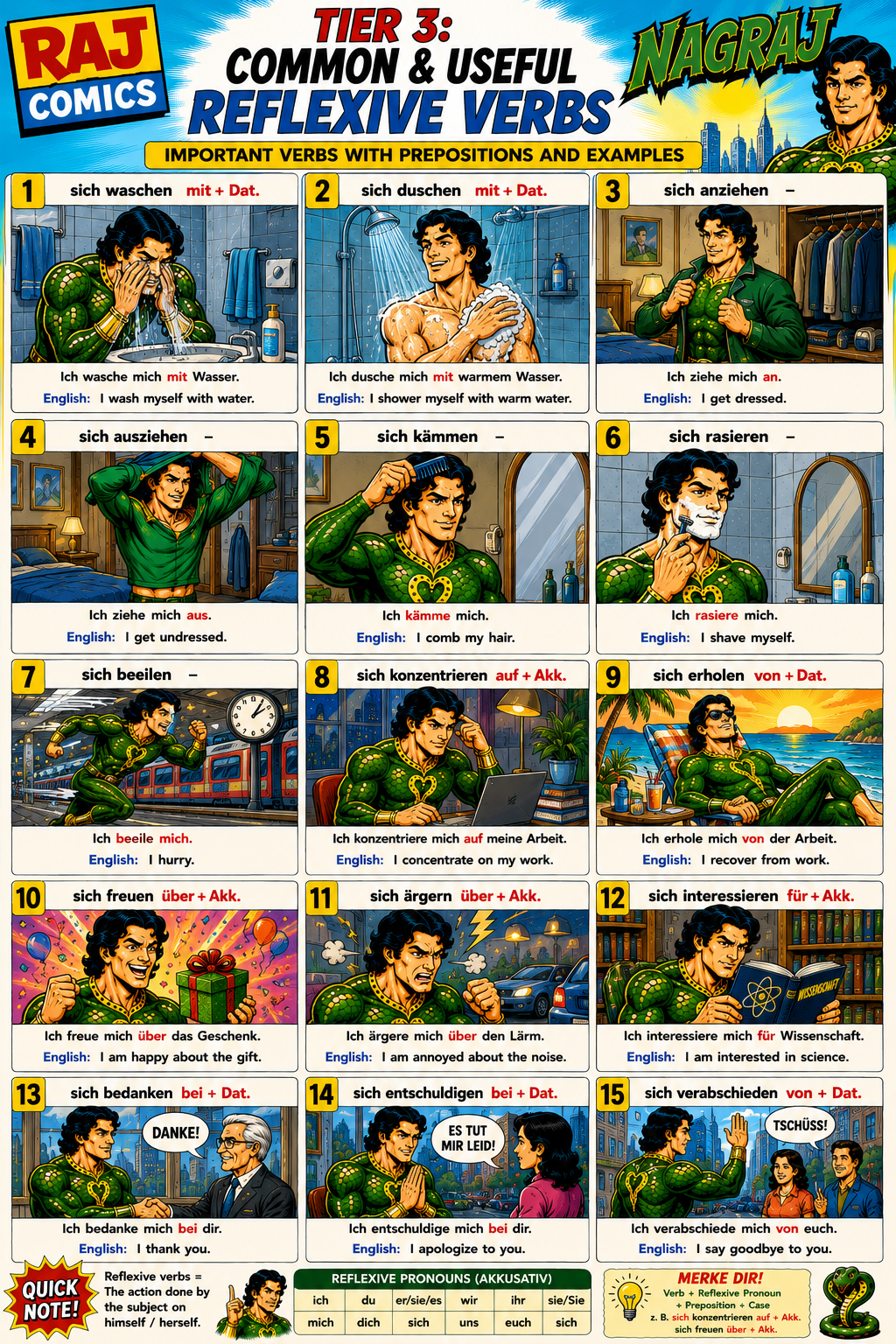
🟢 Tier 3: Everyday Reflexive Verbs
| # | Emoji | Reflexive Verb | Case / Preposition | English | Example | Meaning |
|---|---|---|---|---|---|---|
| 1 | 🧼 | sich waschen | — | to wash oneself | Ich wasche mich jeden Morgen. | I wash myself every morning. |
| 2 | 🚿 | sich duschen | — | to shower | Ich dusche mich jeden Morgen. | I shower every morning. |
| 3 | 👕 | sich anziehen | — | to get dressed | Ich ziehe mich schnell an. | I get dressed quickly. |
| 4 | 👔 | sich ausziehen | — | to get undressed | Ich ziehe mich vor dem Schlafengehen aus. | I get undressed before going to bed. |
| 5 | 🪒 | sich rasieren | — | to shave | Er rasiert sich jeden Morgen. | He shaves every morning. |
| 6 | 💇 | sich kämmen | — | to comb one's hair | Sie kämmt sich vor dem Spiegel. | She combs her hair in front of the mirror. |
| 7 | 🛏️ | sich hinlegen | — | to lie down | Ich lege mich nach der Arbeit hin. | I lie down after work. |
| 8 | 🪑 | sich setzen | — | to sit down | Bitte setzen Sie sich hier. | Please sit down here. |
| 9 | 🧍 | sich stellen | — | to position oneself / stand | Ich stelle mich vor die Tür. | I stand in front of the door. |
| 10 | 😱 | sich fürchten | vor + Dat. | to be afraid | Das Kind fürchtet sich vor dem Hund. | The child is afraid of the dog. |
| 11 | 🥊 | sich verletzen | — | to injure oneself | Er hat sich beim Sport verletzt. | He injured himself while playing sports. |
| 12 | 🎯 | sich verbessern | — | to improve | Mein Deutsch verbessert sich langsam. | My German is improving slowly. |
| 13 | 🌱 | sich entwickeln | — | to develop | Das Kind entwickelt sich sehr gut. | The child is developing very well. |
Double Infinitive Verb (DIV)
Two verbs come together in this system and both are in indefinite forms
Rules
- All rules for TV are ditto applied with DIV
Example:
-
Spazieren gehen -- to go for walk
-
Schlafen gehen -- to fo to sleep
-
Einkaufen gehen -- to go to shopping
-
Kennen lernen -- to get to know
-
I gehe um 11 Uhr schlafen -- I go to sleep at 11 O clock
-
Sie geht jede woche einkaufen -- She goes shopping everey week
-
Ich muss um 10 Uhr schlafen gehen - I must sleep at 10 Ö clock
-
Sie will jede woche einkaufen gehen - She wants to go for shopping every week
Related: Verbs Overview · Pronouns · Lassen