Dative Prepositions (VZSNAMBAG) 🎁
Learn the 9 German prepositions that always take the Dative case — von, zu, seit, nach, aus, mit, bei, ab, gegenüber — plus the mit-vs-bei and nach-vs-in-vs-zu distinctions and country-article rules.
Dative Prepositions 🎁
Dative = Where something is (position / no movement).
Dative = Location, source, accompaniment, recipient, or time.
Unlike the two-way prepositions, these always take the Dative case.
Mnemonic: V Z S N A M B A G
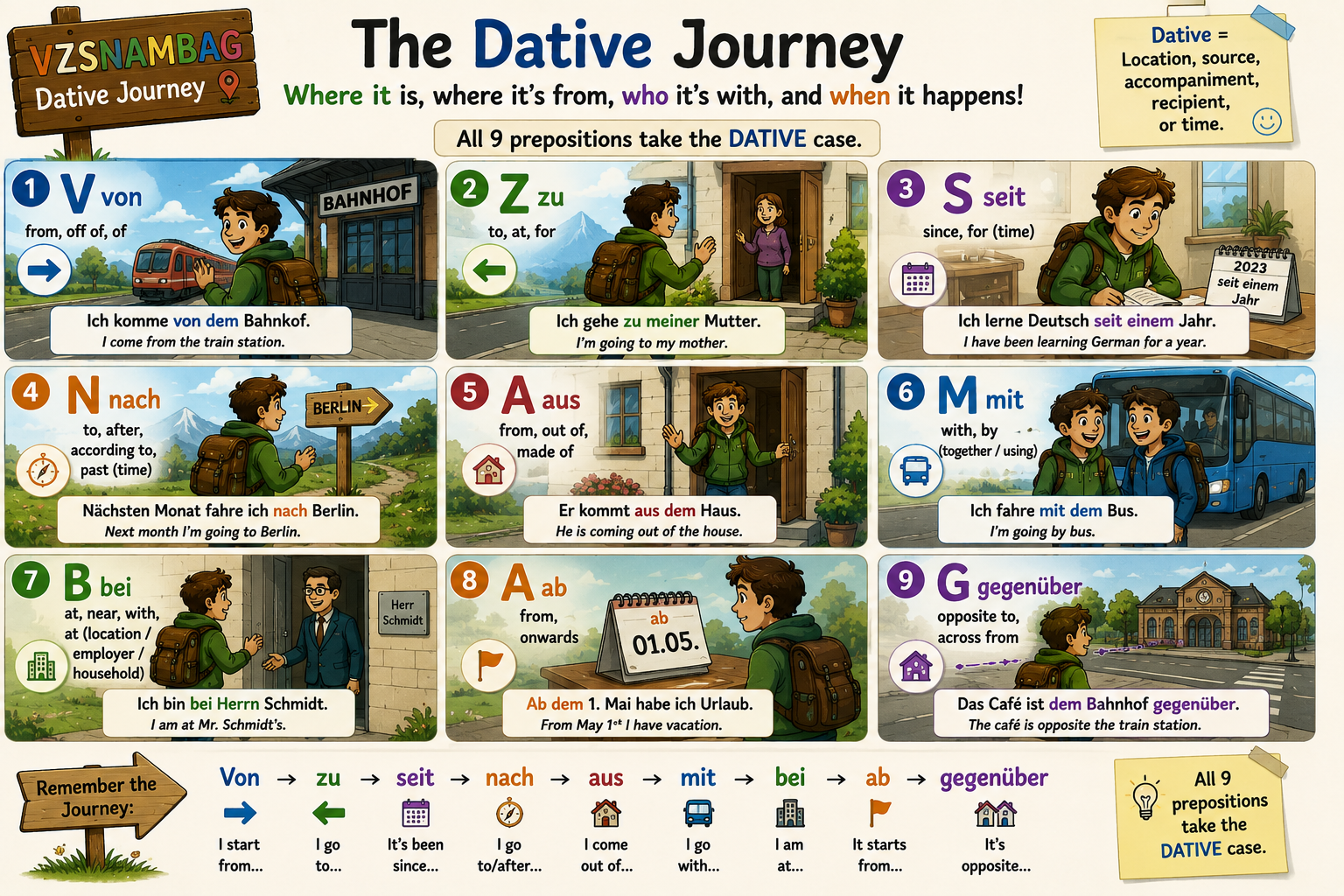
| # | 🆔 | Emoji | Preposition | Meaning |
|---|---|---|---|---|
| 1 | V | ➡️ | von | from, off of, of |
| 2 | Z | ⬅️ | zu | to, at, for |
| 3 | S | 📅 | seit | since, for (time) |
| 4 | N | 🗺️ | nach | to, after, according to, past (time) |
| 5 | A | 🏠 | aus | from, out of, made of |
| 6 | M | 🚌 | mit | with, by (together / using) |
| 7 | B | 🏢 | bei | at, near, with, at (location / employer / household) |
| 8 | A | 🏁 | ab | from, onwards |
| 9 | G | 🏘️ | gegenüber | opposite to, across from |
--> gegenüber always comes at the end of sentence
✅ Examples:
📍 Dativ (Wo? → Location)
| Satz | Präposition |
|---|---|
| Der Schalter ist in der Ecke. | in |
| Die Zeitung ist zwischen den Büchern. | zwischen |
| Der Garten ist hinter dem Haus. | hinter |
| Der Kühlschrank steht in der Küche. | in |
| Die Post ist am Bahnhof. | an |
| Die Fahrgäste sind schon im Zug. | in |
| Das Bier ist im Bauch. | in |
| Der Kuli ist in der Tasche. | in |
| Das Sofa ist zwischen dem Tisch und der Wand. | zwischen |
| Die Lampe hängt über dem Tisch. | über |
| Die Kleider hängen im Schrank. | in |
mit vs bei
mit= together with someone (companionship/accompaniment);bei= at someone's home or place (location)
- mit meinem Freund → with my friend (together, doing something with him)
- bei meinen Eltern → at my parents' place (location — I'm staying there)
in vs nach vs zu
| Preposition | Used for | Example |
|---|---|---|
| 🌍 nach | Countries, cities (no article), directions | Ich fliege nach Spanien → I’m flying to Spain |
| 🏢 in | Countries with article, rooms, buildings, enclosed places | Ich gehe in die Schule → I’m going into the school |
| 🧑⚕ zu | People, institutions, events, small destinations | Ich gehe zu meiner Oma → I’m going to my grandma’s |
🌍 1. nach
for countries, cities, and directions (no article)
Use nach when you’re going to a country or city that has no article, or when talking about a direction.
Examples:
- I’m going to Germany → Ich fahre nach Deutschland
- We’re flying to Berlin → Wir fliegen nach Berlin
- She’s going home → Sie fährt nach Hause
- Look to the right / left → Schau nach rechts / nach links
🏢 2. in
for countries with an article, buildings, rooms, or enclosed places
Use in when you’re going inside somewhere, or when you’re inside a place.
in is a Wechselpräposition (SDMA)
Movement (Akkusativ – going into):
- I’m going into the school → Ich gehe in die Schule
- We’re driving into the city → Wir fahren in die Stadt
- He’s going into the supermarket → Er geht in den Supermarkt
- I’m traveling to Switzerland → Ich reise in die Schweiz 🇨🇭
(Languages like German use “in” with countries that have an article.)
Location (Dativ – being in):
- I’m in the school → Ich bin in der Schule
- We’re in the city → Wir sind in der Stadt
🧑⚕️ 3. zu
for people, events, and smaller destinations Use zu when you go to someone, or to a place/event/institution, but not necessarily inside.
zu emphasizes the destination or person, not entering a place.
- Ich gehe zum Supermarkt → you go to the supermarket.
- Ich gehe in den Supermarkt → you go inside the supermarket.
Examples:
- I’m going to my friend’s house → Ich gehe zu meiner Freundin
- We’re going to the doctor → Wir fahren zum Arzt
- I’m going to work → Ich gehe zur Arbeit
- Are you coming to dinner? → Kommst du zum Essen?
- He’s going to the train station → Er geht zum Bahnhof
🌍 Special Rule for Countries – Articles in German
1️⃣ General Rule – No Article
Use no article with countries when using “nach” (to) for most country names.
Example:
- He goes to Germany. → Er geht nach Deutschland.
- He is in Germany. → Er ist in Deutschland.
| Country | To / Movement | In / Location |
|---|---|---|
| Deutschland | nach Deutschland | in Deutschland |
| Frankreich | nach Frankreich | in Frankreich |
| Italien | nach Italien | in Italien |
| Spanien | nach Spanien | in Spanien |
| Portugal | nach Portugal | in Portugal |
| Japan | nach Japan | in Japan |
| Kanada | nach Kanada | in Kanada |
| China | nach China | in China |
2️⃣ Special Rule – Article Needed
- Some countries require a definite article because they are feminine, plural, or use certain cases.
- Often occurs with “in” (to/in) when referring to a country.
- Use accusative if you go to the country, dative if you are in it.
| Country | Gender/Number | To / Movement | In / Location |
|---|---|---|---|
| Schweiz | die (fem.) | in die Schweiz | in der Schweiz |
| USA | die (plural) | in die USA | in den USA |
| Iran | der (masc.) | in den Iran | in dem Iran (im Iran) |
| Niederlande | die (plural) | in die Niederlande | in den Niederlanden |
| Ukraine | die (fem.) | in die Ukraine | in der Ukraine |
| Türkei | die (fem.) | in die Türkei | in der Türkei |
Related: Prepositions Overview · Accusative Prepositions · Two-Way Prepositions · Cases · Grammar Roadmap