Grammar
Personal Pronouns (Personalpronomen) 👤
Learn German personal pronouns (ich, du, er, sie, wir, ihr, Sie) across all four cases — Nominativ, Akkusativ, Dativ, and Genitiv — with tables, memory maps, and example sentences.
German
Grammar
Pronouns
Personalpronomen
Language
Learning
Personal Pronouns 👤 :: Personalpronomen
Personal pronouns are used to replace nouns in a sentence.
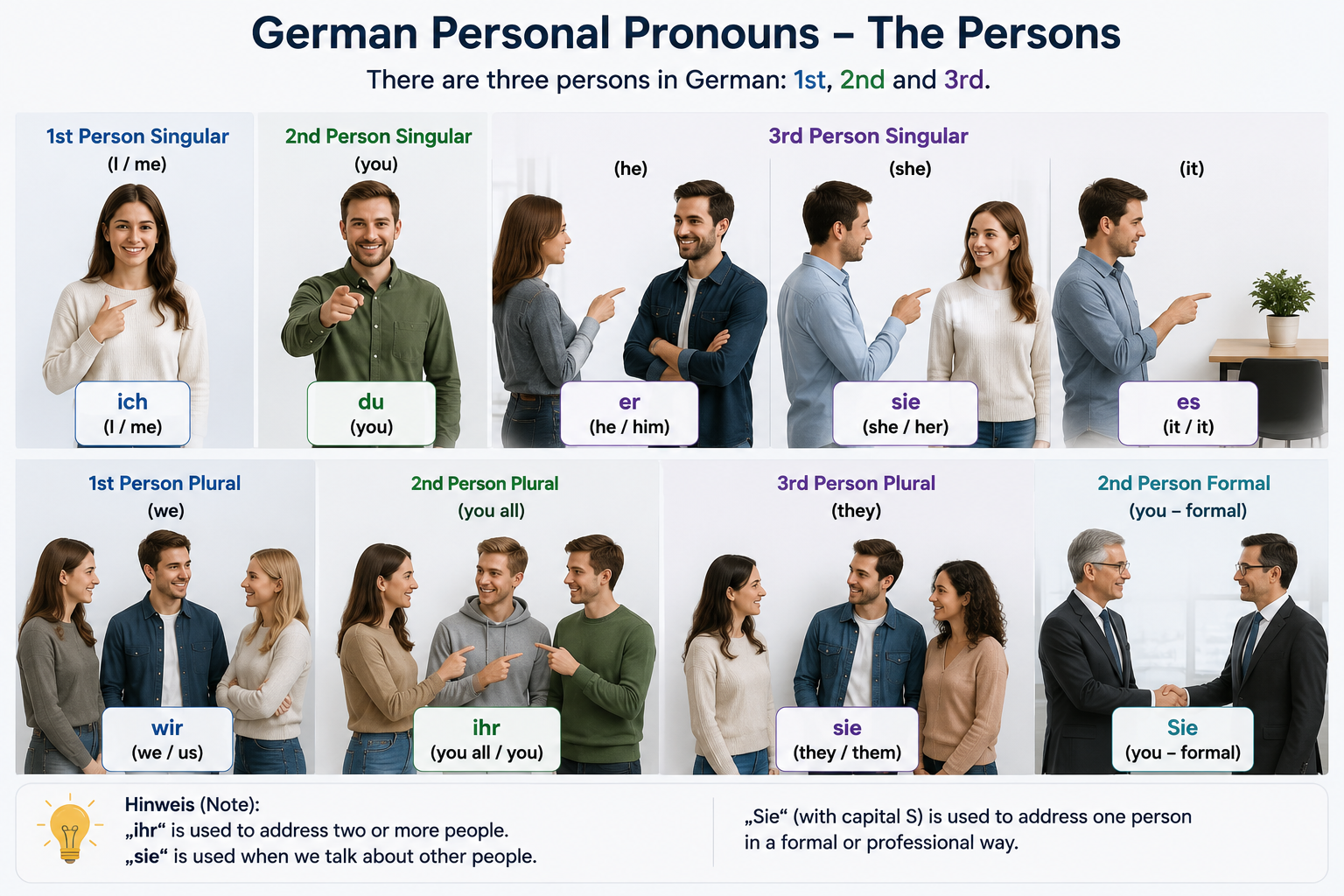
Person can be Singular or Plural
| Person | Singular | Meaning | Plural | Meaning |
|---|---|---|---|---|
| 1st | ich 👤 | I मै | wir 👥 | we / हम लोग |
| 2nd | du 🫵 | you(informal) / तु | ihr 👨👩👧👦 | you all / तुम लोग |
| 2nd formal | Sie 🎩 | you (formal) / आप | Sie 🎩 | you all (formal) / आप लोग |
| 3rd | er / es / sie | he / it / she | sie 🧑🤝🧑 | they / वे लोग |
Not to be confused s/S
- sie = they (plural er/es/sie)
- Sie = you/ You all (formal)
Person
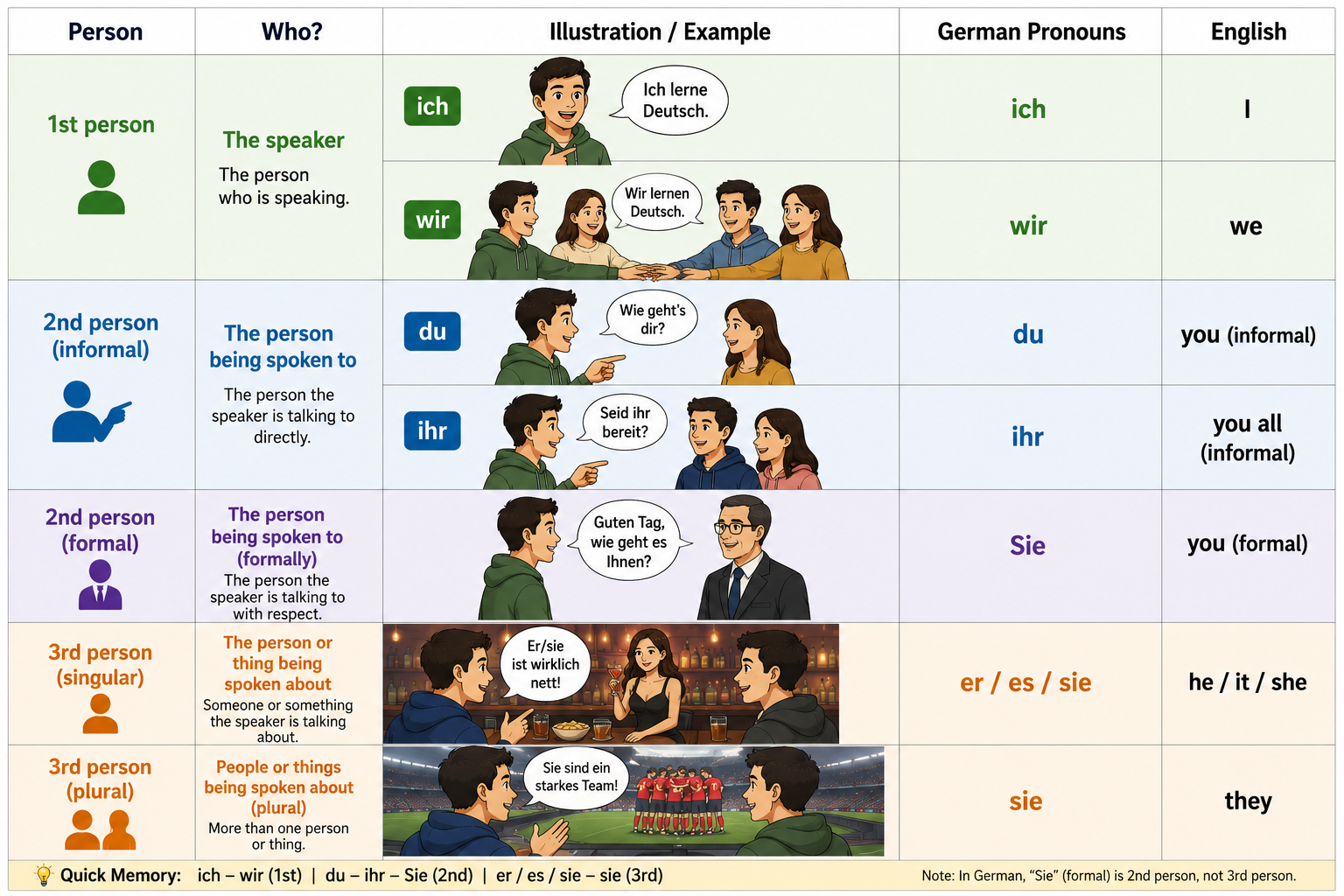
Person tells you who is doing the action.
There are 3 grammatical persons:
| Person | Who? | German Pronouns | English |
|---|---|---|---|
| 1st person | The speaker | ich / wir | I / we |
| 2nd person | The person being spoken to | du / ihr | you |
| 3rd person | The person or thing being spoken about | er / sie / es / sie | he / she / it / they |
Personal Pronouns vs Cases
| Case | 👤 1st | 🫵 2nd | 🟦 3rd Masc. | 🟨 3rd Neut. | 🟥 3rd Fem. | 👥 1st Pl. | 👨👩👧👦 2nd Pl. | 🧑🤝🧑 3rd Pl. | 🎩 Formal |
|---|---|---|---|---|---|---|---|---|---|
| 👤 Nom | ich | du | er | es | sie | wir | ihr | sie | Sie |
| 🎯 Akk | mich | dich | ihn | es | sie | uns | euch | sie | Sie |
| 🎁 Dat | mir | dir | ihm | ihm | ihr | uns | euch | ihnen | Ihnen |
| 🧩 Gen | meiner | deiner | seiner | seiner | ihrer | unser | euer | ihrer | Ihrer |
Same table in Row format
| Emoji | Person | 👤 Nominativ | 🎯 Akkusativ | 🎁 Dativ | 📝 Genitiv | 🇬🇧 English (Nom / Akk / Dat / Gen) |
|---|---|---|---|---|---|---|
| 👤 | Ist singular | ich | mich | mir | meiner | I / me / to me / of me |
| 🫵 | II nd singular | du | dich | dir | deiner | you / you / to you / of you |
| 🟦️ | III rd singular | er | ihn | ihm | seiner | he / him / to him / of him |
| 🟨 | III rd singular | es | es | ihm | seiner | it / it / to it / of it |
| 🟥 | III rd singular | sie | sie | ihr | ihrer | she / her / to her / of her |
| 👥 | Ist plural | wir | uns | uns | unser | we / us / to us / of us |
| 👨👩👧👦 | II nd plural | ihr | euch | euch | euer | you all / you all / to you all / of you all |
| 🧑🤝🧑 | III rd plural | sie | sie | ihnen | ihrer | they / them / to them / of them |
| 🎩 | II nd formal | Sie | Sie | Ihnen | Ihrer | you (formal) / you / to you / of you |
Examples
👤 Nominative
| Emoji | Pronoun | English | Example | Meaning |
|---|---|---|---|---|
| 👤 | ich | I | Ich gehe in den Park. | I go to the park. |
| 👥 | wir | we | Wir gehen ins Kino. | We go to the cinema. |
| 🫵 | du | you (informal) | Du bist müde. | You are tired. |
| 👨👩👧👦 | ihr | you all (informal) | Ihr seid nett. | You all are nice. |
| 🟦 | er | he | Er spielt Fußball. | He plays soccer. |
| 🟨 | es | it | Es regnet. | It is raining. |
| 🟥 | sie | she | Sie liest ein Buch. | She reads a book. |
| 🧑🤝🧑 | sie | they | Sie sind freundlich. | They are friendly. |
| 🎩 | Sie | you (formal) | Sind Sie Herr Müller? |
🎯 Accusative
| Emoji | Pronoun | English | Example | Meaning |
|---|---|---|---|---|
| 👤 | mich | me | Er sieht mich. | He sees me. |
| 🫵 | dich | you (informal) | Ich liebe dich. | I love you. |
| 🟦 | ihn | him | Ich sehe ihn. | I see him. |
| 🟥 | sie | her | Ich kenne sie. | I know her. |
| 🟨 | es | it | Ich sehe es. | I see it. |
| 👥 | uns | us | Er sieht uns. | He sees us. |
| 👨👩👧👦 | euch | you all (informal) | Ich sehe euch. | I see you all. |
| 🧑🤝🧑 | sie | them | Ich kenne sie. | I know them. |
| 🎩 | Sie | you (formal) | Ich sehe Sie. | I see you. |
🎁 Dative
| Emoji | Pronoun | English | Example | Meaning |
|---|---|---|---|---|
| 👤 | mir | me | Er gibt mir das Buch. | He gives me the book. |
| 🫵 | dir | you (informal) | Ich gebe dir das Geschenk. | I give you the gift. |
| 🟦 | ihm | him | Ich helfe ihm. | I help him. |
| 🟥 | ihr | her | Ich gebe ihr das Buch. | I give her the book. |
| 🟨 | ihm | it | Ich gebe ihm Wasser. | I give it water. |
| 👥 | uns | us | Sie gibt uns die Bücher. | She gives us the books. |
| 👨👩👧👦 | euch | you all (informal) | Ich gebe euch Geschenke. | I give you all gifts. |
| 🧑🤝🧑 | ihnen | them | Ich gebe ihnen das Geld. | I give them the money. |
| 🎩 | Ihnen | you (formal) | Ich gebe Ihnen das Buch. | I give you the book. |
🧩 Genitive
💡 Genitive personal pronouns are rare in modern German and are mainly found with certain verbs or in formal/literary language.
| Emoji | Pronoun | English | Example | Meaning |
|---|---|---|---|---|
| 👤 | meiner | of me | Er gedachte meiner. | He remembered me. |
| 🫵 | deiner | of you | Sie bedarf deiner. | She needs you. |
| 🟦 | seiner | of him | Er erinnerte sich seiner. | He remembered him. |
| 🟨 | seiner | of it | Man gedachte seiner. | It was remembered. |
| 🟥 | ihrer | of her | Er gedachte ihrer. | He remembered her. |
| 👥 | unser | of us | Er nahm sich unser an. | He took care of us. |
| 👨👩👧👦 | euer | of you all | Er gedachte euer. | He remembered you all. |
| 🧑🤝🧑 | ihrer | of them | Sie gedachte ihrer. | She remembered them. |
| 🎩 | Ihrer | of you (formal) | Er gedachte Ihrer. | He remembered you. |
**Related: ** Pronouns Overview · Reflexive Pronouns · Possessive Pronouns · Cases · Grammar Roadmap